
LSA-2421
Base recording restoration of statues (subject unstated). Casula (Africa Proconsularis). 408-423
Record details
Photographs
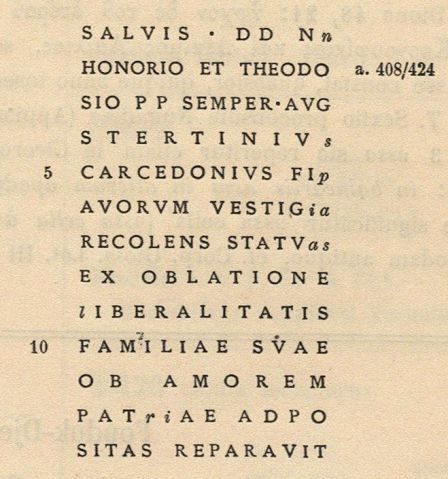
Inscription
Salvis dd(ominis) n[n(ostris)] / Honorio et Theodo-/sio p(er)p(etuis) semper Aug(ustis). / Stertiniu[s] / (5) Carcedonius f<i=I>(amen) p(er)[p(etuus)], / avorum vestig[ia] / recolens statu[as] / ex oblatione / [l]iberalitatis / (10) familiae suae, / ob amorem / pat[ri]ae adpo-/sitas reparavit.
Inscription translation
Our lords Honorius and Theodosius, perpetual, forever Augusti, being safe and well. Stertinius Carcedonius, priest in perpetuity, re-cultivating the traces of his ancestors, restored the statues that were erected from an offering of his family´s generosity on account of their love for the homeland.
Bibliography
- Corpus Inscriptionum Latinarum; , VIII, 24104
- Lepelley, C., Les cités de l'Afrique romaine au Bas-Empire, t. 2, Notices d'histoire municipale, Paris 1981, 104
Discussion
INSCRIPTION
In 13 lines:
Salvis dd(ominis) n[n(ostris)] / Honorio et Theodo-/sio p(er)p(etuis) semper Aug(ustis), / Stertiniu[s] / (5) Carcedonius f<i=I>(amen) p(er)[p(etuus)], / avorum vestig[ia] / recolens statu[as] / ex oblatione / [l]iberalitatis / (10) familiae suae / ob amorem / pat[ri]ae adpo-/sitas reparavit.
'Our lords Honorius and Theodosius, perpetual, forever Augusti, being safe and well. Stertinius Carcedonius, priest in perpetuity, re-cultivating the traces of his ancestors, restored the statues that were erected from an offering of his family´s generosity on account of their love for the homeland.'
Letter height not recorded.
DESCRIPTION (from CIL VIII)
No description is given by CIL. No measurements are published, and there is no published image (but Cagnat 1894?).
PROVENANCE AND CURRENT LOCATION
The inscription was first recorded by Cagnat 1894 and then by CIL VIII in 1916, in Henchir Mesguida (http://www.trismegistos.org/place/18041); this is possibly the location of ancient Casula (Lepelley 1981, 104). There is no more recent account of its location.
HONORAND, AWARDER AND DATE
The subject of the dedication is not named; the inscription states that statues which had been set up by the awarder’s ancestors were restored (lines 6-13).
Stertinius Carcedonius, the awarder, was a local man; he held the highest municipal office of flamen perpetuus (on this office see LSA-2351, ‘Honorand, Awarder and Date’).
The inscription is dated to the common reign of Honorius (Augustus 393-423) and Theodosius II (Augustus 408-50) (lines 2-3).
FURTHER DISCUSSION
This is a remarkable testimony to the care for statues in a small town in northern Africa still in the early 5th century.
Cite: Last Statues of Antiquity, LSA-2421 (Ulrich Gehn).