
LSA-2426
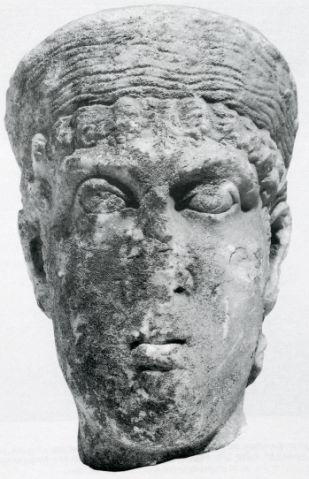
Portrait head of woman with decorated encircling braid, possibly imperial family. Salona. Earlier fourth century.
Record details
Photographs
Bibliography
- Cambi, N., Imago Animi. Antički Portret u Hrvatskoj, Split 2000, 185-6, 416-417, no. 142, pl. 186
Discussion
DESCRIPTION (Object)
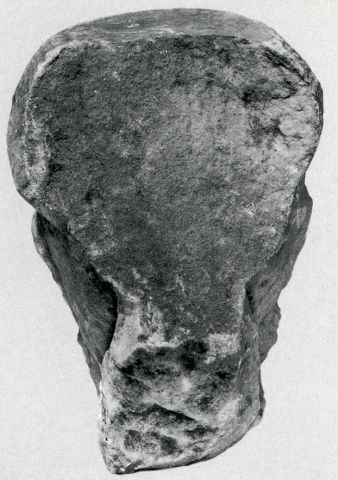
Marble portrait head broken at neck, H 27 cm. The back of the skull is broken off; the lower side of the neck is roughly picked with a point. The eyebrows and the protruding eyes are chipped, partly destroying the marking of the eyes. The nose is chipped off.
The iris is circumscribed by an incised circular line.
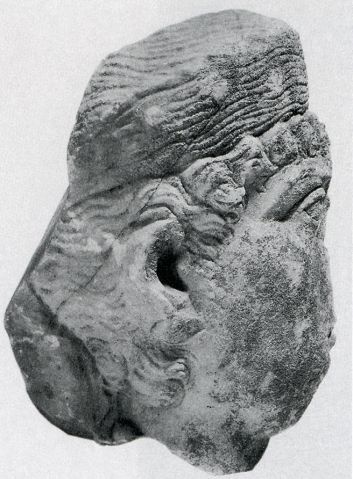
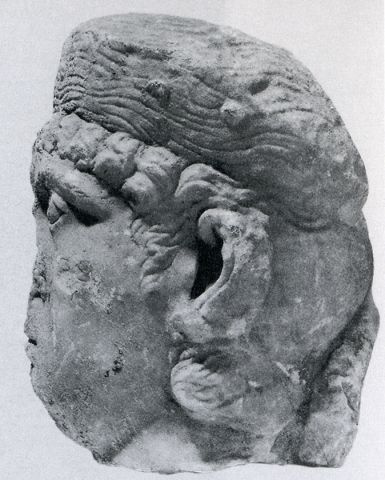
The head was reworked from a massive earlier portrait head; this is visible notably at the back side of the bulky ears, and at the lower face where the original jaw line confines a misshapen double chin.
PROVENANCE AND CURRENT LOCATION
The head was recorded by Cambi 2000, 87 n. 626 in the private collection of Ivane Bojić at Solina. There is no published record of its provenance.
DESCRIPTION (Subject)
The portrait head depicts a woman with enlarged eyes, elongated cheeks, a small mouth, a tiny chin and a bulky double chin. She wears an elaborate hairstyle with small curls surrounding the brow, a bun in the nape which is brought forward onto the skull, and a high circular braid; this circular braid is decorated with needles. The ears are not covered.
HONORAND AND DATE
A coiffure type with similar features, including the decorative needles and the uncovered ears is displayed by a female portrait head in Berlin, assumed to represent Constantine I’s mother Helena (LSA-967). The same hairstyle appears also with Helena’s portraits in the Capitoline museum in Rome (LSA-965) and Florence (LSA-966). Cambi 2000, 86 n. 627 compared our head to a portrait in the Louvre, suggested to depict Constantine’s wife Fausta (LSA-573).
The coiffure type dates our head to the early 4th century; the jewel decoration in the hair possibly indicates that the portrayed was a member of the imperial family.
Cite: Last Statues of Antiquity, LSA-2426 (Ulrich Gehn).