
LSA-2427
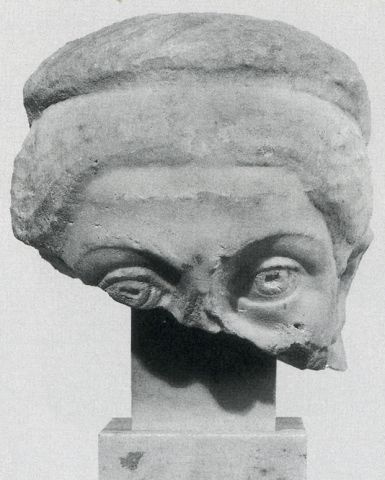
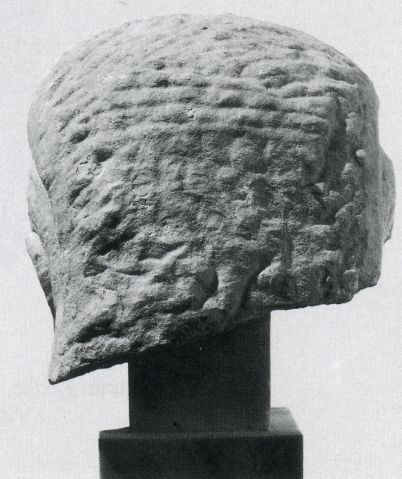
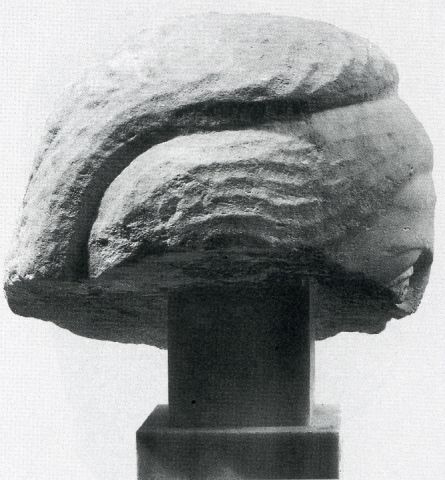
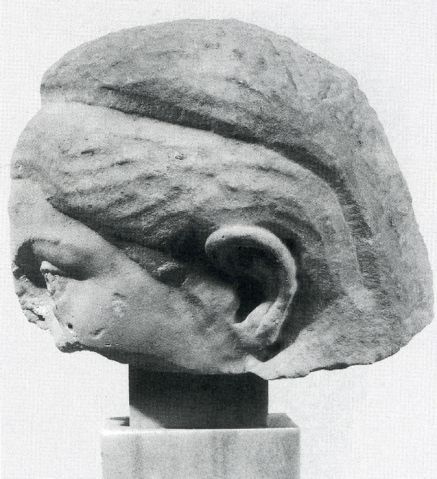
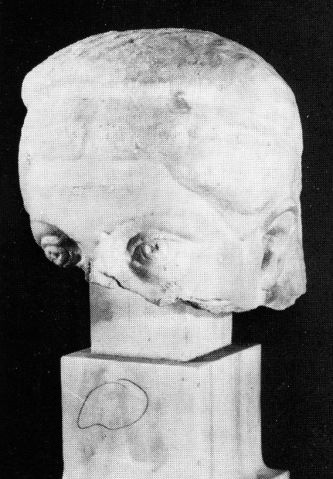
Upper part of female portrait head with unfinished central braid. From Salona. Late third to early fourth century.
Record details
Photographs
Bibliography
- Cambi, N., Imago Animi. Antički Portret u Hrvatskoj, Split 2000, 179, 399, no. 126, pl. 169 (late third to early fourth)
- Jevtovic, J. (ed.), Antički portret u Jugoslaviji : Narodni muzej, Beograd, Muzeji Makedonije, Skopje, Arheološki muzej, Zagreb, Arheološki muzej, Split, Narodni muzej, Ljubljana , Belgrade 1987, 229, no. 211 (260-270s)
Discussion
LSA-2427
DESCRIPTION (Object)
Upper part of a marble portrait head broken below the eyes, H 18 cm.
The hair is rendered in long shallow, parallel strands with a broad chisel and probably in an unfinished state.
The iris is circumscribed by a circular incised line, the pupils are indicated by irregular chisel strokes.
The head is in an intermediate state of being reworked from an earlier portrait. At the back, the hair is only roughly brought into its intended shape. On the brow and in front of the left ear, toolmarks indicate that a layer of material has been removed.
PROVENANCE AND CURRENT LOCATION.
The head is from Salona (without further specification); it is today in the National museum in Split, inv. No. C 226.
DESCRIPTION (Subject)
The portrayed woman wears her hair styled into a large central braid draped from the nape onto the skull where it almost reaches the brow ('Scheitelzopffrisur').
HONORAND AND DATE
Cambi 2000, 179 suggested that our portrait represented Galerius’ wife Galeria who on her coin portraits wears a similar hairstyle. L’Orange 1984, 141, suggested Diocletian’s wife Prisca.
The advanced central braid hairstyle ('Scheitelzopffrisur') with the bun almost reaching the brow indicates a date not earlier than the late 3rd century. The hairstyle remains in fashion throughout the 4th century and can still be observed, in an elaborate variant, as late as around 400 on a female portrait bust in Thessaloniki (LSA-91). A date in the late 3rd or early 4th century appears most probable for our head.
Discussion references
- L'Orange, H. P., Das spätantike Herrscherbild von Diokletian bis zu den Konstantin-Söhnen, 284-361 n. Chr. Das Römische Herrscherbild. III. Abteilung ; Bd. 4 , Berlin 1984
Cite: Last Statues of Antiquity, LSA-2427 (Ulrich Gehn).