
LSA-243
Base for statue of Arcadius, emperor. Koloe (Lydia). 383-408.
Record details
Photographs
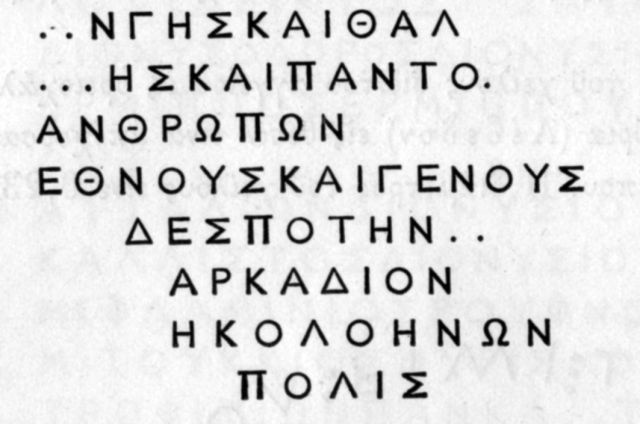
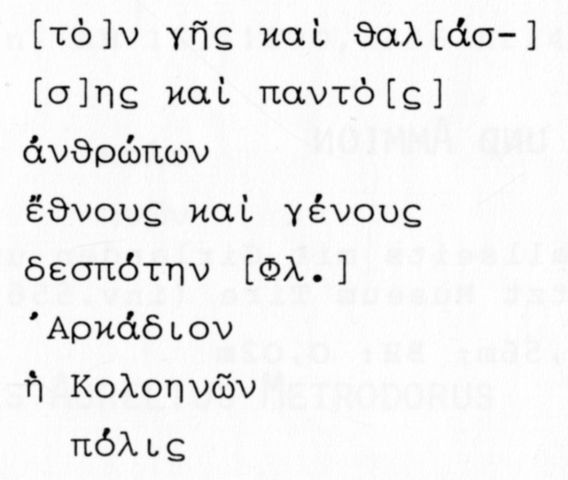
Inscription
[τὸ]ν γῆς καὶ θαλ[άσ]/[σ]ης καὶ παντὸ[ς]/ ἀνθρώπων / ἔθνους καὶ γένους / δεσπότην, [Φλ.] / Ἀρκάδιον, / ἡ Κολοηνῶν / πόλις.
Inscription translation
The city of Koloe [honours] Fl(avius) Arcadius, the ruler of the earth and the sea, and of every tribe and race of men.
The ruler of the earth and sea, and of every tribe and race of men, Flavius Arcadius; the city of the Koloenians [honours him].
Bibliography
- Meriç, R., R. Merkelbach, J. Nollé, and S. Şahin (eds.), Die Inschriften von Ephesos VII,2. Inschriften griechischer Städte aus Kleinasien, vol. 17,2, Bonn 1981, no. 3708
Discussion
INSCRIPTION
In eight lines:
[τὸ]ν γῆς καὶ θαλ[άσ]/[σ]ης καὶ παντὸ[ς] / (ἀνθρώπων / ἔθνους καὶ γένους / (5) δεσπότην, [Φλ.] / Ἀρκάδιον, / ἡ Κολοηνῶν / (vacat) πόλις. (vacat)
'The city of Koloe [honours] Fl(avius) Arcadius, the ruler of the earth and the sea and of every tribe and race of men.'
Letter height not recorded.
DESCRIPTION
No description or measurements of the block have been published, and there is no published image. The formula of the inscription, however, is sufficient to show that this was a statue base.
PROVENANCE AND CURRENT LOCATION
The inscription was first recorded in 1873 in the village of Kiraz (then Kelles); this is the area of ancient Koloe http://www.trismegistos.org/place/34438). There is no published record of its present location.
HONORAND, AWARDER AND DATE
Arcadius, the honorand, was Augustus 383–408. He is here styled 'ruler of the earth and the sea and of every tribe and race of men' (lines 1-5), which perhaps alludes to the situation after his father Theodosius I’s death in 395, when Arcadius became sole ruler over the eastern part of the empire. However, this is by no means certain.
The statue was awarded by the city of Koloe, a Lydian city north of Sardis (for the location of Koloe, see Zgusta 1984, 277-8 § 554).
FURTHER DISCUSSION
The motif of all-embracing rulership, prominent in our inscription, re-occurs, if in a slightly lesser form, in other dedications to emperors of the Theodosian dynasty: for instance, those by Flavius Eutolmius Tatianus to the emperors of the college of Theodosius I (LSA-164 (Aphrodisias), LSA-267 (Side), (LSA-876 (Antinooupolis)), and by the governor Oecumenius Dositheus Asclepiodotus to the same emperors in Gortyn (LSA-472, LSA-770, LSA-950).
Discussion references
- Zgusta, L., Kleinasiatische Ortsnamen, Heidelberg 1984, pp. 277-8 § 554
Cite: Last Statues of Antiquity, LSA-243 (Ulrich Gehn).