
LSA-2432
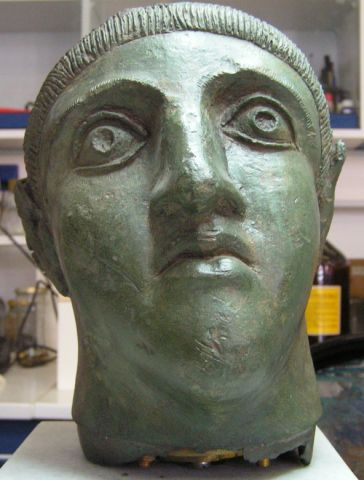
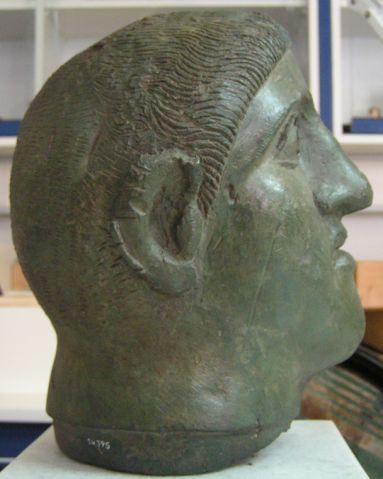
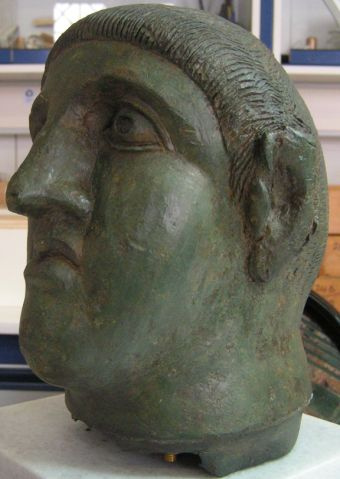
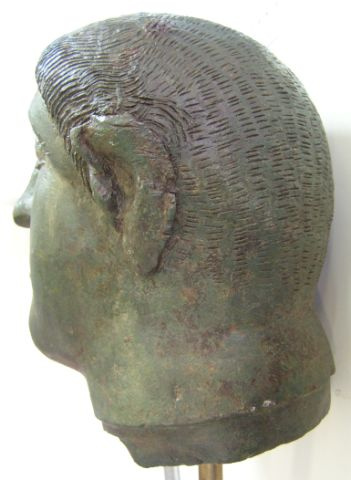
Bronze head of Emperor with socket for insertion into statue. From Metropolis (Thessalia). Early fourth century.
Record details
Photographs
Bibliography
- Delegiannakes, G. 'Ademosieute chalkine kephale autokratora tou Ethnikou Archaiologikou Mouseiou kai to telos tes archaiotetas', Deltion tes Christianikis Archaiologikis Etaireias 34, Athens 2013, 385-94
Discussion
DESCRIPTION (Object)
Bronze head. Preserved in one piece from the top of the head to the neck and most of a joining socket for insertion. Dimensions. Max. H 0.23 (overall); Max. H. 0.17 (chin to hairline)
PROVENANCE
Found in 1910 in Palaiokastro (anc. Metropolis) near Karditsa, Thessaly, Greece (no further details).
DESCRIPTION (Subject)
The face is clean-shaven and youthful. The hair, which fits the head like a cap is brushed forward onto the forehead and temples in thin, long strands, forming a shallow arch; these locks are rendered by long incisions, roughly in two horizontal zones, up to the top of the skull and behind the ear; thin chisel strokes covers the rest of the skull. Ears are blocked out, made by hand and attached to the head later. Many details are carved with a pointed tool shortly after casting.
The shape of the head is long and oval pointed towards the chin. It has large, unnatural wide-open eyes; the irises are rendered in drilled circular holes set on bulging eyeballs; the eyebrows are marked by shallow incisions. The cheeks are puffy; the flesh is smooth, round and even. The nose is long and flat-bridged with flaring nostrils. The mouth is small with fleshy lips. The neck is thick and robust, the head is slightly turned towards the right. The thick joining socket below the neck looks unusual; the head may be attached to a marble torso or bust.
DISCUSSION
The technique and the style of the work point to late antiquity. Furthermore, the asymmetrical rendering of the facial characteristics, especially the big eyes, and the poor technique point to a rather late date, yet this work clearly comes from the periphery where the production of bronze figures in the round had long before declined. It is the only known example of a bronze portrait dated to late antiquity from Greece.
L’ Orange (1984, 79, Beil. C) refers to this head in passing without further details or date; he uses it as an example to illustrate the development of the idealised imperial portrait type of Constantine from “the Constantinian period to Middle Ages” implying that this head represents the end of a transformation process from an imperial portrait to a generic representation of the divine-like Byzantine ruler.
Indeed, the youthful, clean-shaven and idealised male face together with the distinctive hairstyle (presenting a simplified version of the Constantinian hairstyle with an arched fringe brushed forward onto the brow) leaves no doubt that it presents an imperial figure dated to no earlier than the fourth century. Apart from the examples given by L’ Orange in relation to this head, it also shows many similarities in both style and technique with the Messene emperor (Deligiannakis 2005); the latter is most probably dated to 316-337, and certainly no later than 360s, on the grounds of its archaeological context and iconography (i.e. the lack of the diadem). The diadem is also absent here which leads to assuming either an early Constantine portrait, as in the Messene example, or an imperial prince or usurper of the mid-fourth to fifth century. The possibility that a diadem, being now lost, once crowned the head seems unlikely, yet three iron marks on the crown of the head are indicated.
Discussion references
- L'Orange, H. P., Das spätantike Herrscherbild von Diokletian bis zu den Konstantin-Söhnen, 284-361 n. Chr. Das Römische Herrscherbild. III. Abteilung ; Bd. 4 , Berlin 1984, 79, Beil. C.
Cite: Last Statues of Antiquity, LSA-2432 (Georgios Deligiannakis).