
LSA-244
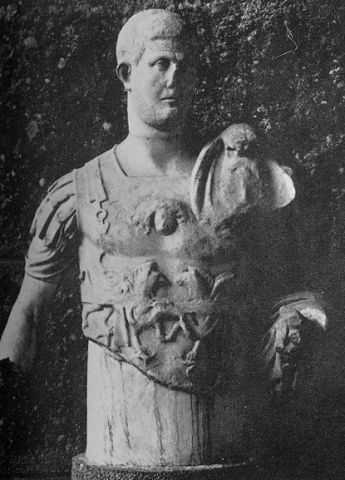
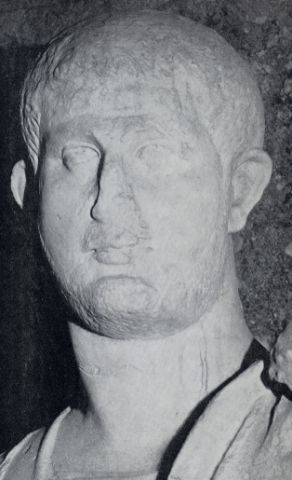
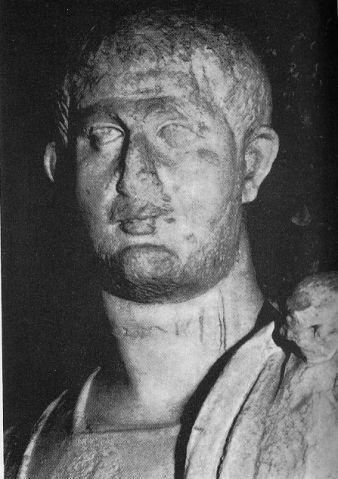
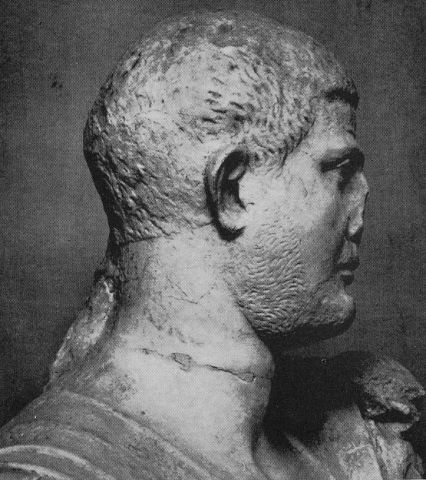
Upper part of armoured statue with re-cut head of Tetrarch. Side (Pamphylia). Late third to fourth century.
Record details
Photographs
Bibliography
- Inan, J., Antalya bölgesi Roma devri portreleri. Römische Porträts aus dem Gebiet von Antalya , Ankara 1965, 84-86, no. 29, pls. 30-31(perhaps Licinius)
- Inan, J. and E. Rosenbaum, Roman and Early Byzantine Portrait Sculpture in Asia Minor, Oxford 1966, 86, no. 63, pls. 40.1-2 and 41.3 (perhaps Licinius)
Discussion
DESCRIPTION (Object)
Five joining fragments of over life-size statue. H: 99, W: 87 cm. H (chin to crown): 29.5, W (head): 25 cm. Fine-grained white marble.
The statue is preserved from the waist to the head. It has been recomposed of five fragments: (1) head, (2) torso, (3)-(4) right arm, and (5) left hand. The nose is broken, and the folds of the cloak on the left shoulder, the mouth, and the brow are chipped.
The head has been re-cut from an earlier portrait which had a longer beard and longer hair. The perimeter of the beard on the cheek is a continuous inscribed line. The beard and moustache have been scored onto the surface with a flat chisel. Traces of a fuller moustache can be seen at the corners of the mouth where the moustache and beard join.
The hair has been taken down. Large pick marks are visible behind the ears, and the upper part of the brow is recessed. The ears also now project.
The pupils are marked by two separate drill holes connected by a curving channel. The inner canthi are also marked by drill holes.
PROVENANCE
The statue fragments were found in the middle niche of the east side of Building M at Side.
DESCRIPTION (Subject)
The fragmentary statue shows a man in military dress. He wears a tunic, a breast plate, and a cloak. He holds his right arm away from his body and uses his left arm to support the cloak which is fastened by a round fibula on the left shoulder.
The breast plate is decorated with shoulder straps, a medusa head between the pectorals, two converging sphinxes which stand on vegetal scrolls, and a belt knotted at the centre. It has two rows of leather flaps at the shoulders.
The head turns to its left. It shows a short-haired and short-bearded man with a thick rectangular face. The brow is creased, both with a horizontal fold and two vertical folds over the nose. The eyes are narrow-set and the cheekbones project. The chin is round and separated from the lower lip by a deep groove.
DATE
The head displays the fashion (short hair, short beard), the physiognomy (thick faces with creased brows), and technical characteristics (emphatic eye drilling and rendering of hair with short strokes of flat chisel) typical of Tetrarchic portraits. The military dress and re-use of an earlier (here probably Antonine) portrait are also common tendencies in Tetrarchic portraiture. For comparanda, see the portrait statues on display in the Perge museum, a statue from Locris (LSA-2384), and a statue from Utica (LSA-1098).
Honorand
The size, the dress, and the find context (with LSA-245 and LSA-246), indicate clearly that this statue represented an Emperor. Because of its full-face, Inan tentatively identifies it as Licinius.
Discussion references
- L'Orange, H. P., Das spätantike Herrscherbild von Diokletian bis zu den Konstantin-Söhnen, 284-361 n. Chr. Das Römische Herrscherbild. III. Abteilung ; Bd. 4 , Berlin 1984, 117 (Licinius)
Cite: Last Statues of Antiquity, LSA-244 (J. Lenaghan).