
LSA-2440
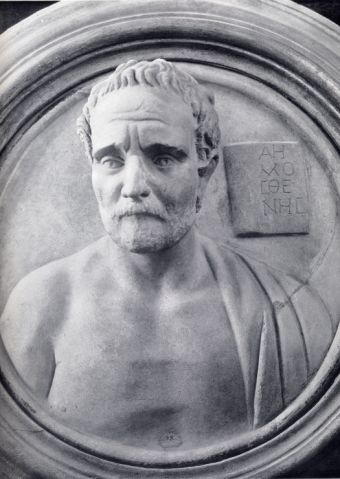
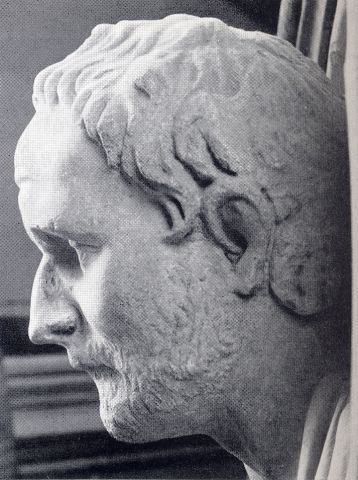
Inscribed portrait tondo of Demosthenes. Italy. Fourth century.
Record details
Photographs
Bibliography
- Calza, R. et al. (eds.), Antichità di Villa Doria Pamphilj, Rome 1977, 268-9, no. 325, pl. 173
- Richter, G.M.A., The Portraits of the Greeks, London 1965, II, 217, no. 9, figs. 1403 and 1409
Discussion
DESCRIPTION (Object)
Shield portrait. Diam: 50 cm. Marble.
The nose and lower edge of the drapery (lower left shoulder) are restoration. The circular wood frame is not ancient.
The pupils are deep circular holes. The irises are not rendered. The hair around the face has been given volume and movement by drill work.
PROVENANCE
The exact provenance is unknown. It was however already recorded in the inventory of 1709 in the Pamphili-Doria collection.
DESCRIPTION (Subject)
The shield portrait shows a short-haired bearded man who wears only a himation over his left shoulder. The bones of the sternum protrude and the pectorals sag. On the background above the left shoulder is a partially opened scroll on which his name, Demosthenes, is inscribed in Greek.
The portrait head is a readily recognizable version of the well-known (there are c. 50 copies) type made for the fourth-century, Athenian orator Demosthenes, probably in c. 280 and set up in Athens. It repeats the oval face and the full but trimmed beard and moustache. It also shows the characteristic brow which is creased and knitted, the down-turned mouth which is lost in the drooping moustache, and the pointed projecting chin. Even the clothing follows the statue type. The hair, however, only loosely relates to that of the model which comes forward over the centre of the brow, and the face is devoid of the specific modulations of the anatomy.
DATE
The loose rendition of a beloved model that renders and intensifies the principal characteristics of that model, the large holes for the pupils, and the script of the inscription suggest a date no earlier than the later third century. This portrait might well belong to the fourth or even fifth century.
Shield portraits of cultural figures of the past were popular in late antique houses as the two series from Aphrodisias show; see LSA-206, LSA-207, LSA-210, LSA-211, LSA-212, LSA-213 and LSA-236, LSA-238, LSA-602
The scroll in the background appears on several other tondi portraits from Rome which are similar stylistically and thematically: see, the Menander LSA-2109<k, the Bornova-Heidelberg type LSA-2441<k, Socrates LSA-2511<k. They all may once have come from the same context.
Discussion references
- Danguillier, C., Typologische Untersuchungen zur Dichter- und Denkerikonographie in römischen Darstellungen von der mittleren Kaiserzeit bis in die Spätantike, Oxford 2001, 250, no. 5 (early Severan)
Cite: Last Statues of Antiquity, LSA-2440 (J. Lenaghan).