
LSA-2441
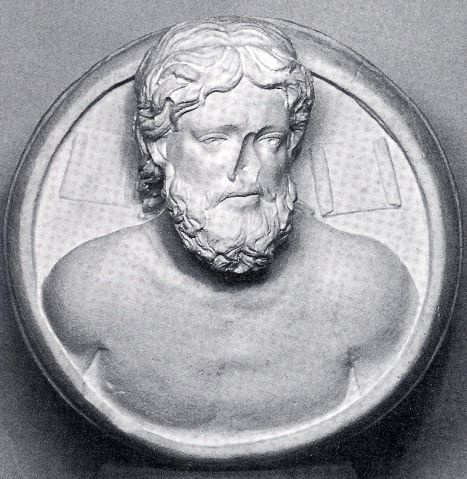
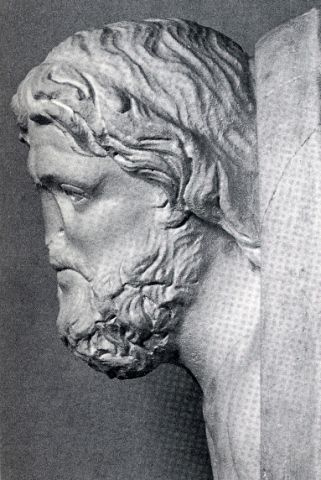
Shield portrait of long-haired, bearded man in Bornova-Heidelberg type. From Rome. Fourth century.
Record details
Photographs
Bibliography
- Bergmann, M., Chiragan, Aphrodisias, Konstantinopel : zur mythologischen Skulptur der Spätantike, Wiesbaden ,1999, 52, no. 2, pl. 49.3 (late antique)
- Smith, R.R.R. 'A New Shield Portrait in Izmir', Mitteilungen des Deutschen Archäologischen Instituts, Römische Abteilung 102, Heidelberg 1995, 335-5, pl. 78 (Antonine allure)
Discussion
DESCRIPTION (OBJECT)
Over life-size shield portrait. H: 43.5, W: 43.5, D: 21-22 cm. H (of head): 23 cm. Large-grained white marble.
The proper left side of the tondo, the proper left shoulder and adjacent chest, and scrolla above the left shoulder are restored. The nose is missing.
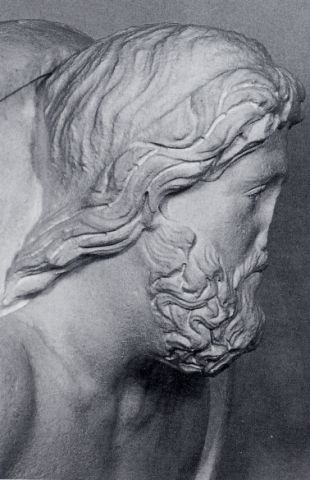
The shield portrait was made without a rectangular supporting panel. The back is roughly worked with a point chisel. The hair around the face has been rendered with broad drill channels, and marble ‘bridges’ have been left between the channels. The irises are rendered with a fine flat chisel, and the pupils are large, round hollows.
PROVENANCE
Purchased in Rome. Probably from the Villa Saraffini.
DESCRIPTION (Subject)
The portrait bust shows a man who turns to his left. The right side of the chest is nude, and above the right shoulder is a scroll.
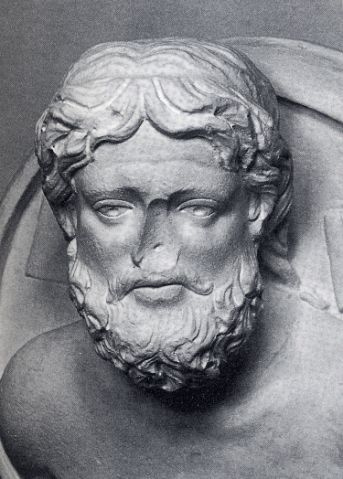
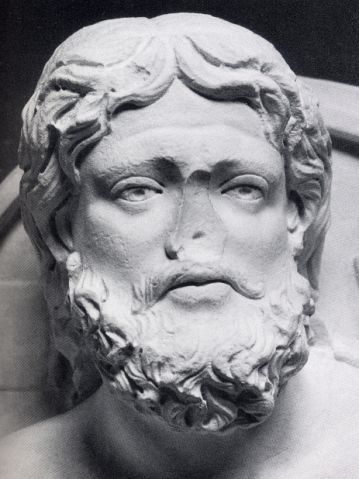
The man has long, centrally parted hair that frames the brow in a symmetrical manner. It is brushed off the face and covers most of the ears. An indentation runs around the head, above the ears, presumably for a flat fillet. The beard and moustache are full. The locks of the beard divide slightly at the centre of the chin.
The face is broad with a tall brow. The brow has a single, strongly marked, and downward sloping crease. The eyebrows also slope downwards, and the cheekbones are prominent. The lips are full.
HONORAND
The honorand wears a fillet and is associated with a scroll. He exists in another version of the same type LSA-236 and probably also in LSA-766 . The model for the portrait was either a late classical creation (Smith, p. 338) or a classicizing invention (see discussion in Danguillier, 154-5) and was intended to represent a thinker of the earliest period of the Greek world.
DATE
The head has been dated either to the Antonine or to the late antique period (for most recent discussion, see Dangullier, 153-4). Smith speaks cautiously of an Antonine allure, and Bergmann considers it to be late antique, mainly because of the rendering of the hair and eyes.
The scroll in the background appears on other tondi portraits from Rome which may also be late in date: see, the Menander LSA-2109, Demosthenes LSA-2440, Socrates LSA-2511.
The long hair, seemingly based on images of divinities, is part of several, similarly-informed late antique portraits; see a portrait bust in Istanbul LSA-375, one in Stockholm, LSA-1195, and a tondo from Aphrodisias, LSA-207 (which, however lacks the fillet).
Discussion references
- Danguillier, C., Typologische Untersuchungen zur Dichter- und Denkerikonographie in römischen Darstellungen von der mittleren Kaiserzeit bis in die Spätantike, Oxford 2001, 153-4, 238, no. 56a (difficult to date)
Cite: Last Statues of Antiquity, LSA-2441 (J. Lenaghan).