
LSA-2442
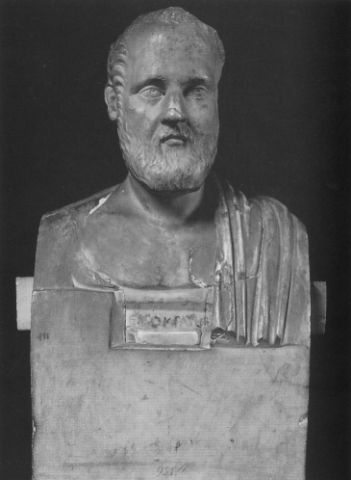
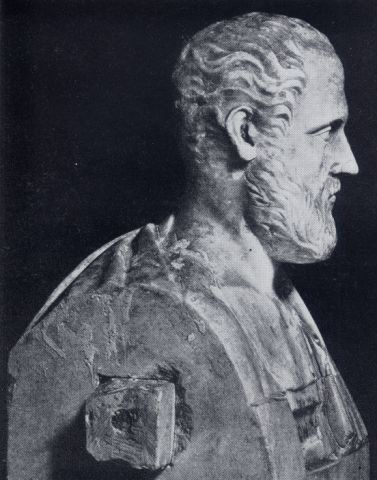
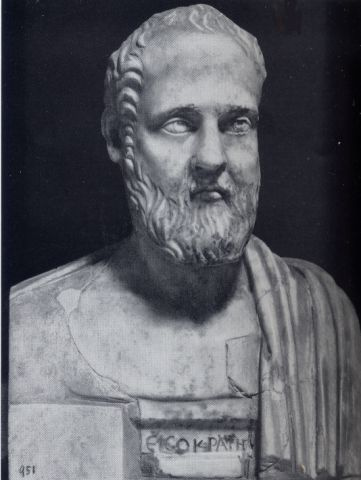
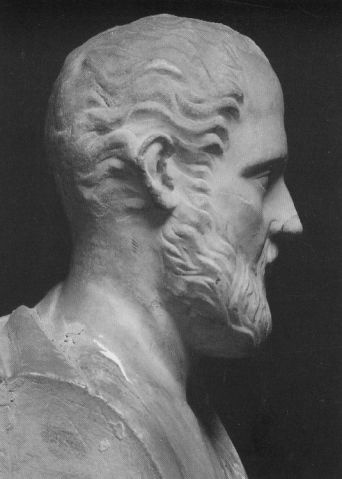
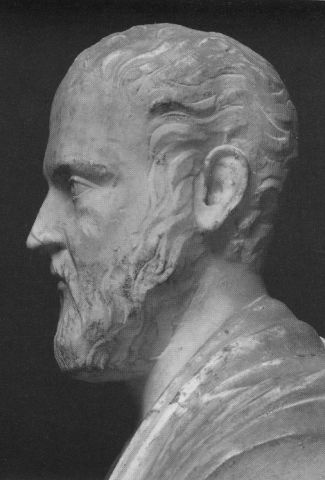
Inscribed portrait bust of Isocrates set into herm. Italy. Late third to fourth century?
Record details
Photographs
Bibliography
- Bol, P. (ed.), Forschungen zur Villa Albani : Katalog der antiken Bildwerke. 1. Bildwerke im Treppenaufgang und im Piano nobile des Casino, Berlin 1989, 216-7, no. 70, pls. 120-121 (L. Giuliani, 3rd century)
- Richter, G.M.A., The Portraits of the Greeks, London 1965, 209, no. 1, figs. 1346-7
Discussion
DESCRIPTION (OBJECT)
Under life-size bust (set into modern herm). H: 27.5, H (of head): 15.5 cm. Fine-grained white marble.
The bust with its preserved and inscribed tabula is inserted into a modern herm. This herm was designed to make it a pendant to another herm (Q. Hortensius) in the Albani collection (possibly by Cavaceppi). On the ancient bust, the tip of the nose and a part of the himation are restored.
The irises are rendered with a fine flat chisel, and the pupils are large and deep heart shapes. The hair is rendered with a large flat chisel that has been used sparingly. The result is thick schematic locks.
PROVENANCE
The bust is first recorded in the Albani collection in a catalogue by Morcelli of 1785. Visconti in 1817 wrote that it had been in the collection for fifty years. It was undoubtedly found in or around Rome in c. 1765.
DESCRIPTION (Subject)
The portrait bust shows a bearded man with a tall brow who wears a himation over his left shoulder. He is identified by an inscription on the tabula of the bust as Isocrates, presumably the Athenian orator of 436-338 BC.
The hair is combed forward. Over the brow it recedes but between the temples and the ears it comes forward in large downward curving locks. The beard is long and straight. Apart from the tall smooth brow, there is little distinctive about the physiognomy. The mouth is short from side to side.
DATE
The rendering of the eyes places the portrait no earlier than the third century. The lack of drill work in the hair and its impressionistic rendering make a date in the late third or fourth-century most plausible.
HONORAND
This is the only securely identified portrait of Isocrates. Only one other extant portrait LSA-2443, again of late Roman manufacture, has been associated with it, as a loose variation of the same model. Christodorus, writing in the early sixth century AD, records a bronze statue of Isocrates in the Baths of Zeuxippus at Constantinople (Ecphra. in Grk Anth. II, 256 ff). That testifies to the continued interest in him and oratory.
Discussion references
- Danguillier, C., Typologische Untersuchungen zur Dichter- und Denkerikonographie in römischen Darstellungen von der mittleren Kaiserzeit bis in die Spätantike, Oxford 2001, 252, no. 15 (early Gallienic)
Cite: Last Statues of Antiquity, LSA-2442 (J. Lenaghan).