
LSA-2443
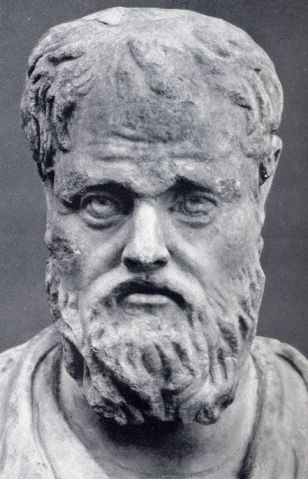
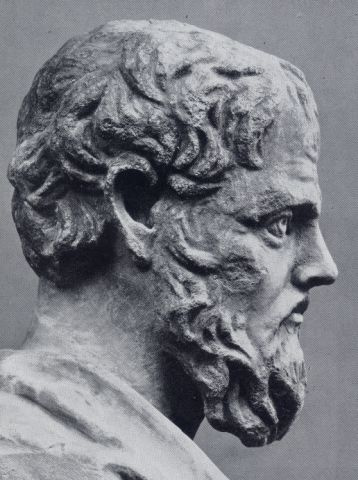
Portrait head of Isocrates on modern bust. Italy. Late third to fourth century.
Record details
Photographs
Bibliography
- Blümel, C., Staatliche Museen zu Berlin. Katalog der Sammlung antiker Skulpturen. Bd. 5. Römische Kopien griechischer Skulpturen des vierten Jahrhunderts v. Chr., Berlin 1938, K 199, pl. 12
- Richter, G.M.A., The Portraits of the Greeks, London 1965, II, 209, no. 2, figs. 1348-9
Discussion
DESCRIPTION (OBJECT)
Life-size head. H: 25.8, H (of head): 16.2 cm. Marble.
The head is broken around the base of the neck. The surface is worn.
The irises are rendered with a fine flat chisel, and the pupils are large and deep, heavy crescent shapes. The hair is rendered with a flat chisel.
PROVENANCE
The head was acquired in 1766 from the Natali collection in Rome. Formerly in Sanssouci Castle.
DESCRIPTION (Subject)
The portrait bust shows a bearded man with tousled hair medium-length hair and a tall brow.
The brow is creased, and the eyebrows heavily shadow the eyes. The beard is long and straight. The nose indents forcefully at the bridge, and the mouth is short from side to side. The cheeks hang loosely around the eyes and nose.
DATE
The rendering of the eyes places the portrait in the advanced third century. The lack of drill work in the hair and the loose dependence on a model make a date in the later third or fourth-century most plausible.
HONORAND
The tall brow, general form of the hair, and details such as the mouth and nose have led scholars justifiably to associate this portrait with a bust of Isocrates, the Athenian orator of 436-338 BC, LSA-2442. Both this head and that bust seem to rely on the same model. Christodorus, writing in the early sixth century AD, records a bronze statue of Isocrates in the Baths of Zeuxippus at Constantinople (Ecphra. in Grk Anth. II, 256 ff), which testifies to the late-antique interest in classical oratory and in Isocrates.
Discussion references
- Danguillier, C., Typologische Untersuchungen zur Dichter- und Denkerikonographie in römischen Darstellungen von der mittleren Kaiserzeit bis in die Spätantike, Oxford 2001, 252, no. 14 (late third c.?)
Cite: Last Statues of Antiquity, LSA-2443 (J. Lenaghan).