
LSA-2445
Base for statue, possibly imperial. Novae (Moesia Secunda). 431
Record details
Photographs
Inscription
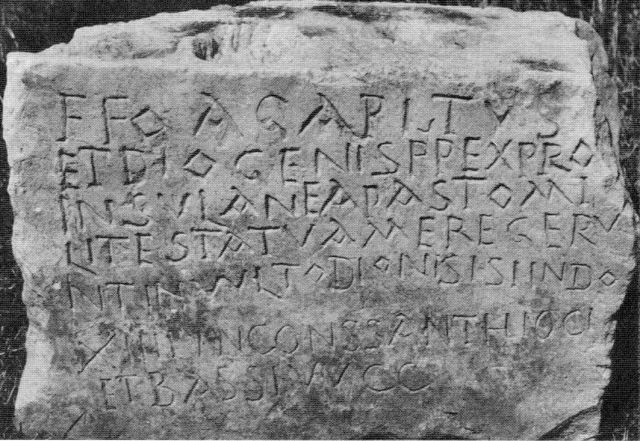
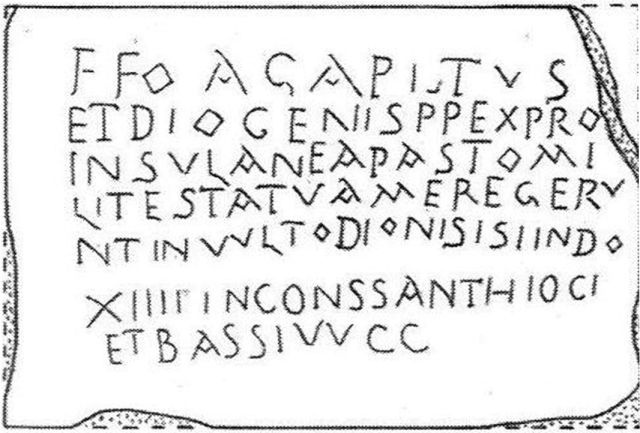
FF(lavii) Agapistus / et Diogenis, p(rimi)p(ilarii) ex pro[v(incia)] / insulanea, pasto mi/lite statuam eregeru/nt (sic) in vulto Dionisisi (sic), ind(ictione)/ XIIII, in conss(ulatibus) Anthioci / et Bassi, vv(irorum) cc(larissimorum).
Inscription translation
The Flavii, Agapistus and Diogenis, primipilari from the province of the Islands, after having finished their service, set up this statue, in front of [the statue of] Dionysius, in the 14th indiction under the consulship of Antiochus and Bassus, men of clarissimus rank.
Bibliography
- Sarnowski, T., Drei spätkaiserzeitliche Statuenbasen aus Novae in Niedermösien, Mirkovic, M. (ed), Römische Städte und Festungen an der Donau, Belgrade 2005, no. 2
Discussion
INSCRIPTION
In seven lines:
FF(lavii) Agapistus / et Diogenis, p(rimi)p(ilarii) ex pro[v(incia)] / insulanea, pasto mi/lite, statuam eregeru/nt (sic) in vulto Dionisisi (sic), ind(ictione)/ XIIII, in conss(ulatibus) Anthioci / et Bassi, vv(irorum) cc(larissimorum).
The Flavii, Agapistus and Diogenis, primipilari from the province of the Islands, after having finished their service, set up this statue, in front of [the statue of] Dionysius, in the 14th indiction under the consulship of Antiochus and Bassus, men of clarissimus rank.
Letter height 2 - 4.2 cm.
DESCRIPTION (from Sarnowski 2005 and the published images)
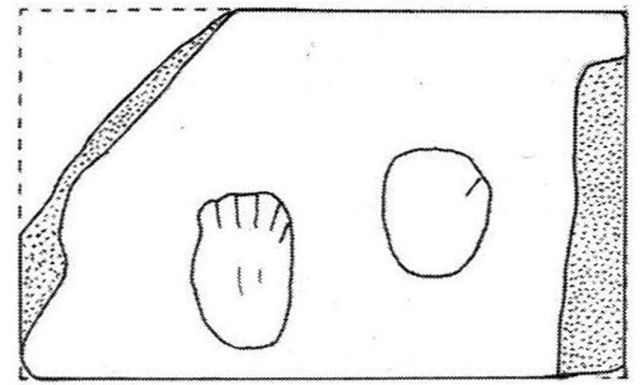
Rectangular limestone base without mouldings; H 36, W 54, D 33 cm. The margins are chipped, the epigraphic field is not framed. On the top side there are the traces of the feet of a bronze statue (L 12-15 cm, W 4-9 cm, D 2-3 cm). Sarnowski 2005, 224 notes traces of red colour in the letters.
PROVENANCE AND CURRENT LOCATION
The block was found in 1999 in the area of the central court of the military camp in Novae (for a map of Novae, see Sarnowski 1999, 56, with a ground plan of the principia at p. 59 fig. 1). It is today in the lapidarium of Novae, inv. no 170/99 w.
HONORAND, AWARDER, AND DATE
The honorand of this dedication is not named. Sarnowski 2005, 228, suggests an imperial personage, such as Theodosius II, his wife Eudocia, or his sister Pulcheria. It is however strange that they are not named.
The awarders Flavius Agapistus and Flavius Diogenis were primipilari. In Late Antiquity this was not the highest-ranking centurion of a legion any more, but a civilian office-holder whose duty was the organization of the food supply (pastus militis, lines 4-5) for the border-troops (LSA-1102; LSA-1103). They set up their dedication after having finished their duties (lines 3-4).
The inscription is dated to the year 431 both by the 14th indiction, and by the consulship of Antiochus (PLRE II, 103-4 Antiochus 7) and Bassus (PLRE II, 220-1 Bassus 8).
FURTHER DISCUSSION
From Novae two further statue dedications by primipilarii from the same period, and with similar inscriptions, have been published (LSA-1102; LSA-1103), constituting a quite exceptional group of statue bases from a very late date in a remote military context..
These dedications, along with others by 4th-century primipilarii in nearby Oescus (LSA-2596, LSA-2597, and LSA-2598) and in Novae (LSA-2594) form a remarkable group. They obviously continue an older tradition fostered by the primi pili of the 2nd and 3rd centuries (Kolendo 1980; Kolendo 1988). There is no way of knowing at present whether this was a very localised phenomenon, or a more widespread practice along the Danube frontier.
If the translation of line 4 is correct, our inscription possibly suggests the presence of a statue of a certain Dionysius in the military camp of Novae. Sarnowski 2005, 227 suggests that in this period this might be the comes et magister utriusque militiae per Orientem of 428-31, Flavius Dionysius (PLRE II, 365-6 Dionysius 13), rather than the pagan god Dionysus.
Discussion references
- Kolendo, J., Le role du primus pilus dans la vie religieuse de la légion en rapport avec quelques inscriptions des principia de Novae, Archeologia. Rocznik Instytutu Historii Kultury Materialnej Polskiej Akademii Nauk 31, 1980, 49-60
- Kolendo, J., Les nouvelles inscriptions des primi pili de Novae, Archeologia. Rocznik Instytutu Historii Kultury Materialnej Polskiej Akademii Nauk 39, 1988, 91-103
- Martindale, J. R., The Prosopography of the Later Roman Empire. Vol. II A.D. 395-527, Cambridge 1980
- Sarnowski, T., Die Principia von Novae im späten 4. und frühen 5. Jh., v. Bülow, G. &- Milceva, A. (eds.), Der Limes an der unteren Donau von Diokletian bis Heraklios. Vorträge der Internationalen Konferenz Svistov, Bulgarien (1.-5. September 1998) , 1999
Cite: Last Statues of Antiquity, LSA-2445 (Ulrich Gehn).