
LSA-2446
Base for statue of Ceionius Iulianus, governor and patron of Madauros. Madauros (Africa Proconsularis). 326-333
Record details
Photographs
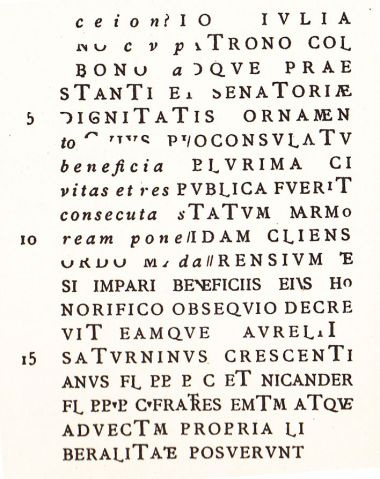
Inscription
[Ceion]io(?) Iulia/no, [c(larissimo) v(iro), p]atrono col(oniae), / bono [a]dque prae/stanti e[t] senatoriae / (5) dignitatis ornament/[to], cuius proconsulatu / [beneficia] plurima ci/[vitas et res] publica fuerit / [consecuta, s]tatuam marm[o]/[ream pone]ndam cliens / (11) ordo Ma[da]urensium et/si impari beneficiis eius ho/norifico obsequio decre/vit, eamque Aurelii / (15) Saturninus Crescenti/anus fl(amen) p(er)p(etuus), p(atronus) c(oloniae) et Nicander / fl(amen) p(er)p(etuus), p(atronus) c(oloniae) fratres etiam atque / advectam propria li/beralitate posuerunt.
Inscription translation
To Ceionius Iulianus, of clarissimus rank, patron of the colony, good and outstanding, and an ornament of the senatorial order, by whose governorship (proconsulatu) the city and the community (res publica) have obtained many benefits. His client, the council (ordo) of Madauros, decreed the erection of [this] marble statue with reverent obedience, although not matching the benefits he provided. Aurelius Saturninus Cescentianus, priest in perpetuity, patron of the colony, and Aurelius Nicander, priest in perpetuity, patron of the colony, also brothers, brought it here and set it up out of their own generosity.
Bibliography
- Gsell, S., Inscriptions latines de l’Algérie, vol. I, Paris 1922 (Rome 1965), 2162
- L'Année épigraphique, , 1922, 16
- Lepelley, C., Les cités de l'Afrique romaine au Bas-Empire, t. 2, Notices d'histoire municipale, Paris 1981, 133
Discussion
INSCRIPTION
In 19 lines:
[Ceion]io(?) Iulia/no, [c(larissimo) v(iro), p]atrono col(oniae), / bono [a]dque prae/stanti e[t] senatoriae / (5) dignitatis ornament/[to], cuius proconsulatu / [beneficia] plurima ci/[vitas et res] publica fuerit / [consecuta, s]tatuam marm[o]/[ream pone]ndam cliens / (11) ordo Ma[da]urensium et/si impari beneficiis eius ho/norifico obsequio decre/vit, eamque Aurelii / (15) Saturninus Crescenti/anus fl(amen) p(er)p(etuus), p(atronus) c(oloniae) et Nicander / fl(amen) p(er)p(etuus), p(atronus) c(oloniae) fratres etiam atque / advectam propria li/beralitate posuerunt.
'To Ceionius Iulianus, of clarissimus rank, patron of the colony, good and outstanding, and an ornament of the senatorial order, by whose governorship (proconsulatu) the city and the community (res publica) have obtained many benefits. His client, the council (ordo) of Madauros, decreed the erection of [this] marble statue with reverent obedience, although not matching the benefits he provided. Aurelius Saturninus Cescentianus, priest in perpetuity, patron of the colony, and Aurelius Nicander, priest in perpetuity, patron of the colony, also brothers, brought it here and set it up out of their own generosity.'
Letter height 4.5 cm.
We reproduce the inscription with the completions proposed by Gsell 1922 and approved by Lepelley 1981.
DESCRIPTION (from Gsell 1965)
Three fragments of a rectangular base. The first piece contains the beginnings of lines 2-6; the second contains the second half of lines 1-13 and the upper portion of the last letter of line 14; the third piece contains the first half of lines 11-13 and lines 14-19. The total height of the base is 138 cm, W 54, D 51 cm. There is no published image.
PROVENANCE AND CURRENT LOCATION
The first piece (see above, ‘Description’) was found on the forum of Madauros in 1917, the other two some 30 metres north-east of the fortification in 1921 (Gsell 1965) (http://www.trismegistos.org/place/17456). There is no recent account of the inscription’s location.
HONORAND, AWARDER AND DATE
The honorand, Marcus Ceionius Iulianus signo Kamenius (Ceionius Iulianus in our inscription), was governor (proconsul) of Africa in 326/33 (PLRE I, 476 M. Ceionius Iulianus signo Kamenius). He was a patron of the city; he is honoured for the many benefits resulting from his good governorship.
The inscription was set up by two local notables, Aurelius Saturninus Cescentianus and Aurelius Nicander. The two men were brothers, they were both priests of the imperial cult (flamen perpetuus; on the office see LSA-2351) and, like the honorand, patrons of their home city.
FURTHER DISCUSSION
Marcus Ceionius Iulianus, the honorand, was a honoured with another statue by the people of Bulla Regia (LSA-2357).
Another honorific inscription in Madauros, on a similar base, to the proconsul Cezeus Largus Maternianus (LSA-2447) uses similar formulae to praise the honorand (senatoriae dignitatis ornamento; cuius proconsulatu beneficia plurima civitas et res publica fuerit consecuta; statuam marmoream ponendam cliens ordo madaurensium etsi impari beneficiis eius honorifico obsequio decrevit). These two similar inscriptions were possibly intended to stand close together; however, the location where they were set up is uncertain.
Discussion references
- Jones, A. H. M. et al., The Prosopography of the Later Roman Empire. Vol. I 260-395, Cambridge et al. 1971 (1975)
Cite: Last Statues of Antiquity, LSA-2446 (Ulrich Gehn).