
LSA-2447
Base for statue of Cezeus Largus, governor of Africa and patron of Madauros. Madauros (Africa Proconsularis). 341-350
Record details
Photographs
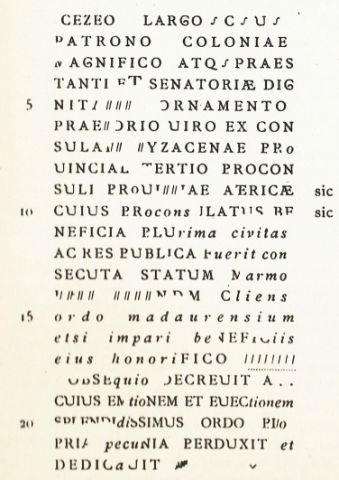
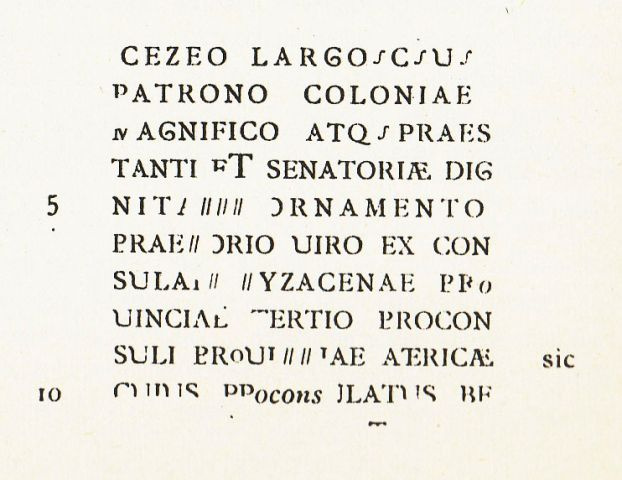
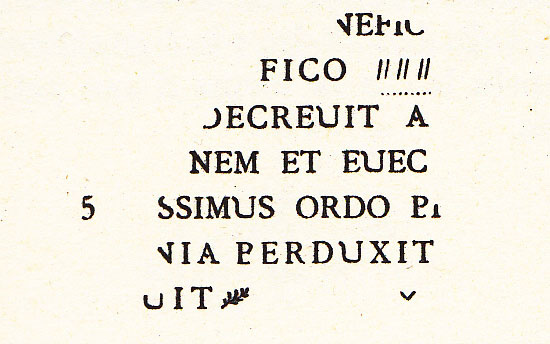
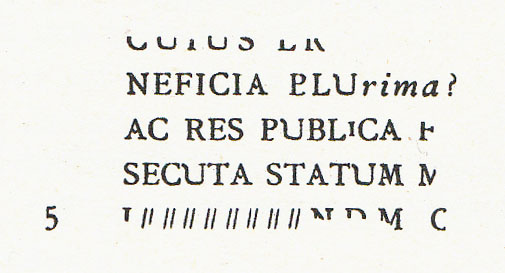
Inscription
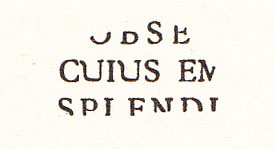
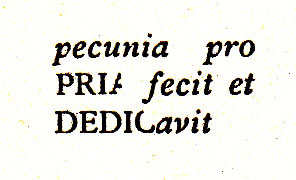
Cezeo Largo c(larissimo) v(iro), / patrono coloniae, / magnifico atq(ue) praes/tanti et senatoriae dig/nita[tis] ornamento, /(6) prae[t]orio viro, ex con/sula[ri B]yzacenae pr[o]/vinciae, tertio procon/suli provi[nc]iae A[f]ricae, /(10) cuius pro[consu]latus (sic, for 'proconsulatu') be/neficia plu[rima civitas] / ac res publica f[uerit con]/secuta. Statuam m[armo]/re[am pone]ndam c[liens] /(15) [ordo Madaurensium] / [etsi impari be]nefic[iis] / [eius honori]fico [[---]] / obse[quio] decrevit a[tque?] / cuius em[tio]nem et evec[tionem] /(20) splendi[di]ssimus ordo pr[o]/pria [pecu]nia perduxit [et] / dedic[a]vit.
Inscription translation
To Cezeus Largus, of clarissimus rank, patron of the colony, distinguished and outstanding, and an ornament of the senatorial order, man of praetorian rank, former governor (consularis) of the province of Byzacena, governor (proconsul) of the province of Africa in the third year, by whose governorship (proconsulatu) the city and the community (res publica) have obtained many benefits. His client, the council (ordo) of Madauros, decreed the erection of [this] marble statue with reverent obedience (…), although not matching the benefits he provided. The most splendid council (ordo) ensured its purchase and transport at its own expense, and dedicated it.
Bibliography
- Gsell, S., Inscriptions latines de l’Algérie, vol. I, Paris 1922 (Rome 1965), 2116
- L'Année épigraphique, , 1922, 17
- Lepelley, C., Les cités de l'Afrique romaine au Bas-Empire, t. 2, Notices d'histoire municipale, Paris 1981, 134
Discussion
INSCRIPTION
In 22 lines:
Cezeo Largo c(larissimo) v(iro), / patrono coloniae, / magnifico atq(ue) praes/tanti et senatoriae dig/nita[tis] ornamento, /(6) prae[t]orio viro, ex con/sula[ri B]yzacenae pr[o]/vinciae, tertio procon/suli provi[nc]iae A[f]ricae, /(10) cuius pro[consu]latus (sic, for 'proconsulatu') be/neficia plu[rima civitas] / ac res publica f[uerit con]/secuta. Statuam m[armo]/re[am pone]ndam c[liens] /(15) [ordo Madaurensium] / [etsi impari be]nefic[iis] / [eius honori]fico [[---]] / obse[quio] decrevit a[tque?] / cuius em[tio]nem et evec[tionem] /(20) splendi[di]ssimus ordo pr[o]/pria [pecu]nia perduxit [et] / dedic[a]vit.
'To Cezeus Largus, of clarissimus rank, patron of the colony, distinguished and outstanding, and an ornament of the senatorial order, man of praetorian rank, former governor (consularis) of the province of Byzacena, governor (proconsul) of the province of Africa in the third year, by whose governorship (proconsulatu) the city and the community (res publica) have obtained many benefits. His client, the council (ordo) of Madauros, decreed the erection of [this] marble statue with reverent obedience (…), although not matching the benefits he provided. The most splendid council (ordo) ensured its purchase and transport at its own expense, and dedicated it.'
Letter height 4 cm.
DESCRIPTION (from Gsell 1965)
Six fragments of a statue base; H (total) 138, W 54, D 51 cm. Fragment (a) contains lines 1-2 and the right half of lines 3-10; fragment (b) contains the beginnings of lines 3-10; both fragments together were published by Gsell 1922, no 2116. Fragment (c) contains the lower portion of the left half of line 10, the left half of lines 11-13, and some letters of line 14; it was published by Gsell 1922, no 2163. Fragment (d) contains large portions of lines 18-22 with the right margin (the beginnings of all lines are missing); it was published by Gsell 1922, no 2159bis. Fragment (e) contains the beginnings of lines 18-20, with the upper portion of line 18 and the lower portion of line 20 are broken off; it was published by Gsell 1922 no. 2164. Fragment (f) contains the initial letters of lines 21-22; it was published by Gsell 1922, no 2169.
There is no published image of the inscription or of any portion of it.
PROVENANCE AND CURRENT LOCATION
The six fragments were found at different times, dispersed over different locations at Mdaourouch. Fragment (a) was found behind the theatre; fragment (b) north of the fortification; fragment (c) in the north-eastern part of the forum; fragment (d) was found in 1920 north-east of the fortification; fragment (f) during the excavations of 1919 north-east of the theatre. No reference is made of the provenance of fragment (e) by Gsell 1922.
There is no recent account of the inscription's location.
HONORAND, AWARDER AND DATE
The honorand, Cezeus Largus Maternianus (Cezeus Largus in our inscription), was governor (proconsul) of Africa Proconsularis (lines 8-9) and patron of Madauros (line 2) (PLRE I, 567 Cezeus Largus Maternianus). He is honoured for the benefits the city obtained through his good governorship (lines 10-13). Before he held office in Africa, he was provincial governor (consularis of Byzacena in 328/50 (Chastagnol 1967, 124-5); before that governorship, he was legate of the proconsul Africae Ceionius Iulianus in 326/33 (LSA-2446; see below, ‘Further Discussion’).
Largus held the governorship in Africa for at least three years (lines 8-9).
The statue was awarded by the council (ordo of Madauros (lines 19-22; for lines 13-17 see the similar formula in (LSA-2446).
A secure terminus post quem for Cezeus Largus’ governorship in Africa is 328 (no consularis of Byzacena is testified to before that date). There is no secure terminus ante quem. Chastagnol 1967 suggested a date of 340/50 for his time in office in Africa; this was accepted by Lepelley 1981.
FURTHER DISCUSSION
Another base, similar in its measurements and with a similar inscription, was set up in Madauros, probably on the forum, to one of Largus’ predecessors as proconsul, Ceionius Iulianus (LSA-2446). It is possible that the two statue monuments stood close to each other.
Discussion references
- Chastagnol, A., Les Gouverneurs de Byzacène et deTripolitaine, Antiquités africaines, 1,1967, 119-134, 124-5
- Jones, A. H. M. et al., The Prosopography of the Later Roman Empire. Vol. I 260-395, Cambridge et al. 1971 (1975)
Cite: Last Statues of Antiquity, LSA-2447 (Ulrich Gehn).