
LSA-2448
Base for statue of Lucius Aelius Dionysius, governor. Maxula (Africa Proconsularis). 299-301
Record details
Photographs
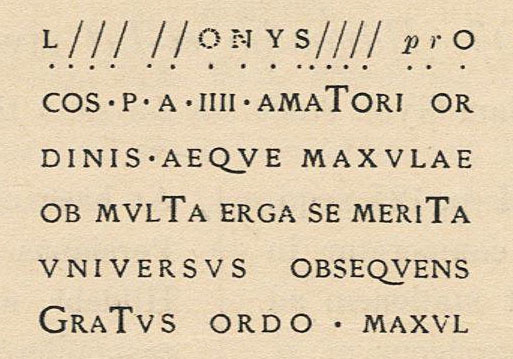
Inscription
[[L(ucio) [Ael(io) Di]onys[io, v(iro) c(larissimo), pr]o]]/co(n)s(uli) p(rovinciae) A(fricae) IIII, amatori or/dinis aequ(a)e Maxulae, / ob multa erga se merita /(5) universus obsequens / gratus ordo Maxul(ensis).
Inscription translation
To Lucius Aelius Dionysius, of clarissimus rank, governor (proconsul) of the province of Africa in the fourth year, friend of the council (ordo) of fair Maxulae. The whole council (ordo) of Maxula [set this up], grateful and compliant for his many merits towards them.
Bibliography
- Corpus Inscriptionum Latinarum; , VIII, 12459
- L'Année épigraphique, , 1888, 120
- Lepelley, C., Les cités de l'Afrique romaine au Bas-Empire, t. 2, Notices d'histoire municipale, Paris 1981, 141
- Merlin, A., Inscriptions latines de la Tunisie, Paris, 1944, 866
Discussion
INSCRIPTION
In six lines:
[[L(ucio) [Ael(io) Di]onys[io, v(iro) c(larissimo), pr]o]]-/co(n)s(uli) p(rovinciae) A(fricae) IIII, amatori or-/dinis aequ(a)e Maxulae, / ob multa erga se merita /(5) universus obsequens / gratus ordo
'To Lucius Aelius Dionysius, of clarissimus rank, governor (proconsul) of the province of Africa in the fourth year, friend of the council (ordo) of fair Maxulae. The whole council (ordo) of Maxula [set this up], grateful and compliant for his many merits towards them.'
Letter height not recorded.
DESCRIPTION (from CIL VIII)
Marble plaque, H 82, W 54, W 5 cm. Our inscription is from a second use of the plaque; on its other side an inscription to Sabina, wife of the emperor Hadrian (117-138), is carved (CIL VIII, 12458). There is no published image.
PROVENANCE AND CURRENT LOCATION
The inscription was found in 1882 in Radès (then Ghades), located on the gulf of Carthago; this is the area of the ancient city of Maxula (Lepelley II, 140-1; http://www.trismegistos.org/place/17136). It was recorded in the Museum St. Louis in Carthago (today Carthage National Museum) by CIL in 1891. There is no recent record of its location.
HONORAND, AWARDER AND DATE
Lucius Aelius Helvius Dionysius, the honorand, was governor (proconsul) of Africa in 296/301 (PLRE I, 260 L. Aelius Helvius Dionysius 12). He held this office for at least four years; our inscription was set up in the fourth year of his governorship (line 2).
The inscription was set up by the council (ordo) of Maxula. Dionysius is styled ‘friend of the council’ (amator ordinis, lines 2-3); Lepelley suggests that this possibly reflected tax relief for the city.
Discussion references
- Jones, A. H. M. et al., The Prosopography of the Later Roman Empire. Vol. I 260-395, Cambridge et al. 1971 (1975)
Cite: Last Statues of Antiquity, LSA-2448 (Ulrich Gehn).