
LSA-245
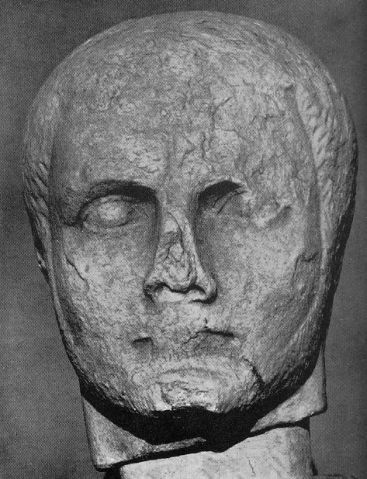
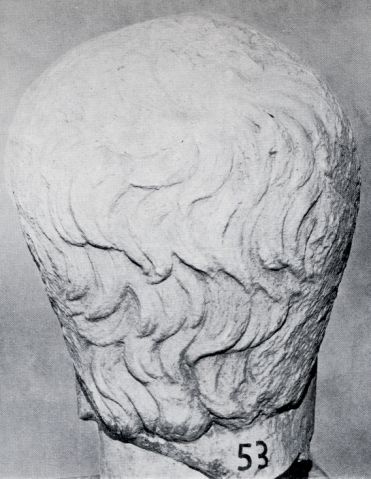
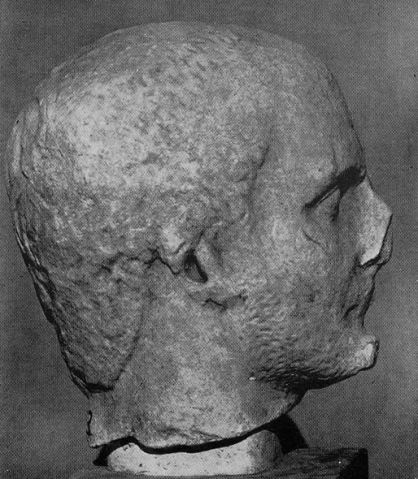
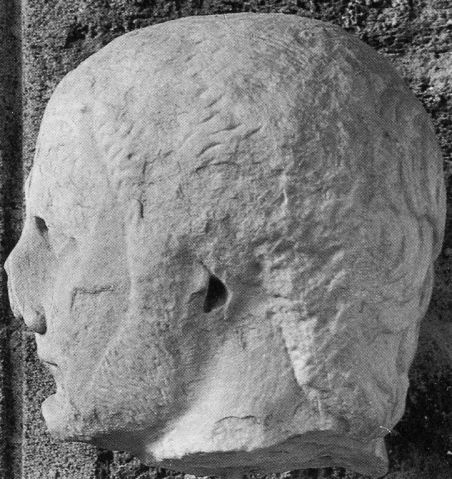
Head of Tetrarch, re-cut, found with fragments of nude statue. Side (Pamphylia). Late third to fourth century.
Record details
Photographs
Bibliography
- Inan, J. and E. Rosenbaum, Roman and Early Byzantine Portrait Sculpture in Asia Minor, Oxford 1966, 86-7, no. 30, pls. 32-33
- Inan, J. and E. Rosenbaum, Roman and Early Byzantine Portrait Sculpture in Asia Minor, Oxford 1966, 87-8, no. 64, pls. 5.4 and 40.3-4
Discussion
DESCRIPTION (Object)
Over life-size head, plinth with bare feet, and left arm in cloak. H (of head): 31, W (of head): 24 cm. Fine-grained white marble.
The head is broken unevenly through the neck; more of the neck is preserved on the proper right side. The end of the nose is broken, and the outer corner of the left eye and chin are chipped.
The head has been re-cut from an earlier portrait. The back of the head was untouched and shows Julio-Claudian hair pattern (not, however, as Inan writes, that of the Augustus of Prima Porta). The front and sides of the original hair have been taken down and scored with slashes of a flat chisel. An original lock which curls into the right ear is still visible. The perimeter of the fringe and of the beard on the cheek is a continuous inscribed line. The beard has been indicated with short strokes of a flat chisel.
The pupils are unmarked.
PROVENANCE
The statue fragments were found in Building M at Side.
DESCRIPTION (Subject)
The extant fragments suggest a nude statue with a cloak over his right shoulder. The head shows a short-haired and short-bearded man. He has a creased brow, hooked nose, and a distinctive prominent , pointy chin.
DATE
The head was originally a portrait of the Julio-Claudian period. It has been re-cut to display the hair and beard fashions of the middle to late third century. The technique of the re-cutting, however, suggests a date late in the third century. This is confirmed by its find context with LSA-244 and LSA-246. These are almost assuredly portraits of Tetrarchs and were probably erected at the same time as this statue.
HONORAND
The size, nude costume, and the find context (with LSA-244 and LSA-246), indicate that this statue represented an Emperor. It probably stood as a pendant to LSA-246.
Discussion references
- L'Orange, H. P., Das spätantike Herrscherbild von Diokletian bis zu den Konstantin-Söhnen, 284-361 n. Chr. Das Römische Herrscherbild. III. Abteilung ; Bd. 4 , Berlin 1984, 117-18 (private portrait)
Cite: Last Statues of Antiquity, LSA-245 (J. Lenaghan).