
LSA-2450
Base for statue of Calicius Honoratianus, local notable. Membressa (Africa Proconsularis). 379-383
Record details
Photographs
Inscription
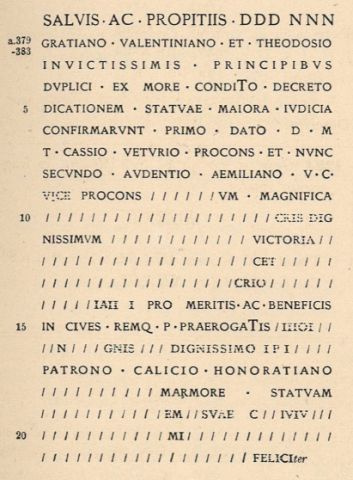
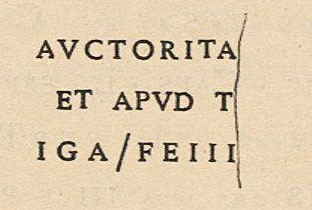
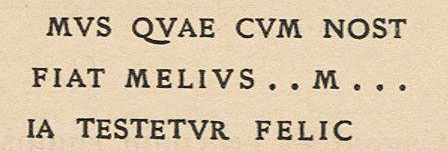
Salvis ac propitiis ddd(ominis) nnn(ostris) / Gratiano Valentiniano et Theodosio / invictissimis principibus, / duplici ex more condito decreto, /(5) dicationem statuae maiora iudicia / confirmarunt primo dato d(ivino?) m(andatu?) / T[ha]lassio v(iro) c(larissimo) tunc procons(ule) et nunc / secundo Audentio Aemiliano v(iro) c(larissimo) / vice procons(ule) [---]um magnifica /(10) [---]veteris dig-/nissimum [---] auctorita[te ---] / [---] et apud T[---] / [---]IGA[---]FEIII[---] / [---] pro meritis ac benefici(i)s /(15) in cives remq(ue) p(ublicam) praerogatis vir[---] / [i]n[si?]gnis[---] dignissimo [---] P [---] / patrono Calicio Honoratiano / [---] marmore statuam / [---]EM[---] suae C[---]IVIV[---] /(20) [---]MI[---] / [---] felici[ter---].
Inscription translation
Our lords Gratian, Valentinian and Theodosius most unconquered emperors, being safe, well, and well-disposed. Established with a decree according to custom twice, the dedication of the statue was confirmed by higher decision first by the issue of an imperial mandate by Thalassius, of clarissimus rank, then governor (proconsul), and now for the second time by Audentius Aemilianus, of clarissimus rank, successor governor (…) eminent (…) worthiest of the old (…) authority (…) and among (…) for the merits and benefits distributed to the citizens and the community (res publica), a man (…) outstanding (…) worthiest (…)to the patron Calicius Honoratianus (…) marble statue (…) luckily (…).
Bibliography
- Corpus Inscriptionum Latinarum; , VIII, 1296 = 14798
- Lepelley, C., Les cités de l'Afrique romaine au Bas-Empire, t. 2, Notices d'histoire municipale, Paris 1981, 142-3
Discussion
INSCRIPTION
Partly preserved in 21 lines:
Salvis ac propitiis ddd(ominis) nnn(ostris) / Gratiano Valentiniano et Theodosio / invictissimis principibus, / duplici ex more condito decreto, /(5) dicationem statuae maiora iudicia / confirmarunt primo dato d(ivino?) m(andatu?) / T[ha]lassio v(iro) c(larissimo) tunc procons(ule) et nunc / secundo Audentio Aemiliano v(iro) c(larissimo) / vice procons(ule) [---]um magnifica /(10) [---]veteris dig-/nissimum [---] auctorita[te ---] / [---] et apud T[---] / [---]IGA[---]FEIII[---] / [---] pro meritis ac benefici(i)s /(15) in cives remq(ue) p(ublicam) praerogatis vir[---] / [i]n[si?]gnis[---] dignissimo [---] P [---] / patrono Calicio Honoratiano / [---] marmore statuam / [---]EM[---] suae C[---]IVIV[---] /(20) [---]MI[---] / [---] felici[ter---].
'Our lords Gratian, Valentinian and Theodosius most unconquered emperors, being safe, well, and well-disposed. Established with a decree according to custom twice, the dedication of the statue was confirmed by higher decision first by the issue of an imperial mandate by Thalassius, of clarissimus rank, then governor (proconsul), and now for the second time by Audentius Aemilianus, of clarissimus rank, successor governor (…) eminent (…) worthiest of the old (…) authority (…) and among (…) for the merits and benefits distributed to the citizens and the community (res publica), a man (…) outstanding (…) worthiest (…)to the patron Calicius Honoratianus (…) marble statue (…) luckily (…).'
Letter height 5 cm (smaller at the end).
We reproduce this mutilated text with the completions proposed by Lepelley 1981.
DESCRIPTION (from CIL VIII)
Statue base, H 12, W 54 cm. There is no published image.
PROVENANCE AND CURRENT LOCATION
The inscription was recorded in Medjez-el-Bab, that is the area of ancient Membressa, by CIL in 1881. CIL recorded it lying in front of a rich house in the city centre. There is no recent account of its location.
HONORAND, AWARDER AND DATE
Caecilius Honoratianus, the honorand, was patron of the city of Membressa (line 17).
The name of the awarder is lost in this heavily mutilated text; however, it is probable that it was the city or one of its bodies. Remarkably, the erection of the inscription and statue was twice approved by the imperial administration (see below, 'Further Discussion').
The outer dates of the inscription are provided by the two governors (proconsuls) mentioned in the text: Thalassius (line 7) held office in 377/8 (PLRE I, 887-8 Thalassius 3); Virius Audentius Aemilianus (line 8) in 379/83 (PLRE I, 22 Virius Audentius Aemilianus 4). The statue was set up, as the inscription states, only under the governorship of Aemilianus, when the decree was confirmed for the second time (line 8; see also below, ‘Further Discussion’).
FURTHER DISCUSSION
As Lepelley 1981, 143 points out, the record of a double intervention of the governor in a local affair is highly unusual. Lepelley suggests that the reason for this must be a conflict between two parties among the decurions, one of which would have denied the honour of a statue to the patron; the double confirmation from the highest authority in the province made sure that the erection of the statue was in accordance with all legal requirements.
For differences between locals concerning the erection of an honorific statue, see Symmachus, ep. IX, 115. Symmachus who was governor of Africa in 373-4 was denied a statue by the provincial assembly; he blamed this on the ‘envy’ of one party in the assembly (aemulati). The motif reoccurs in the inscription for Eupeithius in Aphrodisias, probably also a provincial governor (LSA-183).
Discussion references
- Jones, A. H. M. et al., The Prosopography of the Later Roman Empire. Vol. I 260-395, Cambridge et al. 1971 (1975)
Cite: Last Statues of Antiquity, LSA-2450 (Ulrich Gehn).