
LSA-2452
Base for statue of unstated subject. Neapolis (Africa Proconsularis). 400-401
Record details
Photographs
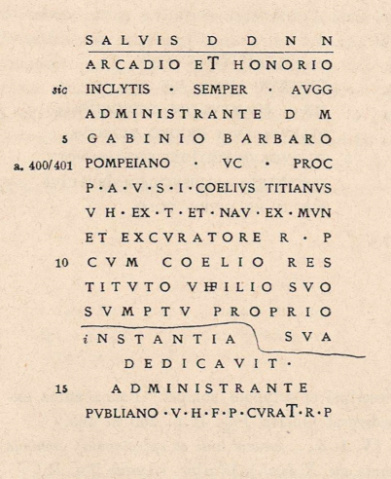
Inscription
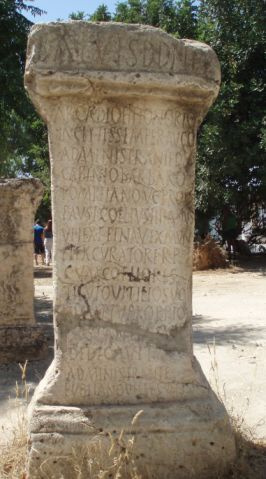
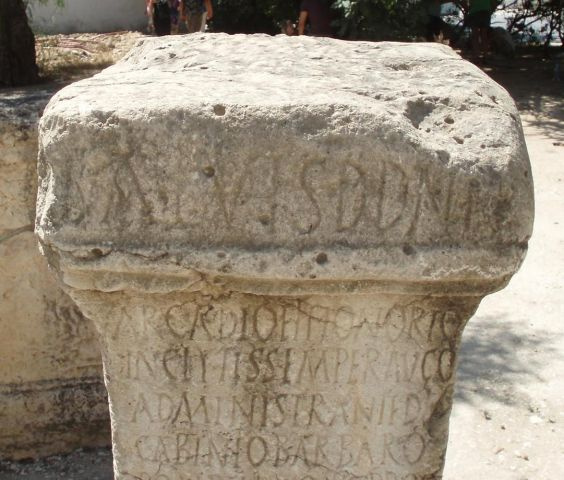
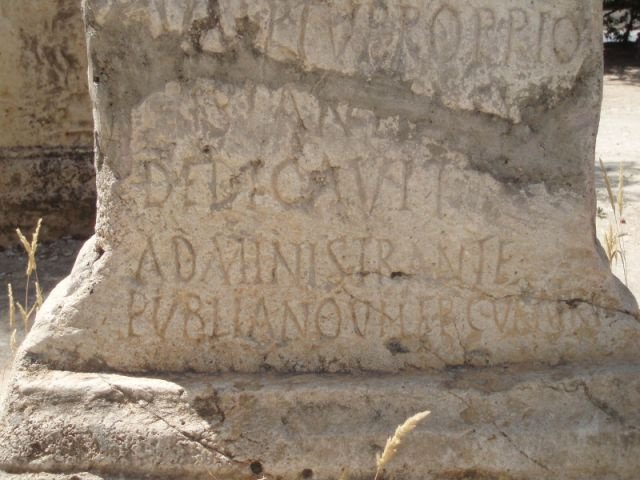
Salvis dd(ominis) nṇ(ostris) / Arcadio et Honorio / inclytis semper Augg(ustis). / Administrante d(ivino) ṃ(andato) /(5) Gabinio Barbaro / Pompeiano, v(iro) c(larissimo), proc(onsule) / p(rovinciae) A(fricae), v(ice) s(acra) i(udicante), Coelius Titianus, / v(ir) h(onestissimus), ex t(ransvectuario) et nav(iculario), ex mun(erario) / ẹṭ ẹx curatore r(ei) p(ublicae) /(10) cum Coelio Res-/ṭịṭuto, v(iro) h(onestissimo), filio suo, / sumptu proprio / [i]ṇstanṭịạ ṣụ[a] / dedicavit. /(15) Administrante / Publiano, v(iro) h(onestissimo), f(lamine) p(erpetuo), curat(ore) ṛ(ei) p̣(ublicae).
Inscription translation
Our lords Arcadius and Honorius, glorious and forever Augusti being safe and well. Being governor by imperial order Gabinius Barbarus Pompeianus, of clarissimus rank, governor (proconsul) of the province of Africa, judge representing the emperor, Coelius Titianus, most respectable man, former freight carrier and shipper, former sponsor of amphitheatrical games and former curator of the city (res publica) with Coelius Restitutus, most respectable man, his son, dedicated [this] with his own funds and at his own insistence. With the supervision of Publianus, most respected man, priest in perpetuity, curator of the city (res publica) (transl. C. Machado).
Bibliography
- Corpus Inscriptionum Latinarum; , VIII, 969 (p 928, 1282)
- Ben Abdallah, Z. B., Catalogue des inscriptions latines païenne du Musée du Bardo, Rome 1986, 393
- Merlin, A., Inscriptions latines de la Tunisie, Paris, 1944, 801
Discussion
INSCRIPTION
In sixteen lines:
Salvis dd(ominis) nṇ(ostris) / Arcadio et Honorio / inclytis semper Augg(ustis). / Administrante d(ivino) ṃ(andato) /(5) Gabinio Barbaro / Pompeiano, v(iro) c(larissimo), proc(onsule) / p(rovinciae) A(fricae), v(ice) s(acra) i(udicante), Coelius Titianus, / v(ir) h(onestissimus), ex t(ransvectuario) et nav(iculario), ex mun(erario) / ẹṭ ẹx curatore r(ei) p(ublicae) /(10) cum Coelio Res-/ṭịṭuto, v(iro) h(onestissimo), filio suo, / sumptu proprio / [i]ṇstanṭịạ ṣụ[a] / dedicavit. /(15) Administrante / Publiano, v(iro) h(onestissimo), f(lamine) p(erpetuo), curat(ore) ṛ(ei) p̣(ublicae).
'Our lords Arcadius and Honorius, glorious and forever Augusti being safe and well. Being governor by imperial order Gabinius Barbarus Pompeianus, of clarissimus rank, governor (proconsul) of the province of Africa, judge representing the emperor, Coelius Titianus, most respectable man, former freight carrier and shipper, former sponsor of amphitheatrical games and former curator of the city (res publica) with Coelius Restitutus, most respectable man, his son, dedicated [this] with his own funds and at his own insistence. With the supervision of Publianus, most respected man, priest in perpetuity, curator of the city (res publica)' (transl. C. Machado).
Letter height 2.5 - 4 cm.
We reproduce the inscription with the completions suggested by CIL. Benzina Ben Abdallah 1986 (ILBardo) has administrante d(o)m(ino) in line 4. We are not convinced by that; the usual abbreviation would be d(ominus), and this title is otherwise reserved to emperors.
DESCRIPTION (from ILBardo and the published image)
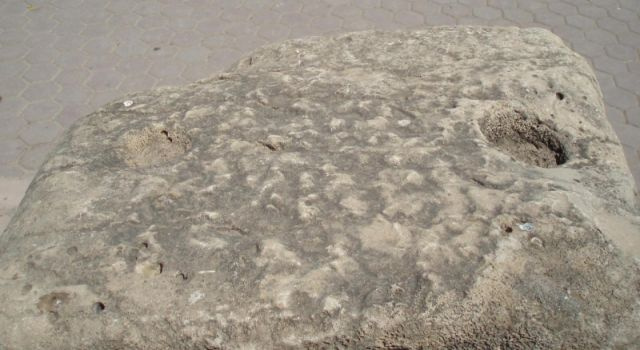
Limestone base moulded at top and bottom; H 135, W 57; D 45 cm. A horizontal break goes through the lower part of the base; the upper right corner is chipped. The top face is roughly finished with a point; it has two round cavities close to the left and right margins.
PROVENANCE AND CURRENT LOCATION
The inscription was recorded in Nabeul (then Nebel-Kedim), the area of ancient Neapolis (http://www.trismegistos.org/place/17343), in 1881. It is today standing inTunis, Bardo Museum, in the museum park (without published inv. no.).
HONORAND, AWARDER AND DATE
The subject of the dedication is not recorded in our inscription.
Coelius Titianus, the awarder, was a local man. He was a freight carrier and shipper, responsible for the transport of corn from Africa to Rome. He had given games in the amphitheatre, and he held the office of curator rei publicae (see LSA-2406). Titianus set up the monument at his own expense and initiative (lines 12-13); he adopted his son Coelius Restitutus into the benefaction (lines 10-11).
The dedication took place under the governorship of Gabinius Barbarus Pompeianus (line 5); Pomperianus held office in 400/1 (PLRE II, 897-8 Gabinius Barbarus Pompeianus 2).
FURTHER DISCUSSION
Another dedication by a freight carrier and shipper is known from Neapolis (LSA-2453).
Freight carrieres and shippers were free of municipal munera (Lepelley 1981, 152 n. 7). As Lepelley points out, Titianus is styled 'former freight carrier and shipper' (ex transvectuario et naviculario, line 8). He possibly lost his immunity after retiring from his possession (ex munerario, line 8).
As Benzina Ben Abdallah 1986 points out, a law from 400 addressed to the governor Gabinius Barbarus Pompeianus confirms the privileges of the African shippers (Codex Theodosianus XIII, 5, 30). It is well possible that our inscription was set up on that occasion.
Discussion references
- Jones, A. H. M. et al., The Prosopography of the Later Roman Empire. Vol. I 260-395, Cambridge et al. 1971 (1975)
- Lepelley, C., Les cités de l’Afrique romaine au Bas-Empire, I-II, Paris 1979-1981, 151-2
Cite: Last Statues of Antiquity, LSA-2452 (Ulrich Gehn).