
LSA-2453
Base for statue of unstated subject. Neapolis (Africa Proconsularis). 395-439
Record details
Photographs
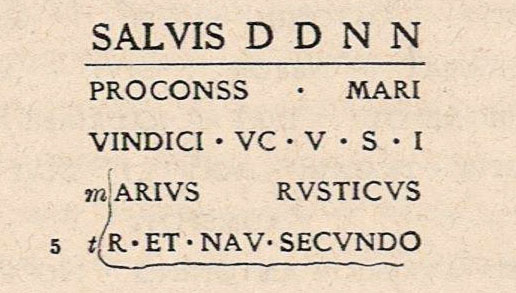
Inscription
Salvis dd(ominis) nn(ostris) / proco(n)ss(ulatu) Mari / Vindici v(iri) c(larissimi) v(ice) s(acra) i(udicantis), / [M]arius Rusticus /(5) [t]r(ansvectuarius) et nav(icularius) secundo / ------.
Inscription translation
Our lords being safe and well. During the governorship of Marius Vindicius, of clarissimus rank, judge representing the emperor, Marius Rusticus, freight carrier and shipper (…)
Bibliography
- Corpus Inscriptionum Latinarum; , VIII, 970
- Lepelley, C., Les cités de l'Afrique romaine au Bas-Empire, t. 2, Notices d'histoire municipale, Paris 1981, 152
Discussion
INSCRIPTION
Partly preserved in five lines:
Salvis dd(ominis) nn(ostris) / proco(n)ss(ulatu) Mari / Vindici v(iri) c(larissimi) v(ice) s(acra) i(udicantis), / [M]arius Rusticus /(5) [t]r(ansvectuarius) et nav(icularius) secundo / ------.
'Our lords being safe and well. During the governorship of Marius Vindicius, of clarissimus rank, judge representing the emperor, Marius Rusticus, freight carrier and shipper (…)'.
Letter height 6 cm (line 1: 10 cm).
DESCRIPTION (from CIL VIII)
Statue base broken at bottom, H 77, W 43 cm. There is no published image.
PROVENANCE AND CURRENT LOCATION
The inscription was recorded built into a house on the road leading from Nabeul (ancient Neapolis; http://www.trismegistos.org/place/17343) to Nebel Kedim by CIL in 1881. There is no recent record of its location.
HONORAND, AWARDER AND DATE
The subject of the dedication is lost in our inscription (if it was ever stated).
Marius Rusticus, the awarder, was a freight carrier and shipper, responsible for the transport of corn from Africa to Rome (see LSA-2452). Our inscription provides no information as to whether he held municipal office or carried out an act of euergetism (cf. LSA-2452).
The inscription was set up under the governorship of Marius Vindicius (lines 2-3) (PLRE II, 1170 Marius Vindicius). This governor (proconsul) cannot be dated by other evidence. Pallu 1901 dated his governorship to the late 4th/ early 5th century; the authors of CIL compared the letter form of our inscription to LSA-2452, datable to 400/1. A date in the late 4th/ early 5th century was accepted by PLRE II. If so, a terminus post quem of 395 is given by the formula referring to two emperors (ddominis nnostris, line 1), when after the death of Theodosius I the imperial college was reduced to his two sons Arcadius (Augustus 383-408) and Honorius (Augustus 393-423). The terminus post quem is the Vandal incursion of 439. Within this time frame, 401/2 is a likely date (see PLRE II, 1274 Fasti).
Another possibility, perhaps less likely, is the common reign of Valens and Valentinian I, 364-7 (in 367 Gratian entered the imperial college).
Discussion references
- Jones, A. H. M. et al., The Prosopography of the Later Roman Empire. Vol. I 260-395, Cambridge et al. 1971 (1975)
- Pallu de Lessert, G., Fastes des provinces africaines sous la domination romaine, t. II (Bas-Empire), Paris 1901
Cite: Last Statues of Antiquity, LSA-2453 (Ulrich Gehn).