
LSA-2454
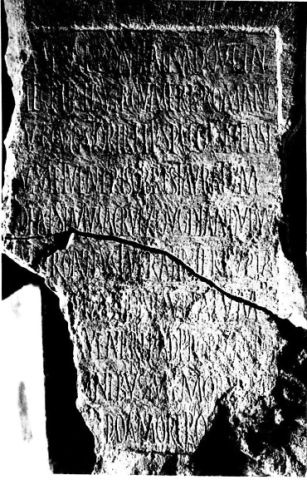
Base for statue of Valerius Romanus, curator of the city and local patron. Sicca Veneria (Africa Proconsularis). 280-337
Record details
Photographs
Inscription
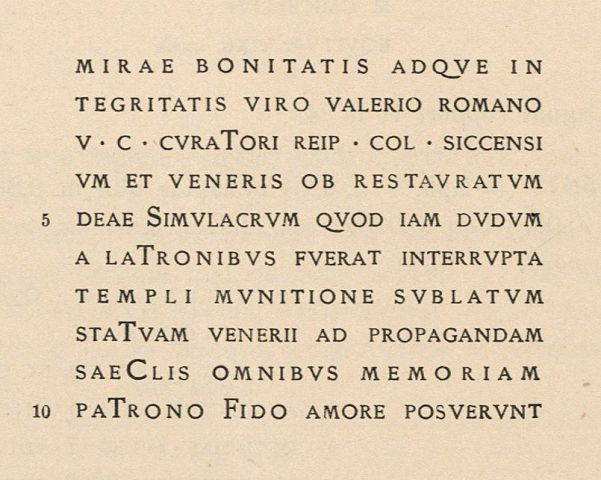
Mirae bonitatis adque in-/tegritatis viro Valerio Romano, / v(iro) c(larissimo), curatori rei p(ublicae) spl(endidissimae) col(oniae) Siccensi-/um et Veneris, ob restauratum /(5) deae simulacrum quod iamdudum / ạ latronibus fuerat interṛụpta /[ templi] ṃụṇịṭịọṇẹ sublatum / [statuam] Venerii ad prop̣ạg̣ạṇḍạm / [saec(u)lis o]ṃnibus ṃemoriạṃ /(10) [patrono fi]do amore po[suerunt].
Inscription translation
To a man of extraordinary goodness and integrity, Valerius Romanus, of clarissimus rank, curator of the city (res publica) of the most splendid colony of the Siccenses and of Venus. On account of the restoration of the statue of the goddess which was taken by bandits who had broken the walls of the temple. The faithful followers of Venus, to spread his memory through all centuries, set up (this) statue to their patron with devoted love.
Bibliography
- Corpus Inscriptionum Latinarum; , VIII, 15881
- Ben Abdallah, Z. B., Catalogue des inscriptions latines païenne du Musée du Bardo, Rome 1986, 366
- Lepelley, C., Les cités de l'Afrique romaine au Bas-Empire, t. 2, Notices d'histoire municipale, Paris 1981, 157-8; 160 no. 5
Discussion
INSCRIPTION
In ten lines:
Mirae bonitatis adque in-/tegritatis viro Valerio Romano, / v(iro) c(larissimo), curatori rei p(ublicae) spl(endidissimae) col(oniae) Siccensi-/um et Veneris, ob restauratum /(5) deae simulacrum quod iamdudum / ạ latronibus fuerat interṛụpta /[ templi] ṃụṇịṭịọṇẹ sublatum / [statuam] Venerii ad prop̣ạg̣ạṇḍạm / [saec(u)lis o]ṃnibus ṃemoriạṃ /(10) [patrono fi]do amore po[suerunt].
'To a man of extraordinary goodness and integrity, Valerius Romanus, of clarissimus rank, curator of the city (res publica) of the most splendid colony of the Siccenses and of Venus. On account of the restoration of the statue of the goddess which was taken by bandits who had broken the walls of the temple. The faithful followers of Venus, to spread his memory through all centuries, set up (this) statue to their patron with devoted love.'
Letter height 5 cm.
We reproduce the text after Ben Abdallah 1986 (ILBardo).
We related Venerii (line 8) to the cult community of the goddess (‘faithful followers of Venus’) rather than to the people of Sicca Veneria, following a suggestion made by Leppeley 1981 (see below, ‘Honorand, Awarder and Date’).
DESCRIPTION (from CIL VIII, ILBardo, and the published image)
Rectangular statue base in local stone, H 154, W 60, D 21 cm. The base is broken into two; the left portion of the lower part is lost, and the lower right corner is broken. The epigraphic field is framed; the left margin and a portion of the right margin of the base's upper portion are broken.
PROVENANCE AND CURRENT LOCATION
The block was found re-used at the Jewish cemetery of Le Kef (the site of ancient Sicca Veneria, http://www.trismegistos.org/place/17127); there it was recorded by CIL VIII in 1891. There is no recent record of its location.
HONORAND, AWARDER AND DATE
Valerius Romanus, the honorand, was of senatorial (clarissimus) rank (PLRE I, 770 Val. Romanus 13). He held the office of curator rei publicae in Sicca Veneria (on the office cf. LSA-2406). In our inscription he is praised for having restored a statue of Venus after the old statue of the goddess had been robbed by ‘bandits’. Romanus is styled patronus of the Venerii (line 10), a title which is not mentioned when his office of curator of the city is recorded. This persuades us that Lepelley’s suggestion that the Venerii are the followers of the goddess rather than the people of Sicca Veneria, is justified (see above, ‘Inscription’). The sanctuary of Venus in Sicca Veneria was the most important sanctuary of this goddess in Africa.
The inscription was set up by the Venerii (line 10), probably the followers of the goddess (see last paragraph).
From the form of the honorand’s name, which is without praenomen, without filiation, and without tribus, Lepelley 1981, 157, suggested a date in the late 3rd/ early 4th century for our inscription (see also below, ‘Further Discussion’).
FURTHER DISCUSSION
As Lepelley 1981, 158 points out, it is improbable that the ‘bandits’ mentioned by our text (a latronibus, line 6) were simple thieves. latrones is a term regularly used for soldiers of an unfavourable emperor or pretender. Lepelley suggested that the latrones of our text be the soldiers of Maxentius who marauded the region when surpressing the usurpation of Domitius Alexander in 310. Maxentius is known to have been much hated in the region because of these events; Constantine, after his victory in 312, sent the head of the ‘tyrant’ to Carthago.
Discussion references
- Jones, A. H. M. et al., The Prosopography of the Later Roman Empire. Vol. I 260-395, Cambridge et al. 1971 (1975), 770 Val. Romanus 13
Cite: Last Statues of Antiquity, LSA-2454 (Ulrich Gehn).