
LSA-2463
Lost column, once crowned with colossal equestrian statue of Justinian I, emperor. Constantinople, Augusteion. 543
Record details
Photographs
Bibliography
- Stichel, R. H. W., Die römische Kaiserstatue am Ende der Antike, Roma 1982, pp. 105-12 no. 132
Discussion
INSCRIPTION
No dedicatory inscription is recorded, and the monument probably never had one.
DESCRIPTION (from Stichel 1982)
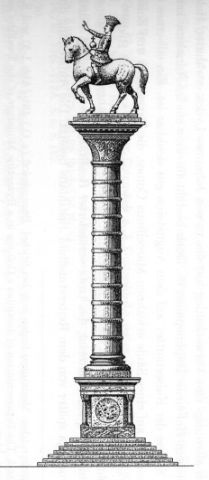
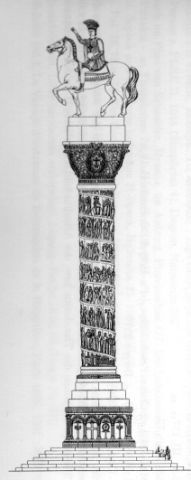
Although long ago totally destroyed (soon after the Ottoman conquest in 1453), and its foundations never investigated archaeologically, this monument was described by a number of sources, including the contemporary Procopius, and so is reasonably well known. It was made up of the following elements, here described from the bottom upwards:
Some later Byzantine sources inform us that there was a column bearing a silver statue to Theodosius I on the Augusteion before Justinian's monument (Marcellinus Comes 62, Parastaseis 68); one of these sources explicitly states that Justinian's statue replaced an earlier one of Theodosius (Zonaras III, 157, 8-13). The Parastaseis 68, moreover, mention a column of Constantine I on the Augusteion; it is therefore possible that the use for the statue to Justininian was the second re-use of an originally Constantinian monument (Bauer 1996, 159).
The statue on top was a re-used monument of the Theodosian period (see below, no. (6)).
(1) Socle of seven steps.
(2) Pedestal, built of alternating courses of brick and stone and faced with marble. One source mentions arcades on all four sides, either relief decoration of the marble revetment (Stichel 1982, 110), or a separate structure around the socle (Bauer 1996, 159).
(3) Column shaft of masonry, sheathed in bronze and decorated with wreaths (like the bands on the column of Constantine, LSA-2457, and other imperial columns in Constantinople). The bronze was taken by the crusaders of 1204.
(4) Capital, allegedly of nine superimposed round slabs of marble, each a little larger than the one below; on top a tenth layer of marble, rectangular with convex sides (a description which suggests the shape of the abacus of a Corinthian capital).
(5) Plinth of two steps for the statue itself, the upper step slightly set back.
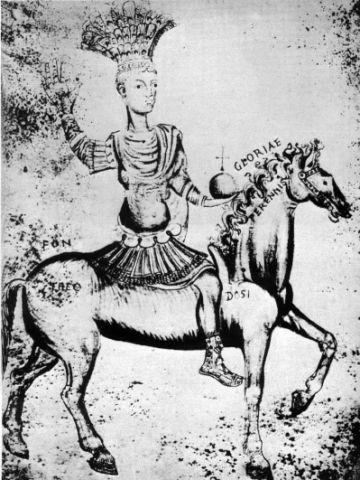
(6) Colossal bronze equestrian statue of Justinian, facing towards the east, with the left foot of the horse raised. According to the descriptions, the emperor was clad in elaborate headgear, tunic, cuirass, chlamys, and strapped boots. The headgear is called a toupha or helmet; one source describes it as like a diadem crowned by feathers. The emperor's right hand was raised, its palm facing east; while in his left hand he held an orb surmounted by a cross. (Already in the 6th century, Procopius provides evidence that the emperor's hand raised towards the east was being interpreted as a protective gesture against eastern enemies.)
The statue was described in exceptional detail by the contemporary Procopius (De Aedificiis I, ii). His description broadly agrees with a renaissance drawing of the statue (see below), and is worth quoting in full: ‘At the summit of the column stands a huge bronze horse turned towards the east, a most noteworthy sight. He seems to be about to advance and to be vigorously pressing forward. Indeed, he lifts up his left front foot as if about to step on the ground before him, while the other is planted on the stone above which he stands as though to take the next step. The hind feet he draws together so as to have them in readiness when it is time to set them in motion. Upon this horse is mounted a bronze image of the Emperor like a colossus. And the image is clad like Achilles, for that is how they call the costume he wears. He is shod in ankle-boots and has no greaves on his legs. Furthermore, he wears a cuirass in heroic fashion and his head is covered with a helmet which gives the impression of swaying, and a kind of radiance flashes forth from there. One might say in poetic style that this was the Autumn star. He gazes towards the rising sun, steering his course, I suppose against the Persians. In his left hand he holds a globe, by which the sculptor has signified that the whole earth and sea were subject to him, yet he carries neither sword nor spear nor any other weapon, but a cross surmounts his globe, by virtue of which alone he has won the kingship and victory in war. Stretching forth his right hand towards the regions of the East and spreading out his fingers, he commands the barbarians that dwell there to remain at home and not to advance any further.’ (translation from Mango (5) 2004, 110-11).
The size of the statue can be calculated to have been about three times lifesize, with an overall height of 7-7.5 m and a length (of the horse) of around 5.6 m (Stichel 1982, 109-10).
A renaissance drawing now in the University Library of Budapest (Mango, Art Bull 1959, 351 ff.) corresponds very closely to the written descriptions of the statue, and appears to be a fairly accurate, if rather naive, visual record of it. This drawing also records a (possibly incomplete) inscription, that was visible on the horse: 'FON (sic) GLORIAE THEODOSI PERENNIS'. The 15th century scholar Cristoforo Buondelmonti who describes the statue confirms that there was the name Theodosius inscribed on the statue (Stichel 1982, 106 dg, and p. 108). This suggests that at least the horse of the statue on top was a re-used monument of the Theodosian period. According to Malalas 482, 14 it was a statue of Arcadius taken from the Forum of Theodosius (Bauer 1996, 187-203, on this equestrian statue of Arcadius p. 201).
PROVENANCE AND CURRENT LOCATION
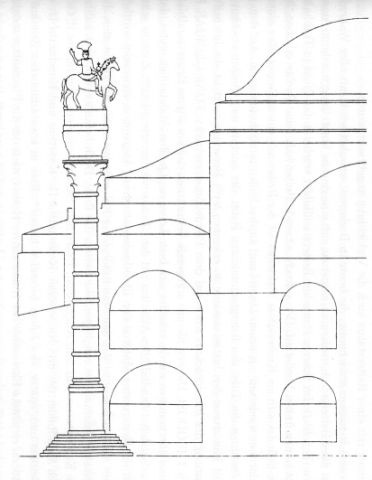
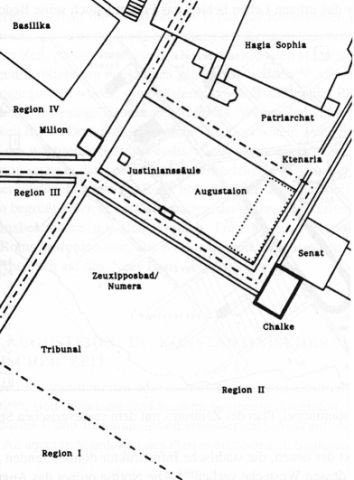
The column was erected on the square known as the Augusteion, a central site in the urban and political life of Constantinople and an important place for imperial ceremonial. The Augusteion lay to the south of the St Sophia, between it and the baths of Zeuxippus, though its precise location and extension are only approximately known (Mango, Art Bull 1959; Mango, Brazen house 19 f., 42 f.; Mamboury in Mango, Brazen house 182-8; Bauer 1996, 148-57; Mueller-Wiener etc.). The statue stood off-centre in the northwestern part of the square, where it was visible to the viewer approaching the Augusteion along the Mese from Constantine's forum (Bauer 1996, 158; Mango, Brazen house 23 fig. 1; Berger 1988, 251).
The statue was removed immediately after the Ottoman conquest of Constantinople in 1453, possibly because of the gesture of its right hand (see above, 'Description' no. (6)); it was brought to the Serail and melted down in 1529 (Stichel 1982, 111). The column was abolished in the very early 16th century, the socle in 1529.
HONORAND AND DATE
The honorand, Justinian I, was emperor 529-65. Literary sources tell us that the statue was erected in 543 (Stichel 1982, 108).
Discussion references
- Berger, A., Untersuchungen zu den Patria Konstantinupoleos: Poikila Byzantina 8, Bonn 1988
- Mango, C., The Art of the Byzantine Empire 312-1453, (5)2004
- Mango, C., The Brazen House, København 1959
- Mansel, A. M., Die Ruinen von Side, Berlin 1963
- Müller-Wiener, W., Bildlexikon zur Topographie Istanbuls, Tübingen 1977
Cite: Last Statues of Antiquity, LSA-2463 (Ulrich Gehn).