
LSA-2465
Base for statue of patron. Sicca Veneria (Africa Proconsularis). Late third to early fourth century
Record details
Photographs
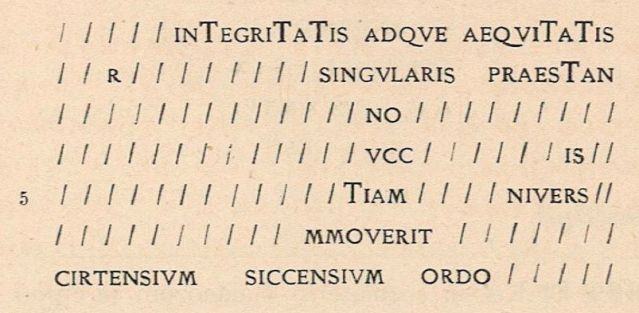
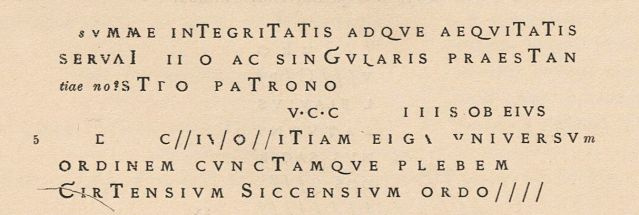
Inscription
[S]umm(a)e integritatis adque aequitatis / servat[ori] [d]i[gn]o ac singularis praestan-/[tiae no]stro patrono [---] / [---] v(iro) c(larissimo) c[ur(atori) rei p(ublicae)] ob eius /(5) [--- obse]q[uen]tiam e[r]ga universu[m] / ordinem cunctamque plebem Cirtensium Siccensium ordo [---] / ------?.
Inscription translation
To the worthy preserver of justice, (a man of) highest integrity and singular excellence, our patron (…) of clarissimus rank, curator of the city(res publica) (?), on account of his (…) complaisance towards the whole council (ordo) and all the people (plebs). The council (ordo) of the Cirtenses Siccenses …
Bibliography
- Corpus Inscriptionum Latinarum; , VIII, 1651=15883
- Lepelley, C., Les cités de l'Afrique romaine au Bas-Empire, t. 2, Notices d'histoire municipale, Paris 1981, 160 no. 6
Discussion
INSCRIPTION
Partly preserved in six lines:
[S]umm(a)e integritatis adque aequitatis / servat[ori] [d]i[gn]o ac singularis praestan-/[tiae no]stro patrono [---] / [---] v(iro) c(larissimo) c[ur(atori) rei p(ublicae)] ob eius /(5) [--- obse]q[uen]tiam e[r]ga universu[m] / ordinem cunctamque plebem Cirtensium Siccensium ordo [---] / ------?.
'To the worthy preserver of justice, (a man of) highest integrity and singular excellence, our patron (…) of clarissimus rank, curator of the city(res publica) (?), on account of his (…) complaisance towards the whole council (ordo) and all the people (plebs). The council (ordo) of the Cirtenses Siccenses …'.
Letter height not recorded.
We reproduce the inscription with the completions proposed by CIL and accepted by Lepelley 1981.
DESCRIPTION (from CIL VIII)
The inscription is carved on a heavily mutilated block (‘in lapide omnino detrito’). No measurements are published, and there is no published image.
PROVENANCE AND CURRENT LOCATION
The inscription was first recorded in El Kef (the area of ancient Sicca Veneria) in the cistern of a collapsing modern house by CIL in 1881, and again in 1891. There is no recent record of its location.
HONORAND, AWARDER AND DATE
The name of the honorand is lost in this mutilated inscription. He was of senatorial (clarissimus) rank and patron of the city (line 3); his virtues are praised in a long eulogy preceding the name (lines 1-2). He was possibly a curator rei publicae (line 4) (but the catalogue of virtues, notably his justice, would fit a provincial governor).
The inscription was set up by the council (ordo) of Sicca Veneria (line 6).
The form of the inscription with the eulogy preceding the honorand’s name is typical for late antique honorific inscriptions in the Latin West; Lepelley 1981 suggested a date in the late 3rd/ early 4th century for our inscription.
Cite: Last Statues of Antiquity, LSA-2465 (Ulrich Gehn).