
LSA-2468
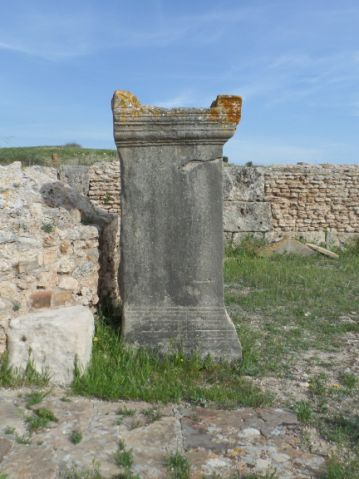
Base for statue of Gabinius Salvianus, local notable. Thuburbo Maius (Africa Proconsularis). 395-408
Record details
Photographs
Inscription
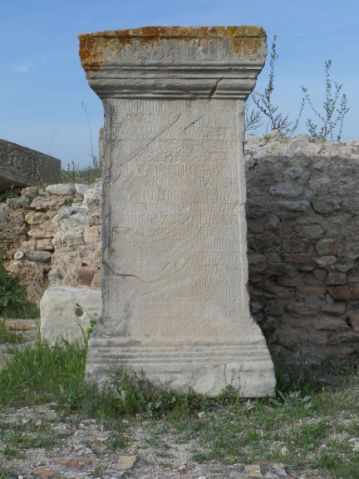
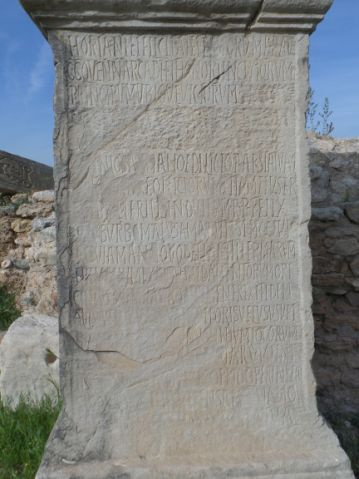
Salviani p(rincipalis) a(lmae) K(artaginis). // Hortante felicitate temporum dd(ominorum) Au-/gg(ustorum)que nn(ostrorum) Arcadi et Honori inclytorum /(4) principum ubique victorum proconsu-/[latu [---]]] / [[------]] / [Gab?]inio Salviano (a)edilicio p(rincipali) a(lmae) K(arthaginis) statuam / [vo]to [pa]triae officiorum etiam eius er-/[ga e]am meritis indultam r(es) p(ublica) felix /(10) T[h]uburbo Maius amantissimo civi / ac sui amanti quod etiam thermarum / hiemalium ex ima fundamentorum ori-/gine usque [ad] fastigia culmen erexit idem / quoque [---] IOC [--- te]mporis vel usus vel /(15) [---]N[---]O[---]TV omnium locorum / [---]IVA [ther]marum finis / INCI[---]S[--- su]mptu proprio oper(ibus) inpen-/sisque suis? EI[--- im]pensam cum amore / [---]MC[---]osia tua / ------.
Inscription translation
[Statue] of Salvianus, leading citizen (principalis) of kindly Carthage. Prompted by the good fortune of the times of our lords, the Augusti Arcadius and Honorius, renowned rulers [and] everywhere victorious, [and] under the governorship (proconsulatu) (...) the fortunate city (res publica) of Thuburbo Maius, granted through a vow of the fatherland and also for the merits of the services he bestowed upon it, [set up this] statue to Gabinius Salvianus, aedile and leading citizen of kindly Carthage, a most beloved citizen and loving her (i. e. the city of Thuburbo Maius), because he built the winter baths from the lowest point of their foundations to their very pinnacle, and also (...) of time and use and (...) of all places (...) the limits of the baths (...) with his own money and expending his own labours and costs (...) spent with love (...) your (...).
Bibliography
- Cagnat, R., Merlin, A., Inscriptions latines d'Afrique, Paris, 1923, 276
- L'Année épigraphique, , 1914, 57
- Lepelley, C., Les cités de l'Afrique romaine au Bas-Empire, t. 2, Notices d'histoire municipale, Paris 1981, 201 no. 4
Discussion
INSCRIPTION
Partly preserved in 19 lines:
Salviani p(rincipalis) a(lmae) K(artaginis). // Hortante felicitate temporum dd(ominorum) Au-/gg(ustorum)que nn(ostrorum) Arcadi et Honori inclytorum /(4) principum ubique victorum proconsu-/[latu [---]]] / [[------]] / [Gab?]inio Salviano (a)edilicio p(rincipali) a(lmae) K(arthaginis) statuam / [vo]to [pa]triae officiorum etiam eius er-/[ga e]am meritis indultam r(es) p(ublica) felix /(10) T[h]uburbo Maius amantissimo civi / ac sui amanti quod etiam thermarum / hiemalium ex ima fundamentorum ori-/gine usque [ad] fastigia culmen erexit idem / quoque [---] IOC [--- te]mporis vel usus vel /(15) [---]N[---]O[---]TV omnium locorum / [---]IVA [ther]marum finis / INCI[---]S[--- su]mptu proprio oper(ibus) inpen-/sisque suis? EI[--- im]pensam cum amore / [---]MC[---]osia tua / ------.
'[Statue] of Salvianus, leading citizen (principalis) of kindly Carthage. Prompted by the good fortune of the times of our lords, the Augusti Arcadius and Honorius, renowned rulers [and] everywhere victorious, [and] under the governorship (proconsulatu) (...) the fortunate city (res publica) of Thuburbo Maius, granted through a vow of the fatherland and also for the merits of the services he bestowed upon it, [set up this] statue to Gabinius Salvianus, aedile and leading citizen of kindly Carthage, a most beloved citizen and loving her (i. e. the city of Thuburbo Maius), because he built the winter baths from the lowest point of their foundations to their very pinnacle, and also (...) of time and use and (...) of all places (...) the limits of the baths (...) with his own money and expending his own labours and costs (...) spent with love (...) your (...).'
Letter height 4-5, signum 7-8 cm.
We reproduce the inscription with the completions suggested by Lepelley 1981.
DESCRIPTION (from L’Année Épigraphique (AE), Inscriptions latines d’Afrique (ILAfr), and our own photographs)
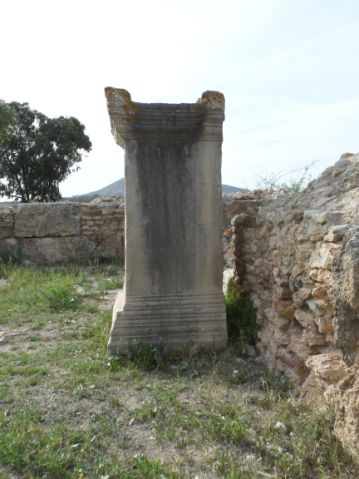
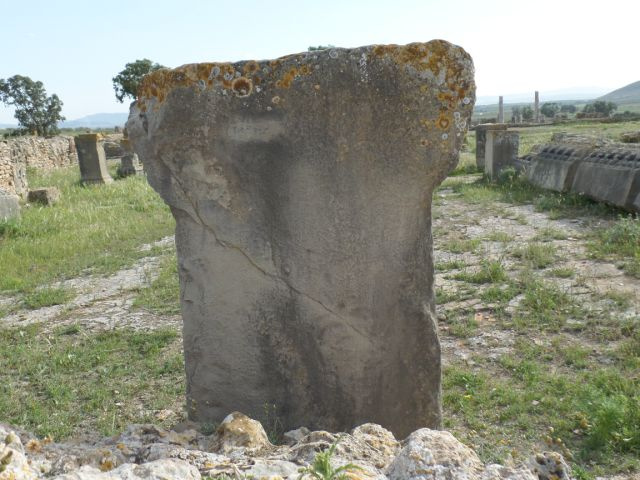
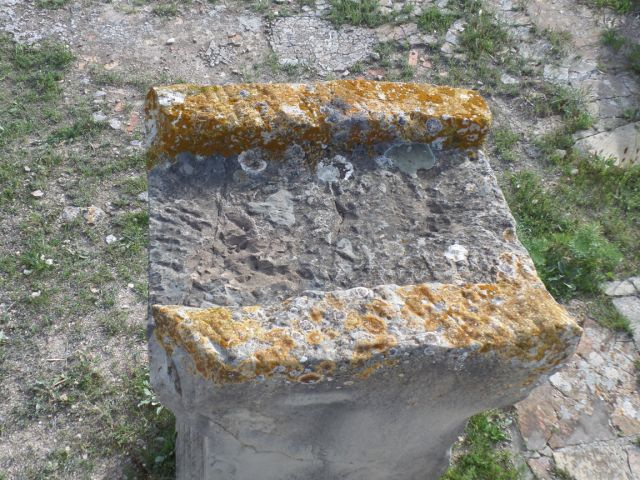
White limestone base moulded at top and bottom; H 165, W 82, D 75 cm. The epigraphic field is framed; the frame is broken off at the left side. The front face is chipped and some cracks are running over it; some portions of the inscription are illegible. Lines 5-6 were deliberately erased (see below, ‘Honorand, Awarder and Date’). The lower mouldings at the lateral faces are richer than at the front; this indicates that the front face was worked back for our inscription. At the top face, a broad depression is carved in between the front and back face; this was possibly to receive a statue plinth.
PROVENANCE AND CURRENT LOCATION
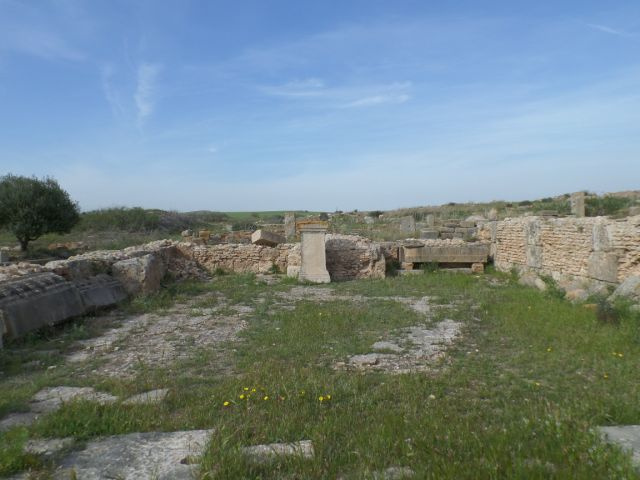
The inscription was first recorded in the Curia ('temple of Pax') at the northern side of the forum of Thuburbo Maius by AE in 1914. There it is still standing.
HONORAND, AWARDER AND DATE
Gabinius Salvianus, the honorand, was a local notable of Thuburbo Maius and a benefactor. He was a citizen of Thuburbo Maius ( amantissimo civi, line 10), and at the same time of the provincial capital Carthago. He held the moderate municipal office of edile (aedilicio, line 7) in Thuburbo Maius; however, he was a leading decurion (principalis) of the provincial capital of Carthago (lines 1 and 7). Double citizenships were often held by leading decurions of Carthago who had possessions and interests in the hinterland of the provincial capital (Lepelley 1981, 22-3). Salvianus is praised in the inscription for having rebuilt the winter baths from its foundations to its summit (lines 11-13) and bestowing further benefactions on the city (lines 13-19).
The inscription was set up by the city of Thuburbo Maius, styled res publica felix Thuburbo Maius (lines 9-10) in our inscription.
The inscription is dated to 395/408 by the common reign of Arcadius (Augustus 383-408) and his brother Honorius (Augustus 393-428) after their father Theodosius’ death (Augustus 379-395) (lines 2-3). A closer date was once given by the name of the governing proconsul; however, this name was later erased (lines 4-6).
Cite: Last Statues of Antiquity, LSA-2468 (Ulrich Gehn).