
LSA-2475
Base for statue of Navigius Egnatuleius Pompeius, local notable. Thubursicu Numidarum (Africa Proconsularis). Late third century
Record details
Photographs
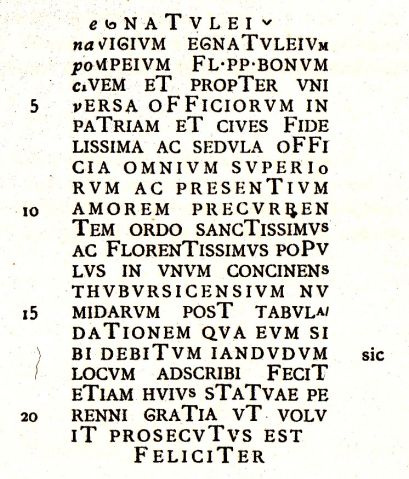
Inscription
[E]gnatulei. / [Na]vigium Egnatuleium / [Po]mpeium, fl(aminem) p(er)p(etuum), bonum / [ci]vem, et, propter uni-/[v]ersa officiorum in /(6) patriam et cives fide-/lissima ac sedula offi-/cia, omnium superio-/rum ac pr(a)esentium /(10) amorem pr(a)ecurren-/tem, ordo sanctissimus / ac florentissimus popu-/lus in unum concinens / Thubursicensium Nu/midarum, post tabula[e] /(16) dationem qua eum si-/bi debitum iandudum (sic) / locum adscribi fecit, / etiam huius statuae pe-/renni gratia ut volvit prosecutus est /(21) feliciter.
Inscription translation
[Statue of] Egnatuleius. Navigius Egnatuleius Pompeius, priest in perpetuity, good citizen, and excelling the love of all men past and present through his most faithful and painstaking carrying out of all of his good deeds towards his fatherland and the citizens. The most sacred council (ordo) and most flourishing people (populus) of the Thubursicenses Numidarum, all agreeing together, after the giving of the tablet on which they ordered that he be ascribed the place long owed to him, also successfully ensured, because of their eternal gratitude, that [this place indeed be that] of this statue.
Bibliography
- Gsell, S., Inscriptions latines de l’Algérie, vol. I, Paris 1922 (Rome 1965), 1296
- Lepelley, C., Les cités de l'Afrique romaine au Bas-Empire, t. 2, Notices d'histoire municipale, Paris 1981, 215
Discussion
INSCRIPTION
In 21 lines:
[E]gnatulei. / [Na]vigium Egnatuleium / [Po]mpeium, fl(aminem) p(er)p(etuum), bonum / [ci]vem, et, propter uni-/[v]ersa officiorum in /(6) patriam et cives fide-/lissima ac sedula offi-/cia, omnium superio-/rum ac pr(a)esentium /(10) amorem pr(a)ecurren-/tem, ordo sanctissimus / ac florentissimus popu-/lus in unum concinens / Thubursicensium Nu/midarum, post tabula[e] /(16) dationem qua eum si-/bi debitum iandudum (sic) / locum adscribi fecit, / etiam huius statuae pe-/renni gratia ut volvit prosecutus est /(21) feliciter.
'[Statue of] Egnatuleius. Navigius Egnatuleius Pompeius, priest in perpetuity, good citizen, and excelling the love of all men past and present through his most faithful and painstaking carrying out of all of his good deeds towards his fatherland and the citizens. The most sacred council (ordo) and most flourishing people (populus) of the Thubursicenses Numidarum, all agreeing together, after the giving of the tablet on which they ordered that he be ascribed the rank long owed to him (that is,a tabula patronatus, a tablet recording his patronage over the city) also successfully ensured, with eternal gratitude, (the giving of) his statue, as it had considered.'
Letter height 4 cm.
DESCRIPTION (from Gsell 1965)
Statue base, chipped on upper left corner; H 128, W 44 cm. There is no published image.
PROVENANCE AND CURRENT LOCATION
The inscription was found during excavations in the Roman baths north-west of the forum novum fo Thubursicu Numidarum (Gsell 1965). There is no more recent record of its location.
HONORAND, AWARDER AND DATE
Navigius Egnatuleius Pompeius, the honorand, was a local man (lines 3-4); he had rund the entire cursus of municipal offices (lines 4-7) and held the priestly office of flamen perpetuus (line 3; see also LSA-2351, 'Honorand, Awarder and Date'); he had recently become patron of his hometown (lines 15-18).
Lepelley 1981 points out that the form of the name, the absence of praenomen, tribus and filiation, and the presence of a signum, indicate a date in the late 3rd century.
The inscription was set up by the council (ordo) and the people (populus) of Thubursicu Numidarum.
Cite: Last Statues of Antiquity, LSA-2475 (Ulrich Gehn).