
LSA-2477
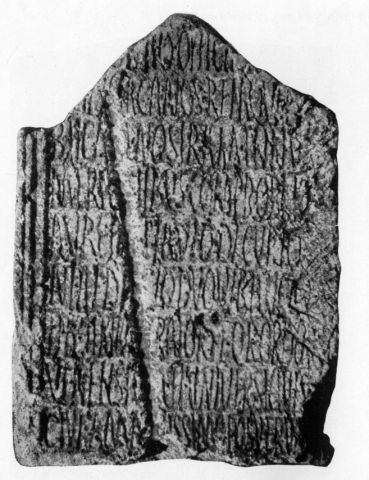
Base for statue of Aurelius Flavius, local notable and curator of the city. Vina (Africa Proconsularis). Later third century
Record details
Photographs
Inscription
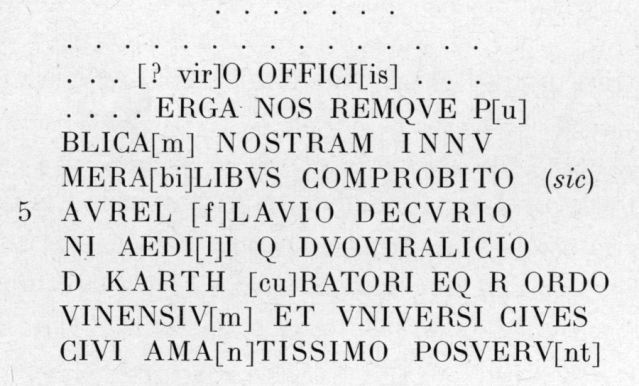
[---vir]o offici[is ---] / [---] erga nos remque p[u]-/blica[m] nostram innu-/mera[bi]libus comprobito (sic, for comprobato) /(5) Aurel(io) [F]lavio decurio-/ni aedi[l]i q(uaestori) duoviralicio / d(ecurioni) Karth(aginis) [cu]ratori eq(uiti) R(omano) ordo / Vinensiu[m] et universi cives / civi ama[n]tissimo posueru[nt].
Inscription translation
(...) to a man approved by innumerable services towards us and our community (res publica), to Aurelius Flavius, decurion, aedile, quaestor, of the rank of duovir (duoviralicio), decurion of Carthage, curator, member of the equestrian order, the council (ordo) of the Vinenses and all the citizens set [this] up for a most loving citizen.
Bibliography
- L'Année épigraphique, , 1961, 200
- Lepelley, C., Les cités de l'Afrique romaine au Bas-Empire, t. 2, Notices d'histoire municipale, Paris 1981, 236-7
Discussion
INSCRIPTION
In nine lines:
[---vir]o offici[is ---] / [---] erga nos remque p[u]-/blica[m] nostram innu-/mera[bi]libus comprobito (sic, for comprobato) /(5) Aurel(io) [F]lavio decurio-/ni aedi[l]i q(uaestori) duoviralicio / d(ecurioni) Karth(aginis) [cu]ratori eq(uiti) R(omano) ordo / Vinensiu[m] et universi cives / civi ama[n]tissimo posueru[nt].
'(...) to a man approved by innumerable services towards us and our community (res publica), to Aurelius Flavius, decurion, aedile, quaestor, of the rank of duovir (duoviralicio), decurion of Carthage, curator, member of the equestrian order, the council (ordo) of the Vinenses and all the citizens set [this] up for a most loving citizen.'
Letter height not recorded.
We reproduce the inscription with the completions proposed by its first editor (Veyne 1958).
DESCRIPTION (from Veyne 1958 and the published image)
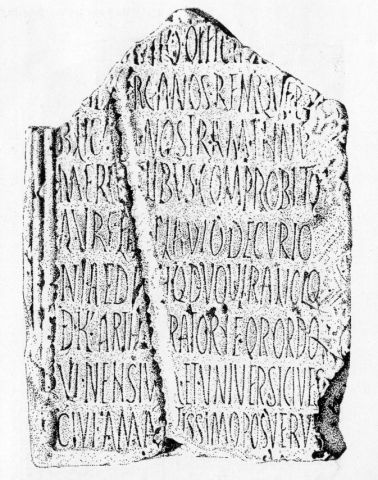
Limestone block, later reused as architectural element. No measurements are published. The block is broken at top; a channel running almost vertically through the epigraphic field makes one or two letters in each line illegible. The epigraphic field is framed; the frame is damaged at the bottom and cut back at the right side.
PROVENANCE AND CURRENT LOCATION
The inscription was first recorded in a private property in Bou Arkoub, on the site of ancient Vina, in 1958 (http://www.trismegistos.org/place/17155). There is no recent record of its location.
HONORAND, AWARDER AND DATE
Aurelius Flavius, the honorand, was a local notable. His cursus honorum of municipal offices in his hometown is recorded in ascending order. After it his non-municipal honours are recorded, likewise in ascending order: he was adopted into the ordo of Carthago (decurioni Karthaginis, line 7); he became curator rei publicae at Vina (line 7; see also second to next paragraph); and he was a Roman knight (equiti Romano, line 7).
The inscription was set up by the council (ordo) and all citizens (universi cives) of Vina (lines 7-9).
Lepelley suggested that the form in which the honorand’s name is recorded (without praenomen, filiation and tribus) suggested a date in the late 3rd century for our inscription. Veyne 1958, 114 pointed out that the curatorship held by Aurelius Flavius in his native city indicated a time late in the 3rd century; these office holders were usually foreigners in earlier periods, but were taken from local aristocracies in the 4th century (on the office see LSA-2406, ‘Further Discussion’). A date in the 4th century, on the other hand, is improbable since the last curators in Africa holding the rank of eques Romanus are known from the late 3rd century; the title, moreover, was abandoned in the 4th century (Veyne 1958, 114).
Discussion references
- Veyne, P., Deux inscriptions de Vina, Karthago IX, 1958, 89-117, 110-17 no. II
Cite: Last Statues of Antiquity, LSA-2477 (Ulrich Gehn).