
LSA-248
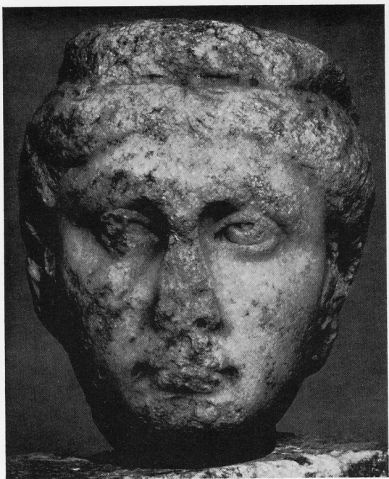
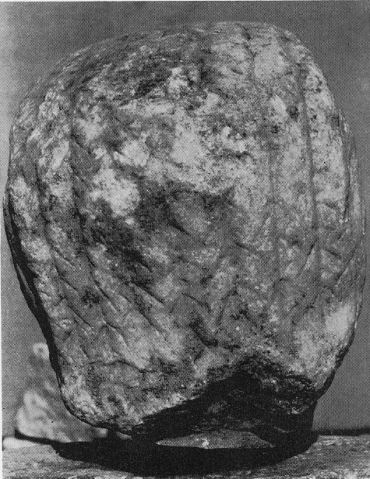
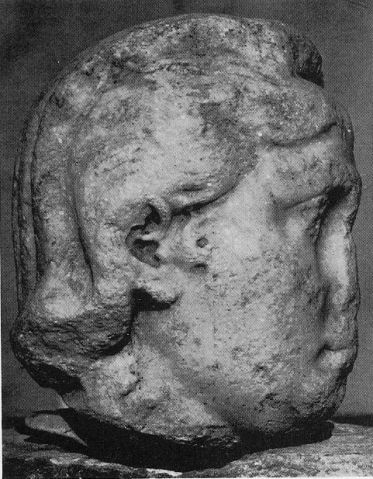
Portrait head of woman with central braid. Side (Pamphylia). Late third century.
Record details
Photographs
Bibliography
- Inan, J., Antalya bölgesi Roma devri portreleri. Römische Porträts aus dem Gebiet von Antalya , Ankara 1965, 80-81, no. 26, pl. 27 (last quarter of third century)
- Inan, J. and E. Rosenbaum, Roman and Early Byzantine Portrait Sculpture in Asia Minor, Oxford 1966, 197, no. 271, pl. 148
Discussion
DESCRIPTION (Object)
Life-size head. H: 23, W: 17 cm. Coarse-grained white marble.
The head is broken through the top of the neck, and the bottom edge of the hair at the back of the head is broken. The nose is mainly missing. The eyebrows, right eye, lips, chin, and rims of the ears are badly chipped. The front of the hair and cheeks are worn and abraded. There is a dowel hole at the back of the neck, possibly to attach the figure to a wall.
The locks of the braids are rendered with a flat chisel. Drill holes appear in the curls in front of the ears. The pupil of the right eye consists of two distinctly separate drill holes. The lips were also set apart by a drill channel which rises at the corners.
PROVENANCE
The head was brought to the museum by villagers.
DESCRIPTION (Subject)
The head shows a mature woman with a hairstyle of the late third century. The full cheeks and the sagging skin below the jaw-line seem to convey a mature age. The brow is low, and the eyes appear small and close-set in the broad face.
The hair is parted in the centre and brushed backwards around the ears. It is then collected in 8 braids and pulled up to the brow where the braids fold under themselves. In front of each ear a loose lock curls into itself.
DATE
The hairstyle is shown on coins of Ulpia Severina (270-275). It probably existed both before and after that date, and there are numerous extant portraits which show variations of this hairstyle.
This head has four details which define it within the larger group of these late third century female portraits: 1) the broad central braid which reaches almost to the brow; 2) the simple hair around a low brow; 3) the loose curls with drilled centres near the ear; and 4) and the broad facial structure. The simple linear rendering of the hair around the brow allows it to be associated with heads, which have slightly different hairstyles ; for example, in Berlin (LSA-1588) and in the Villa Doria Pamphili (LSA-1298). The drilling in the locks in front of the ears recall a tendency which is more developed in heads in Munich (LSA-1552) and Boston (LSA-1592). All of the comparanda cited belong to the Tetrarchic period.
In addition, the pupils of the eyes are marked by two separate drill points. This occurs at Side also in a portrait of a Tetrarch (LSA-244) . Thus, the head seems best placed near end of the third century.
Discussion references
- Bergmann, M., Studien zum römischen Porträt des 3. Jahrhunderts n. Chr., Bonn 1977, 194, fn. 789 (compares to Berlin head)
Cite: Last Statues of Antiquity, LSA-248 (J. Lenaghan).