
LSA-2481
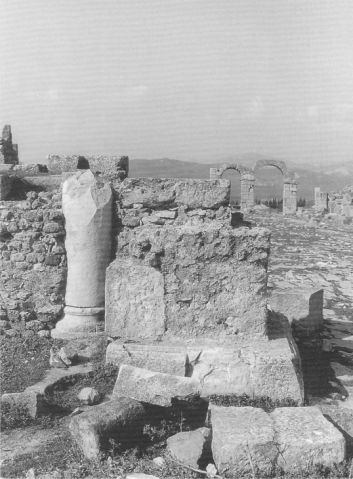
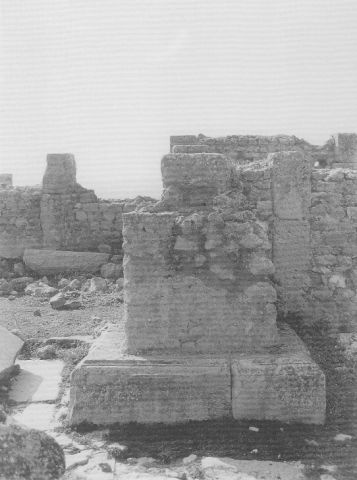
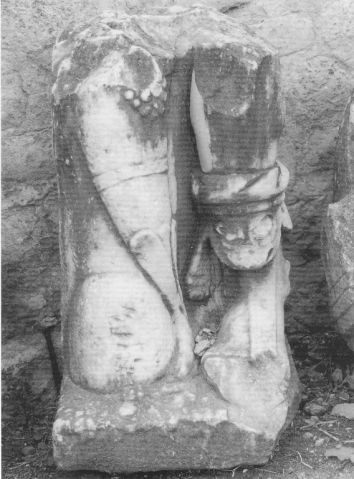
Base for re-erected colossal statue, probably of Antoninus Pius or Marcus Aurelius. Thubursicu Numidarum (Africa Proconsularis). 361-362
Record details
Photographs
Inscription
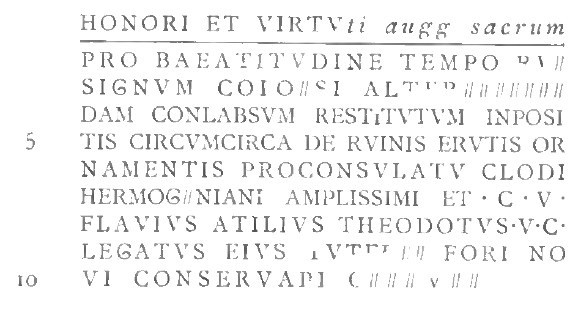
Honori et virtu[ti Augg(ustorum) sacrum].
Pro baeatitudine (sic) tempo[r]u[m], / signum co[l]o[s]si alte[rius, quon]/dam conlabsum, restitutum, inposi/tis circumcirca de ruinis erutis or/namentis, proconsulatu Clodi / (7) Hermog[e]niani, amplissimi et c(larissimi) v(iri), / Flavius Atilius Theodotus, v(ir) c(larissimus), / legatus eius, [t]ute[lae] fori no/vi conserva[r]i c[ura]v[it].
Inscription translation
Sacred to the honour and virtue of the two Augusti.
For the blessedness of the times, the statue of one of the two colossi, once fallen, [has been] restored, with ornaments, removed from some ruins, placed nearby; under the governorship of Clodius Hermogenianus, a most important man of clarissimus rank; Flavius Atilius Theodotus, of clarissimus rank, his legate, took care of the safeguarding of the new forum.
Bibliography
- Gsell, S., Inscriptions latines de l’Algérie, vol. I, Paris 1922 (Rome 1965), no. 1229
- Lepelley, C., Les cités de l'Afrique romaine au Bas-Empire, t. 2, Notices d'histoire municipale, Paris 1981, p. 213, n. 12
Discussion
INSCRIPTION
In ten lines:
Honori et virtu[ti Augg(ustorum) sacrum].
Pro baeatitudine (sic) tempo[r]u[m], / signum co[l]o[s]si alte[rius, quon]/dam conlabsum, restitutum, inposi/tis circumcirca de ruinis erutis or/namentis, proconsulatu Clodi / (7) Hermog[e]niani, amplissimi et c(larissimi) v(iri), / Flavius Atilius Theodotus, v(ir) c(larissimus), / legatus eius, [t]ute[lae] fori no/vi conserva[r]i c[ura]v[it].
'Sacred to the honour and virtue of the two Augusti.
For the blessedness of the times, the statue of one of the two colossi, once fallen, [has been] restored, with ornaments, removed from some ruins, placed nearby; under the governorship of Clodius Hermogenianus, a most important man of clarissimus rank; Flavius Atilius Theodotus, of clarissimus rank, his legate, took care of the safeguarding of the new forum.'
DESCRIPTION (from Gsell)
Great base made of several blocks with plinth and crown ('grande base formée de plusieurs pierres avec couronnement'). The inscription is craved on a plaque framed with two pilasters ('le texte est gravé sur une plaque flanquée de pilastres').
Base : H. 190, W. 155, depth unrecorded
Plaque : H. 104, W. 114, depth unrecorded
PROVENANCE AND CURRENT LOCATION
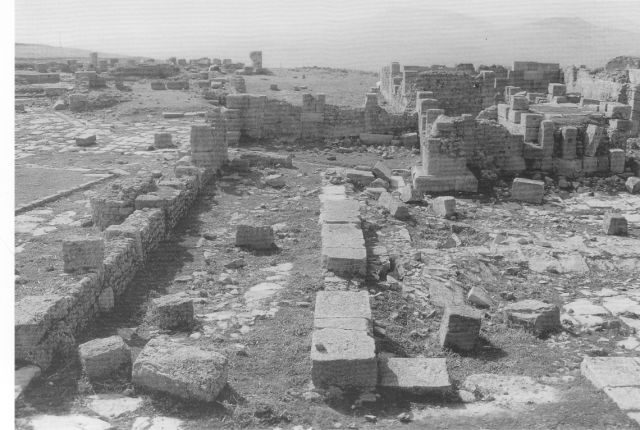
The base was found on West side of the forum novum. The inscription refers to it being removed here 'from [some] ruins (de ruinis erutis)'. This probably refers to the old forum which was abandoned in the period between Constantine and Julian, possibly because it had been destroyed by a natural disaster, such as an earthquake (Lepelley, 1981, 214).
It still remains in situ.
HONORAND, AWARDER AND DATE
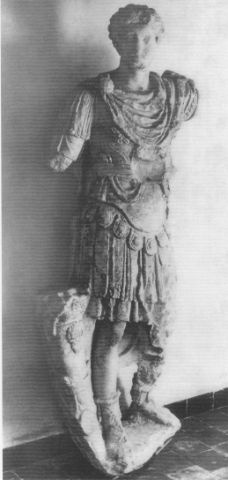
Gsell compared our inscription with another found at Thugga related to two colossus of Marcus Aurelius and Lucius Verus. He thus thought our base was bearing a colossal statue of one of these two emperors. Sassy published in 1954 an imperial colossal statue and a foot of another imperial colossal statue found very close to our base and identified the first as Lucius Verus Caesar. That discovery seemed to confirm Gsell's hypothesis, but recently Fittschen corrected the identification of the statue and assigned it to Marcus Aurelius Caesar. As the foot discovered belongs to a statue bigger than the one of Marcus Aurelius, it seems impossible that it represented Lucius Verus Caesar. It is much probable that a bigger statue would have represented an Augustus. Then, if we consider that the two statues formed a group, it should have been Antoninus Pius.
Therefore, our base was probably bearing a colossal statue of Marcus Aurelius Caesar or Antoninus Pius.
This inscription can be securely dated to 361/2 because it was set up by the legate Flavius Atilius Theodotus (PLRE I, 905-6, Theodotus 3), under the proconsulship of Clodius Hermogenianus (PLRE I, 640-2, Olybrius 3), who is attested as governor of Africa in 361, but with all probability was still in office in the first half of the year 362 (Chastagnol 1958).
FURTHER DISCUSSION
The evidence of this and other statue-bases found on and near the new forum, suggests that those statues still thought to be important in 361/2 were moved from the old to the new forum, leaving others behind (see the 'Further Discussion' under LSA-1176).
Theodotus and Hermogenianus are also recorded in LSA-1182, LSA-2470, LSA-2473 and LSA-2482. Theodotus , moreover, was honoured with a statue in Thubursicu Numidarum 'because of the foundation of the new forum' by the grateful citizens (LSA-2474).
Discussion references
- Fittschen, K., Prinzenbildnisse Antoninischer Zeit, Mainz, 1999, p. 25, B 29, taf. 52, a
- Kleinwächter, C., Platzanlagen nordafrikanischer Städte : Untersuchungen zum sogenannten Polyzentrismus in der Urbanistik der römischen Kaiserzeit, Mainz, 2001, p. 326, no. 44 ; p. 328-9, no. F 11-12, taf. 120, 2-3
- Sassy, G., Note sur une statue colossale de Thubursicu Numidarum, Libyca, Alger, 1954, p. 107-12
Cite: Last Statues of Antiquity, LSA-2481 (Gabriel de Bruyn).