
LSA-2483
Base for statue of Hercules Invictus. Thubursicu Numidarum (Africa Proconsularis). 287-305
Record details
Photographs
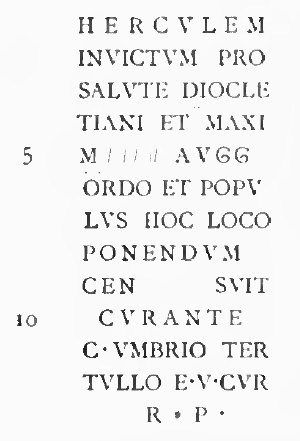
Inscription
Herculem / Invictum, pro / salute [[Diocle/tiani et Maxi/m[iani]]], Augg(ustorum), / (6) ordo et popu/lus hoc loco / ponendum / censuit, / (10) curante / C(aio) Umbrio Ter/tullo, e(gregio) v(iro), cur(atore) / r(ei) p(ublicae).
Inscription translation
For the welfare of Diocletianus and Maximianus, both Augusti; the council and the people decided to set up Hercules Invictus in this place, with Caius Umbrius Tertullus, of egregius rank, curator of the community, taking charge.
Bibliography
- Gsell, S., Inscriptions latines de l’Algérie, vol. I, Paris 1922 (Rome 1965), no. 1228
- Lepelley, C., Les cités de l'Afrique romaine au Bas-Empire, t. 2, Notices d'histoire municipale, Paris 1981, p. 215, no. 3
Discussion
INSCRIPTION
In 13 lines:
Herculem / Invictum, pro / salute [[Diocle/tiani et Maxi/m[iani]]], Augg(ustorum), / (6) ordo et popu/lus hoc loco / ponendum / censuit, / (10) curante / C(aio) Umbrio Ter/tullo, e(gregio) v(iro), cur(atore) / r(ei) p(ublicae).
'For the welfare of Diocletianus and Maximianus, both Augusti; the council and the people decided to set up Hercules Invictus in this place, with Caius Umbrius Tertullus, of egregius rank, curator of the community, taking charge.'
Letter height : 5.5 cm
The imperial names (l. 3-5) have been erased, probably by Christians.
DESCRIPTION (from Gsell)
Rectangular base : H. 111, width and depth unrecorded.
PROVENANCE AND CURRENT LOCATION
Found in the forum novum.
There is no record of its present location.
HONORAND, AWARDER AND DATE
Our base is dedicated to Hercule Invictus for the welfare of Diocletian and Maximian, who were both Augusti from 286 to 305. About 287, Diocletian assumed the title Iovius and Maximian Herculius. The hierarchy between the two gods was supposed to reflect the relationship between the two emperors.
The awarder was the city, as usual with imperial statues in Africa.
Caius Umbrius Tertullus, curator of Thubursicu Numidarum, is known only by our inscription and LSA-2484.
FURTHER DISCUSSION
This base and another dedicated to Jupiter Optimus Maximus (LSA-2484) have the same formula and awarder. They must have been set up as a pair. The two bases attest of the good diffusion and representation of imperial ideology and theocracy in an average provincial city.
Our base was re-used later for a re-erected statue of Trajan (LSA-2482).
Cite: Last Statues of Antiquity, LSA-2483 (Gabriel de Bruyn).