
LSA-249
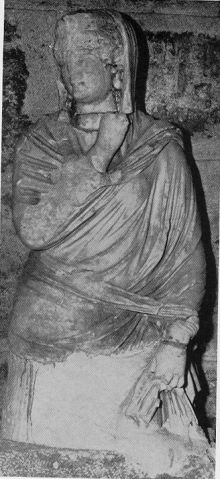
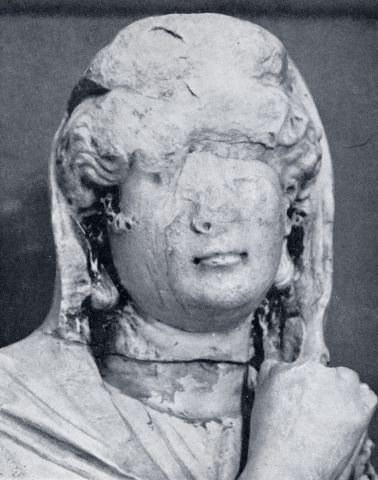
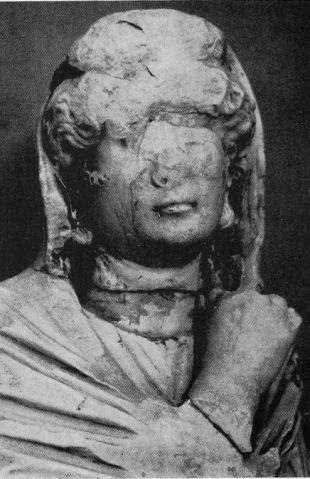
Upper half of portrait statue of woman with central braid hairstyle. Side (Pamphylia). Late third century.
Record details
Photographs
Bibliography
- Inan, J., Antalya bölgesi Roma devri portreleri. Römische Porträts aus dem Gebiet von Antalya , Ankara 1965, 81-2, no. 27, pls. 13 and 28
- Inan, J. and E. Rosenbaum, Roman and Early Byzantine Portrait Sculpture in Asia Minor, Oxford 1966, 197-8, no. 272, pl. 149
Discussion
DESCRIPTION (Object)
Upper body of over life-size statue. H: 125.5, W: 53, H (of head): 31, W (of head) 22 cm. Fine-grained white marble.
The extant portion of the statue extends between the right hip, the lowered left hand, and the head. It has been recomposed of numerous small fragments. The head has been reattached as has a portion of the lower face which includes the chin, mouth, nose area. The eyes, nose, and brow are missing.
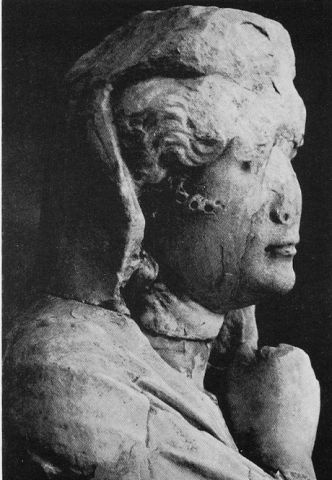
A broad flat chisel has been used to define the hair of the head. The lock in front of the ear, however, is punctuated by drill holes.
PROVENANCE
The head was excavated at the Nymphaeum.
DESCRIPTION (Subject)
The portrait statue shows a full-faced woman with a hairstyle of the late third century. She wears traditional female clothing, an inner chiton and an outer himation.
The himation is pulled modestly over her head. The right arm reaches up to hold the edge of the himation near the neck; the left arm holds the bottom hem of the himation against the thigh. Both arms are tightly wrapped within the garment. The weight of the figure rests over the right leg. The pose and dress follow a type that is based on the popular “Ceres” motif. It can be found on two other fully preserved statues from Asia Minor, both of which date to the late second century.
The full-face probably represents a mature age. The hair is worn in a crown-braid. It is thick, broad, and reaches the front of the brow. The hair is pulled off the face in thick wavy locks which touch the ears. Two thin locks with fine artificial curls extend onto the cheeks in front of the ears.
DATE
The crown braid hairstyle became popular in the second half of the third century and continued in use in the fourth century. There are numerous variations upon it.
The hairstyle of this head has three defining characteristics. 1) the central braid is broad and thick and reaches the brow; 2) the hair around the brow is thick and moves around and partially over the ears in large waves; 3) a lock in front of the ears comes forward in a stylized curl.
In most aspects the head resembles the group of portraits dated by M. Bergmann (Studien zum römischen Porträt des 3. Jahrhunderts n. Chr., Bonn 1977, pp. 95-101, pls. 29-30) to the late Gallienic period. The dating of this group, however, is not fixed, and Bergmann makes no reference to this statue. Moreover, this statue is damaged in precisely the most-telling places, the end of the crown braid and the eyes. Thus, it is prudent to adhere to the broader and slightly later date set by J. Inan who sees stylistic similarities between this portrait and LSA-248.
Cite: Last Statues of Antiquity, LSA-249 (J. Lenaghan).