
LSA-2493
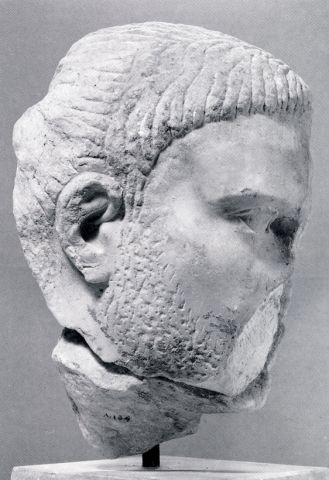
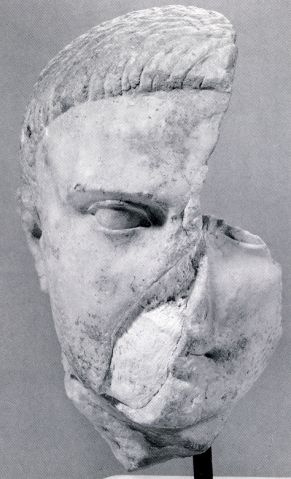
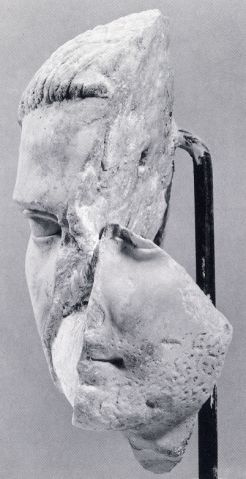
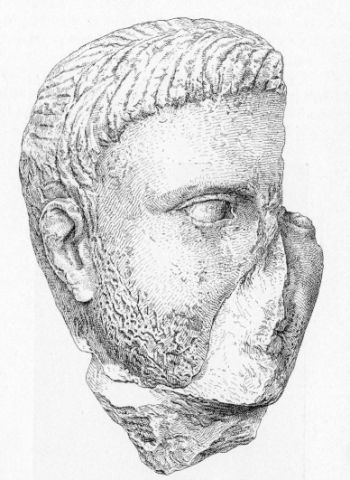
Two fragments of portrait head of man with stubble beard. From Olympia. Later third to earlier fourth century.
Record details
Photographs
Bibliography
- Goette, H.R. and K. Hitzl, 'Zwei umgearbeitete Porträtköpfe in Olympia', Mitteilungen des deutschen archäologischen Instituts. Athenische Abteilung 102, Berlin 1987, 283-8, no.1, pls. 23-5 (first century portrait re-carved after AD 267)
Discussion
DESCRIPTION (Object)
The head is split at the centre, the two fragments fit together; pentelic marble, H 30, W 18 cm. Fragment (a) contains the right half of the head with hair, brow, ear, eye, cheek and jawbone; H 24, D 20 cm. Fragment (b) is the lower portion of the head’s left half containing chin, corner of the mouth, cheek, ala of the nose, lower eyelid, and a portion of the neck (no published measurements). The upper portion of the head’s left half is broken off. The nose is broken; a large cleft between the right cheek and the left lower portion of the face is today filled with plaster.
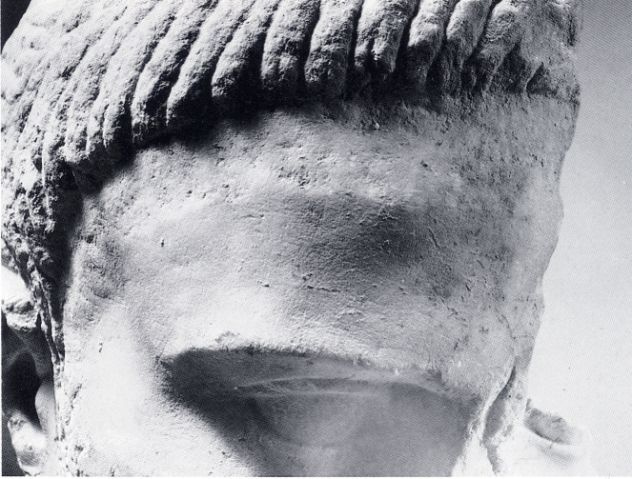
The hair is a flat cap, strands are singled out by long parallel strokes with a point chisel; they run into different directions at the forehead and at the back. The beard is picked with a point directly into the flesh, in irregular strokes.
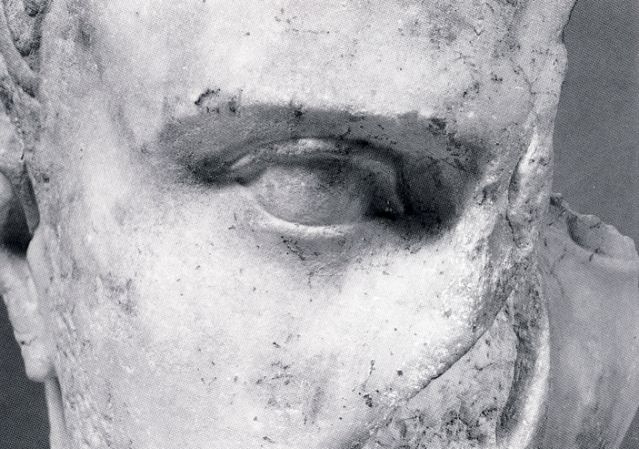
The eyes are not accentuated, the eyebrow is flat and burred.
The head has been re-carved from an earlier portrait as is clearly indicated by the hairline above the brow where the earlier hair has been cut back; marks of a point behind the right ear indicate that here also earlier hair has been worked back. The picked beard likewise belongs to the re-work, whereas the rest of the face and particularly the eyes appear to have been left untouched.
There are traces of sinter below the right cheek
PROVENANCE AND LOCATION
Fragment (a) was found in 1876 at the northern side of the temple of Zeus, at the drums of the sixth column from the east. Fragment (b) was found 1879 at the northern side of the temple. The head is today in the Olympia Museum, inv. no. Λ 134.
DESCRIPTION (Subject)
Male with short lank hair, brushed forward and forming a flat arch high above the brow. The short hair and stubble beard betoken him as a 'man on campaign’, probably an imperial office holder.
HONORAND AND DATE
The rendering of the eyes with the burred eyebrow and lids, and without accentuation of iris and pupil date the original head into the early imperial period (Goette & Hitzl 1987, 284-5: 1st quarter of 1st century).
The re-work of the head was dated into the 3rd quarter of the 3rd century by Goette & Hitzl 1987, 286-8, arguing that after the Herulian raid there were no statue dedications any more in Olympia. Treu 1897 dated the head to the 3rd century. The unusual technique by which the hair is rendered closely resembles a head in Athens which possibly likewise dates to the earlier 3rd century, before the Herulian raid of 267 (LSA-2295).
There is, however, the inscription to Polycharmus, governor (proconsul) of Achaea, set up by the Phigalians and datable to the 4th century. Heads that are typologically comparable to ours are known from 4th century Athens (LSA-128, LSA-129) and Corinth (LSA-66, LSA-73, LSA-2343).
Hairstyle and beard together with 'classicising’ features would fit well into the late tetrarchic or constantinian period; we therefore do not exclude a later, post-Herulian date for our head.
Both, hairstyle and stubble beard indicate that this is an imperial official rather than an athlete or ephebe.
Discussion references
- Treu, G., Die Bildwerke von Olympia in Stein und Ton (Olympia. Die Ergebnisse der von dem deutschen Reich veranstalteten Ausgrabungen III), Berlin 1897, p. 249 fig. 283 d
Cite: Last Statues of Antiquity, LSA-2493 (Ulrich Gehn).