
LSA-2494
Epigram testifying to honorific images, possibly statues, of the father (Memnonius) and brother of Agathias. Myrina (Asia). Mid to late sixth century.
Record details
Photographs
Textual evidence
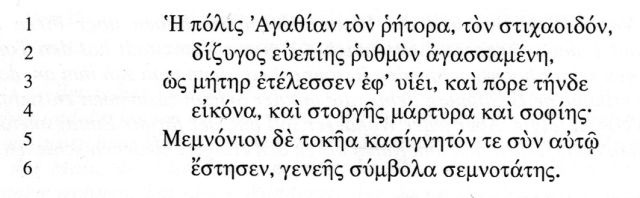
ἡ πόλις Ἀγαθίαν τὸν ῥήτορα, τὸν στιχαοιδόν,
δίζυγος εὐεπίης ῥυθμὸν ἀγασσαμένη,
ὡς μήτηρ ἐτέλεσσεν ἐφ’ υἱέι, καὶ πόρε τήνδε
εἰκόνα, καὶ στοργῆς μάρτυρα καὶ σοφίης·
Μεμνόνιον δὲ τοκῆα κασίγνηστόν τε σὺν αὐτὧ
ἔστησεν, γενεῆς σύμβολα σεμνοτάτης.
Translation
The city [set this up to] Agathias, the orator, the poet, admiring the rhythm of his twofold eloquence. Like a mother she finished it for her son, and set up this image, a witness to his love [towards her] and to his skill. Memnonius the father, and his brother did she set up along with him, warrants of a most noble family.
Bibliography
- Aubreton, R. & F. Buffière, Anthologie Grecque XIII : Anthologie de Planude, Paris 1980, 198 no. 316
- Merkelbach, R. and J. Stauber (eds.), Steinepigramme aus dem griechischen Osten. Bd. 1. Die Westküste Kleinasiens von Knidos bis Ilion , Stuttgart 1998, 566 no.5/4/1
Discussion
SOURCE (Anthologia Palatina 16 (= Planudean Anthology) no. 316)
Verse epigram in three distichs:
ἡ πόλις Ἀγαθίαν τὸν ῥήτορα, τὸν στιχαοιδόν,
δίζυγος εὐεπίης ῥυθμὸν ἀγασσαμένη,
ὡς μήτηρ ἐτέλεσσεν ἐφ’ υἱέι, καὶ πόρε τήνδε
εἰκόνα, καὶ στοργῆς μάρτυρα καὶ σοφίης·
Μεμνόνιον δὲ τοκῆα κασίγνηστόν τε σὺν αὐτὧ
ἔστησεν, γενεῆς σύμβολα σεμνοτάτης.
'The city [set this up to] Agathias, the orator, the poet, admiring the rhythm of his twofold eloquence. Like a mother she finished it for her son, and set up this image, a witness to his love [towards her] and to his skill. Memnonius the father, and his brother did she set up along with him, warrants of a most noble family.'
The epigram is recorded in the Planudean Anthology, hence Merkelbach 1998.
This epigram records two addition images alongside one to Agathias, orator and poet (LSA-663): to his father, Memnonius, and to an unnamed brother. These presumably had their own epigrams, that are not recorded.
LOCATION
All these images were set up in Agathias' home town, since the city which honoured him is described as his mother (μήτηρ, line 3). If the principal honorand was Agathias the 6th-century poet and historian, which seems highly likely, then they were set up in Myrina, known to be Agathias' home town (http://www.trismegistos.org/place/16536).
HONORAND, AWARDER AND DATE
Agathias, the principal subject of this epigram, was very probably the poet and historian Agathias, who died around 582 (see LSA-663, 'Honorand, Awarder and Date'). Nothing further is known of his father, Memnonius, or of his unnamed brother.
FURTHER DISCUSSION
Whether these were statues or two-dimensional images (in mosaic or paint) is not clear; εἰκόνα (line 4) can refer to either. If the principal honorand of the epigram was the historian Agathias, and the images therefore of the later 6th century, two-dimensional representations are perhaps more likely (Mango 1986), though the wording of the epigram would be entirely appropriate for statues.
Cite: Last Statues of Antiquity, LSA-2494 (Ulrich Gehn).