
LSA-2499
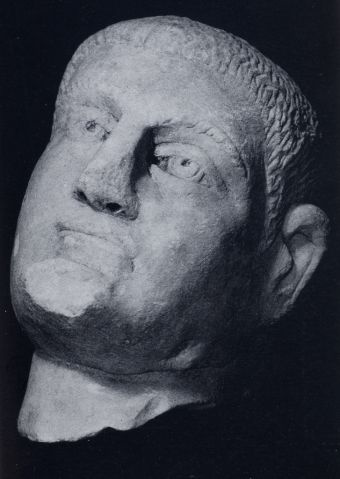
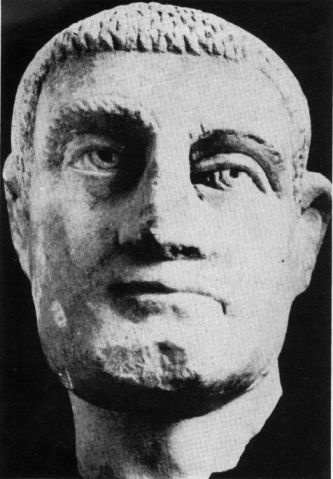
Portrait head of clean-shaven young man. Region of Constantia (Tomis) (Scythia). Early to mid fourth century.
Record details
Photographs
Bibliography
- Bordenache, G. et al., Römer in Rumänien : Ausstellung des Römisch-Germanischen Museums Kölns und des Historischen Museums Cluj : Kunsthalle Köln, 12. Februar bis 18. Mai 1969., Cologne 1969, 249, no. G 105, pl. 73 (second half of third century)
- Covacef, Z. 'Porträts aus dem 3. Jahrhundert u. Z. in Scythia Minor', Wissenschaftliche Zeitschrift der Humboldt-Universität zu Berlin. Reihe Gesellschaftswissenschaften, 31, Berlin 1982, 173-4, no. 1, fig. 26 (second quarter of third century)
Discussion
DESCRIPTION (Object)
Marble portrait head broken at neck, H 21.5, W 16.2, D 18.4 cm. The chin is broken, the tip of the nose chipped, and there are minor chips on the right cheek, the left jawbone, and at the breakline of the neck. At the back of the neck there is a support ('Nackenbosse').
The head is slightly turned to the left. The two sides of the face are disproportional, the left cheek broader, the left eye and ear sitting lower than the right, the lips extending further to the left; the left ear is sticking out.
The hair is set against the flesh by a clear cut line at the temples. Above the brow short strands are fringing out; they are slightly bent towards the left. The strands on the skull are singled out by short angular chisel strokes.
The eyebrows are thin bulges marked by short strokes. The eyeballs are marked by two concentric incised lines, the pupil is a small round drill hole set against the upper lid. The upper lids cover about one third of the eyeballs.
The large areas of the face (brow and cheeks) are smooth.
PROVENANCE AND MOST RECENTLY RECORDED LOCATION
The head was found in 1966 in the village of Valul lui Traian in the district of Constanţa; that is the region of ancient Constantia/Tomis. It was recorded in the Constanţa Museum, inv. no. 2444 by Covacef 1982.
DESCRIPTION (Subject)
The portrayed is a youthful man, without wrinkles and clean shaven; his thick hair is short. He has full cheeks, a large nose and a marked chin; his lips are tightly closed.
HONORAND AND DATE
The head was dated to the 2nd half of the 3rd century by Bordenache 1969 who suggested that this was an imperial portrait. Covacef 1982 saw individual traits of Philipp the Arab (Augustus 244-9) and associated the portrait with a sojourn of this emperor at Tomis in 245-6.
The portraits of Philipp show a man with a heavily furrowed brow, deep naso-labial folds, and a cultivated beard; likewise all emperors of the later 3rd century were bearded. The hairstyle as well as the technique by wich the strands of hair are singled out indicate a date in the late-tetrarchic or Constantinian period rather than in the mid 3rd century for our portrait. The smooth appearance of the facial features distinguish this head from the disrupted physiognomies usually associated with the portraiture of the first tetrarchy in the late 3rd century.
If this is an imperial portrait, an emperor of the later tetrarchy, or a prince of the Constantinian dynasty would be the most plausible solutions.
Discussion references
- Zevi Gallina, A. (ed.), Civiltà romana in Romania : Roma, Palazzo delle Esposizioni, Via Nazionale, febbraio-aprile 1970, Rome 1970, 243, no. G 84 (era immediately before Tetrarchy)
Cite: Last Statues of Antiquity, LSA-2499 (Ulrich Gehn).