
LSA-250
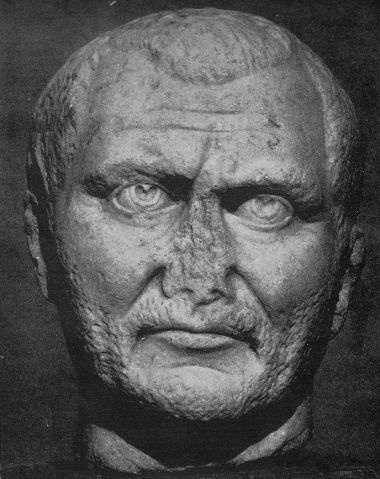
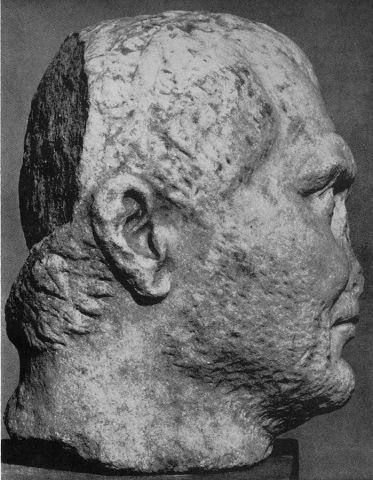
Portrait head of man with stubble beard, short-cropped hair, and ivy crown in low relief. Side (Pamphylia). Late third century.
Record details
Photographs
Bibliography
- Inan, J., Antalya bölgesi Roma devri portreleri. Römische Porträts aus dem Gebiet von Antalya , Ankara 1965, 89-90, no. 32, pls. 35-6
- Inan, J. and E. Rosenbaum, Roman and Early Byzantine Portrait Sculpture in Asia Minor, Oxford 1966, 198-9, no. 274, pl. 151
Discussion
DESCRIPTION (Object)
Life-size head. H: 26.5, W: 23 cm. Medium-grained white marble.
The head is broken (?) through the middle of the neck. The upper part of the back of the head is missing. The nose has broken off.
The pupils of the eyes are drilled out in a U-shape. The semi-circular irises are engraved. The hair has been rendered with short chisel strokes. The crown is rendered in low relief.
The head has probably been re-cut from an earlier head. The short hair and sloping brow, the lower part of which protrudes forcefully, suggest this. The unusually low relief of the crown (added at a second moment?) and the size would corroborate such an hypothesis.
PROVENANCE
The head was excavated in the street leading to Byzantine Bath.
DESCRIPTION (Subject)
The portrait statue shows a square-faced elderly man who wears an ivy crown. He has short hair, which recedes at the corners of the brow, and a stubble beard and moustache. His face is marked by creases across the brow, deep naso-labial folds, and a small protruding chin. His eyes are large and deep-set with emphatically marked pupils.
DATE AND HONORAND
The portrait follows Tetrarchic models in fashion style, physiognomic traits, and in technique. The crown may even indicate that a Tetrarch himself was intended.
Discussion references
- Bergmann, M., Studien zum römischen Porträt des 3. Jahrhunderts n. Chr., Bonn 1977, 156 (certainly Tetrarchic)
Cite: Last Statues of Antiquity, LSA-250 (J. Lenaghan).