
LSA-2500
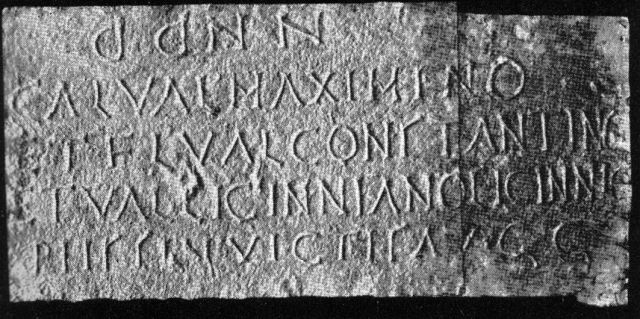
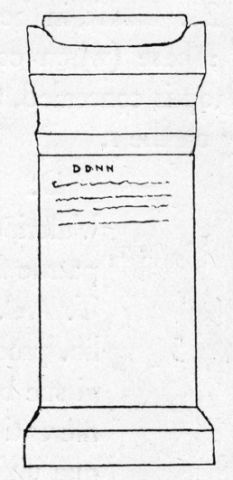
Milestone, or just possibly statue base, with dedication to Maximinus Daia, Constantine I, and Licinius, emperors. Laodicea Combusta (Katakekaumene), Pisidia. 311-313
Record details
Photographs
Inscription
Dd(ominis) nn(ostris) / Gal(erio) Val(erio) Maximino, / et Fl(avio) Val(erio) Constantino, / et Val(erio) Licinniano (sic) Licinnio (sic), / piis, invictis Augg(ustis).
Inscription translation
To our lords Galerius Valerius Maximinus, and Flavius Valerius Constantinus, and Valerius Licinianus Licinius, pious, unconquered Augusti.
Bibliography
- Calder, W., Monumenta Asiae Minoris antiqua, Vol. I, London 1928, p. 13 no. 19
Discussion
INSCRIPTION
DD(ominis) nn(ostris) / Gal(erio) Val(erio) Maximino, / et Fl(avio) Val(erio) Constantino, / et Val(erio) Licinniano (sic) Licinnio (sic), / piis, invictis Augg(ustis).
To our lords Galerius Valerius Maximinus, and Flavius Valerius Constantinus, and Valerius Licinianus Licinius, pious, unconquered Augusti.
Letter height 1.5 – 2.5 cm.
DESCRIPTION (from Calder 1928, and the published images)
Rectangular block of bluish limestone, with mouldings at top and bottom: H 110; W (top) 40 (shaft) 38; D 43 cm.
PROVENANCE AND CURRENT LOCATION
The inscription was found in the eastern cemetery of the village of Serai önü, in the region of the ancient city of Laodicea Combusta (Kekaumene). There is no recent record of its location.
HONORANDS AND DATE
Maximinus Daia, the first honorand, was Augustus 310-13; Constantine I, the second honorand, Augustus 306-337, but acknowledged in the East only after 310; Licinius, the third honorand, was Augustus 308-24.
The terminus post quem for our inscription is provided by the death of Galerius in 311, who was Augustus together with the three honorands from 308-11 and would certainly have been named if still alive. The terminus ante quem is provided by Maximinus’ death in 313.
Maximinus Daia claimed the title of senior Augustus ('titulum primi nominis’) for himself in 311 (Lactantius, De morte persecutorum 44, 11; Kienast 1996, 288). Accordingly he is named first in our inscription.
FURTHER DISCUSSION
The use of the dative for the honorands in this Latin inscription, and the general size and shape of the block on which it appears, would suit a statue base; see, for example, LSA-293 from Larisa appears to be a base (one of three?) for the exact same three honorands.
Here, however, the rural findspot, and the lack of a named awarder, would favour an interpretation as a milestone (despite the absence of the clinching evidence of an inscribed mileage). Further strong support for its identification as a milestone is the existence of an almost identical dedication in the territory of Laodicea Kekaumene, again from a rural context (LSA-2092). These two probable milestones are very similar to a pair of dedications from the territory of Smyrna, datable to a very similar period (317-24), for which there is additional evidence that they were milestones (LSA-518 and LSA-519).
If our block were a statue base, it will have been accompanied by two similar dedications, one of which, indeed, could be LSA-2092.
Discussion references
- Kienast, D., Römische Kaisertabelle : Grundzüge einer römischen Kaiserchronologie, Darmstadt, 1996
Cite: Last Statues of Antiquity, LSA-2500 (Ulrich Gehn).