
LSA-2508
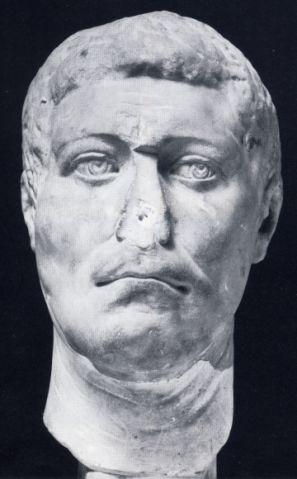
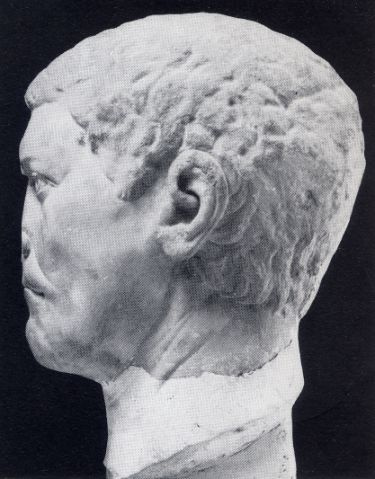
Portrait head of heavy-set, clean-shaven mature man. From Italy. Earlier fourth century.
Record details
Photographs
Bibliography
- Felletti Maj, B.M., I ritratti, Rome 1953, 168, no. 347 (Tetrarchic)
- Giuliano, A. (ed.), Museo Nazionale Romano. Le Sculture I,9. Magazzini. I Ritratti. Parte II, Rome 1988, 455-7, no. R347 (A.L. Cesarano: Tetrarchic-early Constantinian)
Discussion
DESCRIPTION (OBJECT)
Head. H: 31 cm. Carrara marble.
The head is broken unevenly under the chin at the top of the neck. The nose was repaired and is missing. The join surface is smoothly worked and preserves a pin hole.
The portrait has been created from another portrait. The hair over the brow and around the front of the ears appears to have been taken back but not given new detail. In contrast behind the left ear, are longer and fully rendered locks which presumably belonged to the previous portrait. The eyeballs have been emphatically marked with thick irises that are three-quarters of a circle and large crescent-shaped pupils. The mouth appears also to have been drilled out.
PROVENANCE
The provenance is unknown.
DESCRIPTION (Subject)
The portrait head shows a mature man who turns to his left. The face is rectangular with a tall, slightly lined brow. The cheeks are full, and the skin hangs loosely at all points. The eyebrows are fine, and the eyes are relatively small but with large pupils. The mouth is down-turned and thin-lipped.
The hair is short and full. It is roughly rendered, making it seem coarse, and stands off the brow in a horizontal line.
DATE
The fashion style (clean-shaven with short-hair), the rendering of the eyes (large pupils), and the clear indications of re-cutting in the hair suggest that this portrait belongs to the fourth century AD. A.L. Cesarano compares it to portraits of the early Constantinian period and Felletti Maj dated it to the Tetrarchic period.
The fleshy rectangular face and the eyes, which appear not to have been originally worked, suggest that the original portrait may have belonged to the later first or early second century AD.
Cite: Last Statues of Antiquity, LSA-2508 (J. Lenaghan).