
LSA-2511
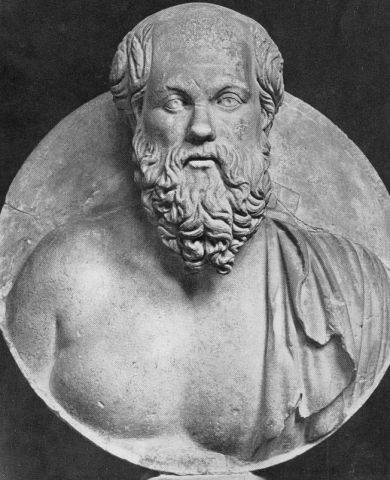
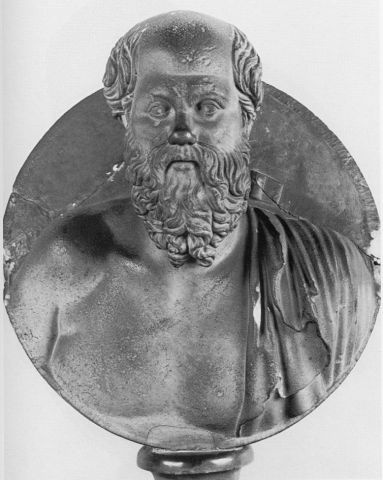
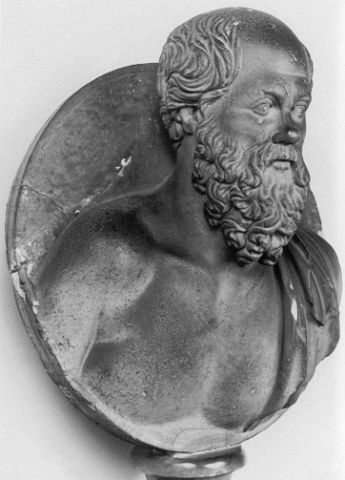
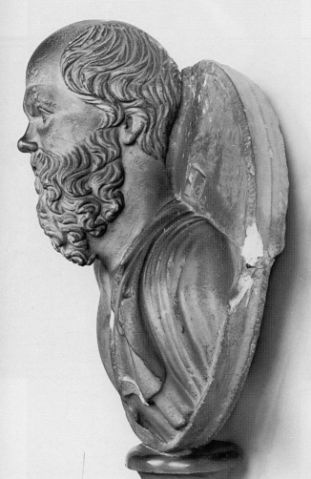
Tondo portrait of Socrates. From Italy. Late third to fourth century.
Record details
Photographs
Bibliography
- Bol, P. (ed.), Forschungen zur Villa Albani : Katalog der antiken Bildwerke. 2. Bildwerke in den Portiken, dem Vestibül und der Kapelle des Casino , Berlin 1990, 272-4, no. 229, pls. 193-5 (Voutiras: post AD 250)
Discussion
DESCRIPTION (OBJECT)
Tondo. Diam: 56 cm. H (of head): 34, W (of head): 18.5 cm. Fine-grained white marble.
A large area of the tondo above the shoulder is modern restoration as is the nose and a small area near the base.
The irises are not indicated and the pupils are large circular hollows in the middle of the eyeballs. The hair is stiffly rendered with a large, bull-nosed chisel. The folds of the drapery are also broad and flat.
PROVENANCE
The provenance is unknown.
DESCRIPTION (Subject)
The tondo shows Socrates wearing only a himation which is draped over his left shoulder. His pectorals are fleshy and sagging. His head looks straight forward. Above his left shoulder is the trace of a scroll.
The head shows the immediately recognizable physiognomy of what modern scholars call the Type B Socrates. This Socrates type down-played the silenic features of the Type A and was more popular in the Roman period. Here the tall balding brow, the full hair around the temples which is brushed back, the long beard, and the broad face with small eyes are all reproduced. The hair pattern, however, is simplified and repeated symmetrically on both sides of the head.
DATE
It is difficult to date the tondo with certainty. Danguillier places it in the Severan period. Voutiras writes that a date after 250 should not be ruled out and notes the popularity of portraits of Socrates in late antiquity. The drilling of the eyes supports this date. Scheibler considers a date in the later fourth century possible because of the treatment of the hair.
Moreover, the trace of a scroll in the background connects the portrait with other tondi from old Roman collections (Menander, Demosthenes, Heidelberg-Izmir type, LSA-2109, LSA-2440, and LSA-2441 ). These portraits seem also on stylistic grounds to belong to the late third or fourth century, and that of Demosthenes is particularly close stylistically.
Discussion references
- Danguillier, C., Typologische Untersuchungen zur Dichter- und Denkerikonographie in römischen Darstellungen von der mittleren Kaiserzeit bis in die Spätantike, Oxford 2001, 259, no. 52 (Severan)
- Richter, G.M.A., The Portraits of the Greeks, London 1965, 113 Type B no. 8, fig. 512
- Scheibler, I. 'Rezeptionsphasen des jüngeren Sokratesporträts in der Kaiserzeit', Jahrbuch des Deutschen Archäologischen Instituts 119, Berlin 2004, 242-3, no. 29 (later fourth century)
Cite: Last Statues of Antiquity, LSA-2511 (J. Lenaghan).