
LSA-2518
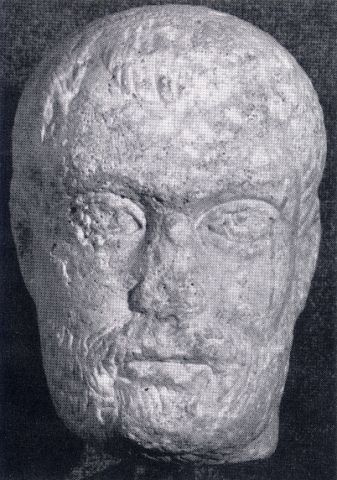
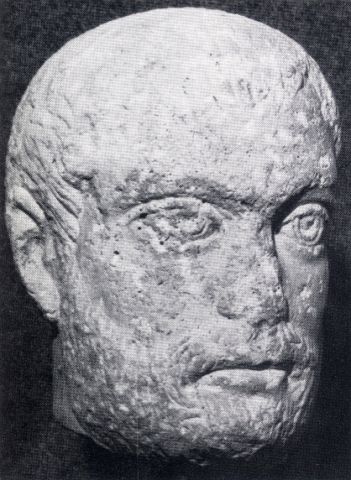
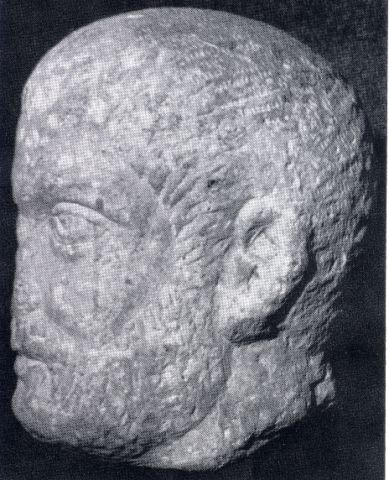
Portrait head of bearded man with short-cropped hair. From Intercisa (Pannonia Valeria). Early to mid fourth century.
Record details
Photographs
Bibliography
- Meischner, J., Bildnisse der Spätantike : 193-500 : Problemfelder : die Privatporträts , Berlin 2001, 180, fig. 269 (AD 337-364)
- Ruprechtsberger, E.M. 'Ein römischer Grabstein aus Lentia/Linz. Spätantike Porträts des 4. Jahrhunderts aus der Austria Romana', Jahrbuch für Antiken und Christentum 23, Münster 1980, 139-140, pl. 9a-c (c. 315)
Discussion
DESCRIPTION (Object)
Portrait head of freestone broken at back, H 24 cm. The nose is broken, and the surface is chipped all over.
The hair which lies like a tight fitting cap on the skull is set off the flesh by a clear cut line. It is articulated into single strands around the face by short chisel strokes. Beyond the line of hair surrounding the face, the skull is only finished with a claw. The beard is indicated in the same way as the hair on the cheeks and around the mouth; under the chin, it is arranged into little knobs.
The iris is circumscribed by an incised line. The pupil is standing proud against the upper lid and is marked out by a broad lunular carving.
The head is of a rectangular, cubic type. The large areas of the face are plain and without modeling, lending an expression of ‘classicist calmness’ to the face .
PROVENANCE AND CURRENT LOCATION
The head was found in 1927 in Dunaujvaros, that is the area of the ancient city of Intercisa on the Pannonian limes. It was recorded in the Hungarian National Museum in Budapest, inv. no. 22. 1927. 4, by Ruprechtsberger 1980.
DESCRIPTION (Subject)
The portrayed is a mature man as is indicated by the full beard and the receding hairline at the temples; however no furrows or wrinkles are indicated. His hair is brushed forward towards the face. Above the brow it forms a convex line; the strands are slightly bent inwards to meet at the center of the brow.
HONORAND AND DATE
The head was declared a portrait of Licinius (Augustus 308-324) by the Museum exhibition of 1980 (Ruprechtsberger 1980, 139; historical considerations to support such an identification: l. c. 140 n. 108). While this identification is questionable, the stylistic and typological features do indicate a date in the early or mid-4th century.
Ruprechtsberger 1980 suggested that the lack of an inner structure which would determine the modellings of the face indicated a date in the late tetrarchic period around 315. Meischner 2001 dated to the Constantinian period (337/64).
The marking of the eyes assigns a date not earlier than the late 3rd century to our head. The cubic head type with the trimmed beard and hair is in the tetrarchic tradition; the appeased, classicizing features, however, would not be expected before the late tetrarchic period.
Whether this is an imperial portrait is not easy to determine. The head does not conform to the public image of Licinius (Smith 1997); Constantine whose portrait was clean shaven at the suggested period can be ruled out, as can be Galerius whose beefy facial features are probably portrayed in the porphyry head from Gamzigrad which much more than our head adheres to the imperial portrait type of the earlier tetrarchy (LSA-845). Of the two remaining candidates, Maximinus Daia and Severus, the latter whose coin portraits occasionally show the receding hair at the temples (Kent-Overbeck-Stylow 1973 pl. 132 no. 607) appears to be a more likely candidate than Maximinus (Kent-Overbeck-Stylow 1973 pl. 133 no. 612, 613: full hair and small beard covering only the jawbones).
The classicizing features of the head, in our view, support the consideration that this is an imperial portrait which then would have to be dated to the early 4th century, with a terminus post quem of ca 310/15, and a terminus ante quem of 324 (sole reign of Constantine). Any identification, however, is beyond scope, and typological features of the tetrarchy were pursued in non-imperial portraits of the mid 4th century.
Discussion references
- Kent, J. P. C., Overbeck, B. & A. U. Stylow, Die römische Münze, München 1973
Cite: Last Statues of Antiquity, LSA-2518 (Ulrich Gehn).