
LSA-2519
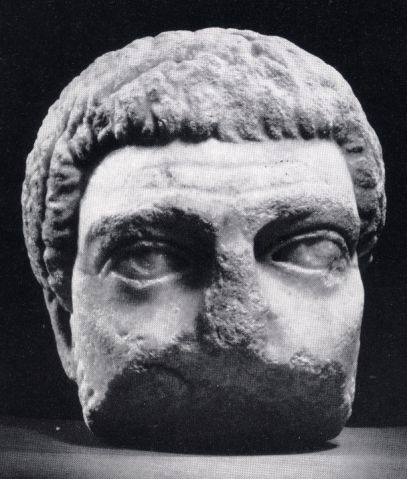
Portrait head of man with hair combed forward and beard. From Virunum (Noricum Mediterraneum). Earlier second, or earlier fourth century.
Record details
Photographs
Bibliography
- Piccottini, G., Die Rundskulpturen des Stadtgebietes von Virunum. Corpus signorum Imperii Romani. Österreich , Bd. 2.1 , Vienna 1968, 32, no. 51, pl. 38 (late third-early fourth century)
Discussion
DESCRIPTION (Object)
Upper portion of a head of fine grained marble (imported according to Piccottini 1968), H 25, W 22, D 22 cm. The mouth and the chin with the adjacent cheekbones are broken off; the nose and the eyebrows are chipped off.
The hair is a fluffy mass arranged into dense small tufts by chisel work. The tufts are not ordered into a concise direction; around the face they loosely fall into various directions. The beard, as far as recognizable from the published image, is treated in the same technique; on the right cheek it is visible how it grows organically out of the flesh.
The eyes are not marked.
The area around the eyes and on the cheeks is characterized by subtle modellings; the eyes are organically embedded into the cheeks.
PROVENANCE AND CURRENT LOCATION
The provenance of the head is unknown, but it is believed that it is from Zollfeld, the area of the ancient city of Virunum. It was recorded in Klagenfurt, Landesmuseum für Kärnten, inv. no. 304, by Piccottini 1968, and again by Ruprechtsberger 1980, 137 n. 85.
DESCRIPTION (Subject)
The full beard and the gently frowning brow indicate that the portrayed is a man of mature age.
HONORAND AND DATE
The head was dated to the late 3rd/early 4th century by Piccottini 1968 who compared the design of the eyes and the hairstyle to portraits of the tetrarchic period; he considerd the emperor Licinius (Augustus 308-24) to be the honorand. Ruprechtsberger 1968 saw (and was puzzled about) the plastic values of the head (see above, ‘Description (Object)’), yet insisted on the established tetrarchic date.
In our view, the late dating of the head is not convincing. Notably in the properties quoted by Piccottini 1968, the arrangement of the hair and the design of the eyes, the tetrarchic portraiture shows markedly different features. A head in Copenhagen (LSA-805), quoted by Ruprechtsberger 1980 for comparison, shows emphatically raised eyebrows, a sharp delineation of the lower lid, and a uniformly arranged forward-brushed hairstyle where single strands are without plastic volume. The head of Constantius I on Constantine’s arch in Rome, likewise called a witness for the tetrarchic date of our head, shows a similar delineation of the lower lid as the Copenhagen head; beard and hair are set off the flesh by a sharp line, and again the single locks are without plastic values.
The treatment of the hair, as well as the plastic values of our head and notably the embedding of the eyes find much closer parallels in heads of the 2nd or early 3rd century; in the close area, a fine portrait bust (Piccottini 1968 no. 48) of the Hadrianic period indicates the art historical and chronological environment where our head belongs.
Discussion references
- Ruprechtsberger, E.M. 'Ein römischer Grabstein aus Lentia/Linz. Spätantike Porträts des 4. Jahrhunderts aus der Austria Romana', Jahrbuch für Antiken und Christentum 23, Münster 1980, 137-8, pl. 6c (c. 315)
Cite: Last Statues of Antiquity, LSA-2519 (Ulrich Gehn).