
LSA-252
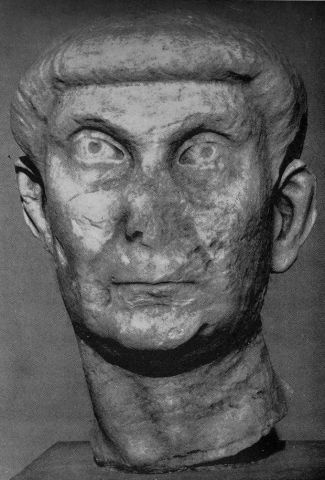
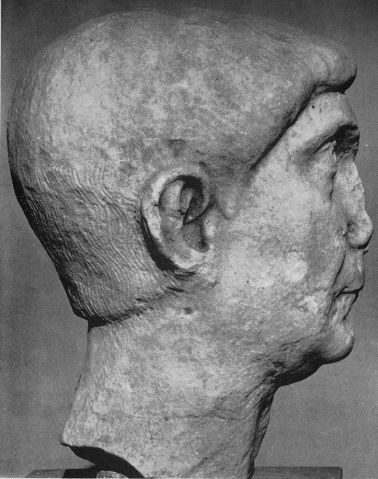
Portrait head of clean-shaven man with low fringe and intense eyes. From Side (Pamphylia). Later fourth to earlier fifth century.
Record details
Photographs
Bibliography
- Inan, J., Antalya bölgesi Roma devri portreleri. Römische Porträts aus dem Gebiet von Antalya , Ankara 1965, 91-2, no. 34, pls. 37-8
- Inan, J. and E. Rosenbaum, Roman and Early Byzantine Portrait Sculpture in Asia Minor, Oxford 1966, 200-201, no. 276, pl. 153
Discussion
DESCRIPTION (Object)
Life-size head. H: 31, W: 20 cm. Fine-grained white marble.
The head is broken through the base of neck. The nose is missing. The surface is damaged.
The pupils are drilled out in a thick crescent-shape; they are almost circular with a notch in the upper side. The irises were incised with a fine flat chisel. Behind the right ear hair is shallowly engraved in fine long strands.
PROVENANCE
The head was found at the back of the courtyard of the city-gate.
DESCRIPTION (Subject)
The head represents a clean-shaven man with full short hair that is cut straight across a low brow. The face seems large because of the low cap of the hair. The eyes are large and the arching eyebrows cut further into the small brow. The mouth is broad with tightly pursed lips. The jawline is square with a projecting chin. The naso-labial folds are deep, and there is a bulge of flesh below the chin, a double chin.
The sternocleido-mastoids are rendered and show a turn to the proper left.
On the crown of the head a large cross has been engraved.
DATE
Inan dates the head to the Constantinian period. Von Sydow considers it fifth century. The technique of the hair and eyes are similar to those on a statue of a Theodosian prince, LSA-163, which is securely dated between 388 and 392, and the hairstyle recalls an unfinished statue from Aphrodisias, LSA-154, of roughly the same date. In addition, the hair, behind the ear, is rendered almost identically to the hair behind the ear of LSA-247, also from Side, and presumably of the same date.
HONORAND
The portrait was found in an impressive mausoleum of the west necropolis to which Mansel assigns a late third-century date. The mausoleum may still have been in use a century later; Mansel, who published the building, notes mosaics which belong to a later period.
On the basis of the description of the location and its lack of visibility in the published photos, it seems to this author that the cross on top of the head had a function similar to the three letters (Christon Maria genna or Christ was born to Mary) that appear on LSA-150 and LSA-176. It seems indended to protect either the honorand, probably a pagan, or the sculptor, probably a Christian. This sort of religious dilemma is unlikely to have occurred before the later fourth century.
Discussion references
- Sydow, W. von, Zur Kunstgeschichte des spätantike Porträts im 4. Jahrhundert. n. Chr, Bonn 1969, 118, 129, 132 ff. (fifth century)
Cite: Last Statues of Antiquity, LSA-252 (J. Lenaghan).