
LSA-2520
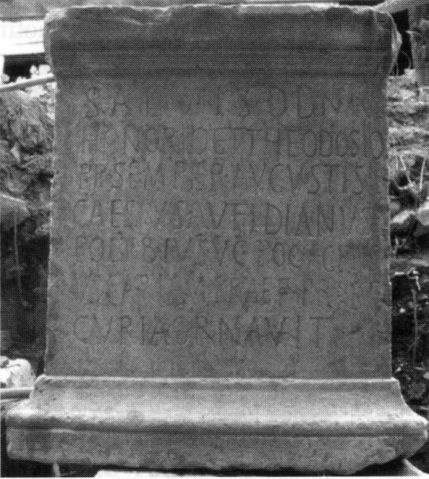
Base for statue of unstated subject. Cirta (Numidia). 407-423
Record details
Photographs

Inscription
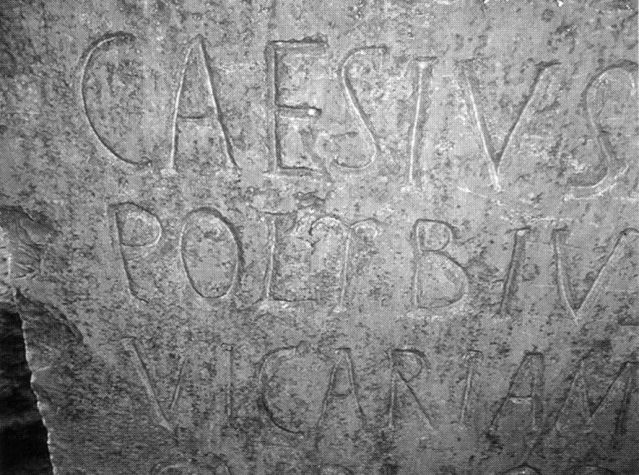
Salvis dd(ominis) nn(ostris) / Honorio et Theodosio / p(er)p(etuis) semper Augustis / Caesius Aufidianus /(5) Polybius v(ir) c(larissimus), p(rimi) o(rdinis) c(omes), agens / vicariam praef(ecturam) praet(orio), / curia(m) ornavit.
Inscription translation
Our lords Honorius and Theodosius perpetual and forever Augusti, being safe and well. Caesius Aufidianus Polybius, of clarissimus rank, count of the first order, acting deputy of the praetorian prefecture, embellished the Curia.
Bibliography
- Benseddik, N., Lueurs cirtéennes, Zeitschrift für Papyrologie und Epigraphik 153, 2005, 249-60, 252-4 no. 2
- L'Année épigraphique, , 2005, 1696c
Discussion
INSCRIPTION
In seven lines:
Salvis dd(ominis) nn(ostris) / Honorio et Theodosio / p(er)p(etuis) semper Augustis / Caesius Aufidianus /(5) Polybius v(ir) c(larissimus), p(rimi) o(rdinis) c(omes), agens / vicariam praef(ecturam) praet(orio), / curia(m) ornavit.
'Our lords Honorius and Theodosius perpetual and forever Augusti, being safe and well. Caesius Aufidianus Polybius, of clarissimus rank, count of the first order, acting deputy of the praetorian prefecture, embellished the Curia.'
Letter height 4.5 – 6 cm.
DESCRIPTION (from L’Année Épigraphique (AE), Benseddik 1995, and the published image)
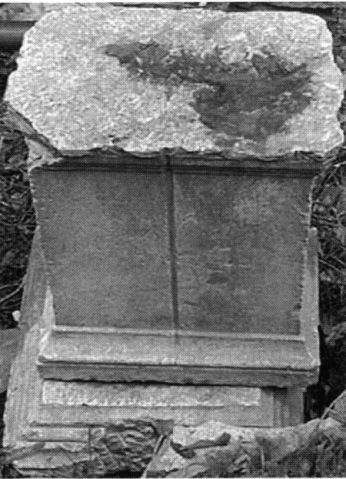
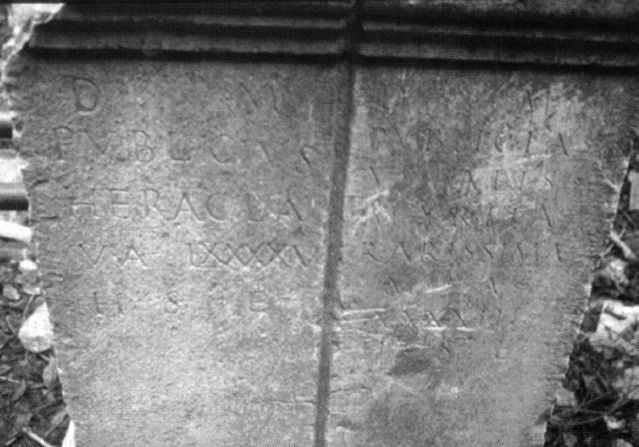
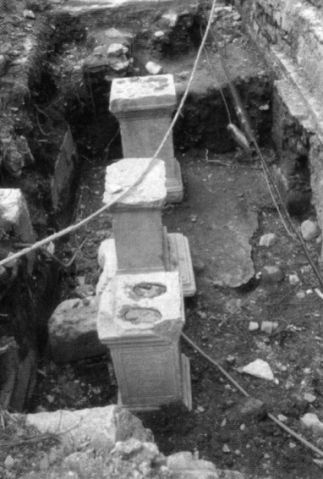
Limestone base moulded at top and bottom; H 133, W 83, D 40 cm. Our inscription is from a second use of the base; the first use on the back side of our inscription was a funerary inscription to a married couple from the earlier imperial period (Benseddik 1995, 252 no. 2 face A). Possibly on occasion of its second use, the inscribed block was placed on a broad moulded plinth, H 42, W 82, D 90 cm (see below, ‘Provenance and Current Location’). The top is broken. At the back face (the original front) a vertical channel divides the epigraphic field and the upper moulding into two halves; one half is used for the husband, the other one for the wife.
PROVENANCE AND CURRENT LOCATION
The inscription was first recorded in the stable of the Ottomanic period during restoration work in the palace of the Bey in Constantine in 1995. It was lined up with two other bases, one with an inscription to Constantius II (LSA-2234), the other one uninscribed. The find spot is possibly the original setting of our inscription;Benseddik 1995, 259-60 argues that the area of the palace of the Bey where our inscription was found is probably built on the site of the forum of Cirta. The inscription was left standing in situ.
HONORAND, AWARDER AND DATE
The subject of the dedication is not recorded in our inscription; it was possibly a personification or other ideal sculpture. Our inscription states that it was set up to embellish the council house (curia, line 7).
Caesius Aufidianus Polybius, the honorand, was vicar of the African provinces (agens vicariam praefecturam praetorio, lines 5-6; on the variety of abbreviations for this office in Africa see Benseddik 1995, 254). He was not known prior to this inscription (no entry in PLRE).
Polybius’ time in office is defined by the common reign of Honorius (Augustus 393-423) and Theodosius II (Augustus 402-50). The inscription was set up before Theodosius II’s father Arcadius’ death in 408. From the period 408/23 three vicars of Africa were formerly known (see PLRE II, 1276-7 Fasti – Vicarii Africae). The possible dates for Polybius’ time in office are 408, 410/13, or 414/23.
Cite: Last Statues of Antiquity, LSA-2520 (Ulrich Gehn).