
LSA-2521
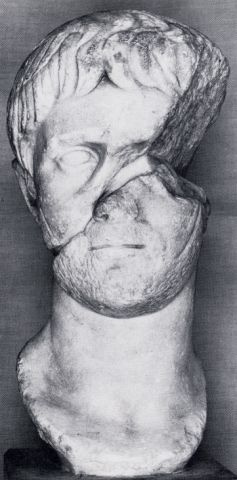
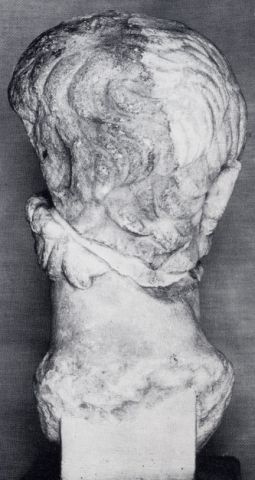
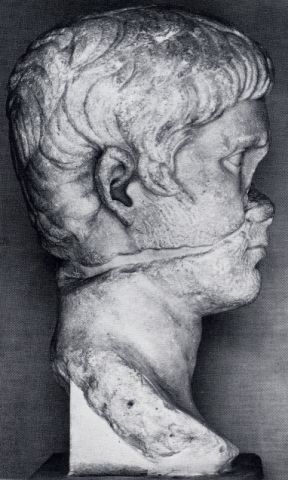
Portrait head of Julio-Claudian prince re-used with engraved beard. From Assos. Later third century or fourth century.
Record details
Photographs
Bibliography
- Inan, J. & E. Alföldi-Rosenbaum, Römische und frühbyzantinische Porträ̈tplastik aus der Türkei : neue Funde, Mainz 1979, 75-6, no. 20, pl. 17
Discussion
DESCRIPTION (Object)
Over life-size head, worked separately. H: 41, H (chin to crown): 26.5, W: 18 cm. Fine-grained white marble.
The head has been restored from two pieces; the upper portion of the head from the right mandible to the left temple; and the lower portion with the neck. Missing is a section of the left side of the head which includes the area of the temple, the outer eye, and the ear. The nose is also broken.
The head was made separately to be inserted into a socket on a statue. The hair is rendered with the flat chisel. The eyes are unmarked. A beard and moustache have been added with a claw chisel. The inner perimeter line of the beard on the cheek has been engraved with a flat chisel.
PROVENANCE
Found in the Agora at Assos by the American excavations.
DESCRIPTION (Subject)
The head shows a young man with lank, medium-length locks and a short beard. The hair follows a Julio-Claudian arrangement which begins from a starfish pattern at the top of the head. There is a fork or parting in the fringe over the inner corner of the right eye. A beard and moustache have been scratched onto the surface of the cheeks and upper lip.
The head turns to its right. The face has a regular rectangular form with evenly spaced features. The eyes are not large, the eyebrows are even, and the brow is flat and unmarked.
DATE
The separately worked portrait head is in all but its beard and moustache typical of the production of the Julio-Claudian period. The fashion of the hair and the rendering are all standard to that period. The original portrait probably represented a Julio-Claudian prince.
The portrait, however, has been used again to show a bearded young man. Although beards became popular amongst the Romans in the second quarter of the second century, the schematic rendering and the short style of this beard make it most likely that the honorand was a man of the later third century or fourth century. That the eyes were not touched is irrelevant to the date. A proconsul of Africa of the middle of the fourth century similarly re-uses a Julio-Claudian portrait head, LSA-1130. Two other portraits, which also originally represented Julio-Claudian youths, show a similar mode of re-use, LSA-1203 and LSA-2144.
Cite: Last Statues of Antiquity, LSA-2521 (J. Lenaghan).