
LSA-2524
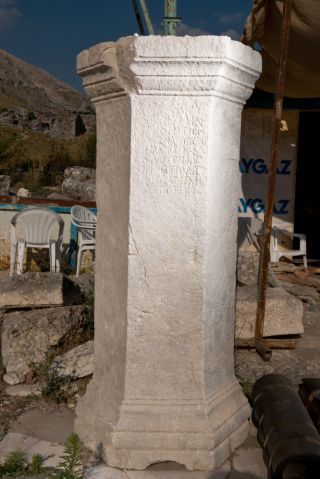
Base for statue of Constantius II, emperor. Sagalassus (Pisidia). 354-361
Record details
Photographs
Inscription
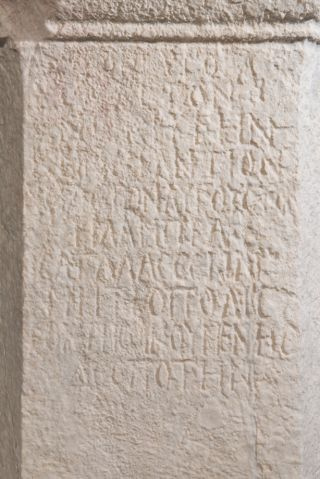
Α]ὐ̣τ̣ο̣[κ]ρ̣ά̣τ̣ο̣ρ̣α̣ / Σ̣[εβα]σ̣τ̣ὸν / Ν̣[εικ]η̣τὴν / Κ̣ω̣ν̣σ̣τ̣α̣ντίον /(5) [μεγισ]τ̣ο̣ν̣ Αὔγουστον / ἡ ̣ λαμπρὰ / Σαγαλασσέων / [μ]ητ̣ρ̣όπολις / [τὸν τῆς] ο̣ἰ̣κουμένης /(10) δ̣ε̣σπότην.
Inscription translation
The emperor Augustus, victor, Constantius, most powerful Augustus. The shining metropolis of the Sagalassians [honours] the ruler of the civilised world.
Bibliography
- Devijver, H. & M. Waelkens, Roman Inscriptions from the Upper Agora at Sagalassos, Sagalassos III. Report on the Fourth Excavation Campaign of 1993, ed. By M. Waelkens and J. Poblome, 115-25, Leuven 1995, pp. 116-17 no. 2
- L'Année épigraphique, , 1995, 1544
Discussion
INSCRIPTION
In ten lines:
Α]ὐ̣τ̣ο̣[κ]ρ̣ά̣τ̣ο̣ρ̣α̣ / Σ̣[εβα]σ̣τ̣ὸν / Ν̣[εικ]η̣τὴν / Κ̣ω̣ν̣σ̣τ̣α̣ντίον /(5) [μεγισ]τ̣ο̣ν̣ Αὔγουστον / ἡ ̣ λαμπρὰ / Σαγαλασσέων / [μ]ητ̣ρ̣όπολις / [τὸν τῆς] ο̣ἰ̣κουμένης /(10) δ̣ε̣σπότην.
'The emperor Augustus, victor, Constantius, most powerful Augustus. The shining metropolis of the Sagalassians [honours] the ruler of the civilised world.'
Letter height 3 - 3.5 cm.
DESCRIPTION (from Devijver & Waelkens 1995 and the published images)
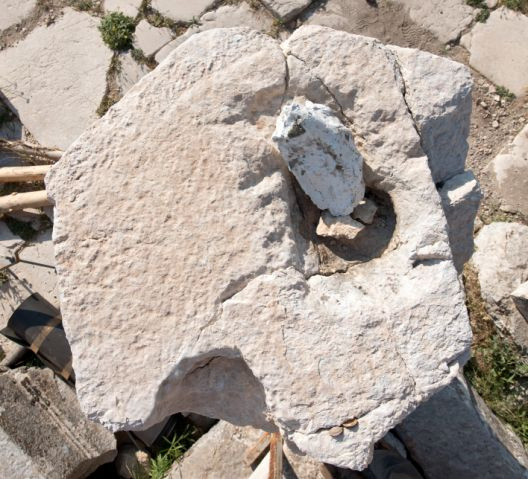
Hexagonal base of white limestone with mouldings at top and bottom: H 180.5; W (maximum at top) 84.5; W (each side) 36 cm. On the top face there are the traces of the fixings for a bronze statue. The six sides are plain, the inscriptions is on one side only. The surface is worn, rendering portions of the inscription difficult to read.
PROVENANCE AND CURRENT LOCATION
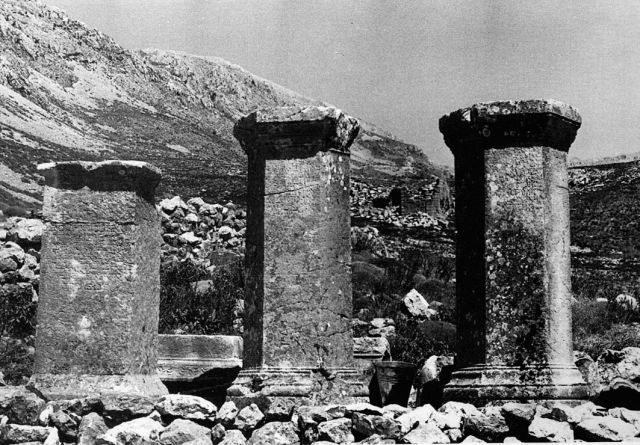
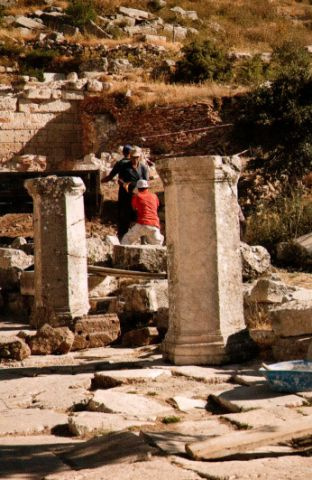
The inscription was found in 1993 in the centre of the eastern edge of the Upper Agora of Sagalassus, close to another inscribed base to Constantius II (LSA-2525). This is possibly the original location of the base. It is still standing on the Upper Agora, alongside LSA-2525.
HONORAND, AWARDER AND DATE
Constantius II, the honorand, was Augustus 337-61. The formula τὸν τῆς οἰκουμένης δεσπότην ('the ruler of the civilised world', lines 9-10) is an indicator that the inscription was set up after Constantius II’s victory over Magnentius in 353, and the execution of his cousin Gallus in 354, when Constantius gained undisputed power over the whole empire (Nollé 1993, 326; for two other examples, see LSA-264 and LSA-2525).
The inscription was set up by the city of Sagalassus, styling itself 'metropolis' (line 8), and thereby claiming the most elevated rank among the cities of the province of Pisidia.
FURTHER DISCUSSION
The presence side by side of two identical bases, with identical inscriptions, both to Constantius II (and, for all we know, once with identical statues on top of them), shows very clearly one of the major differences between the statue habit of the ancients, and that of today. In Roman times, it was entirely acceptable, indeed desirable, to repeat an identical gesture of loyalty to the emperor.
Discussion references
- Nollé, J. , Side im Altertum : Geschichte und Zeugnisse (Inschriften griechischer Städte aus Kleinasien ; Band 43), Bonn 1993
Cite: Last Statues of Antiquity, LSA-2524 (Ulrich Gehn).