
LSA-2527
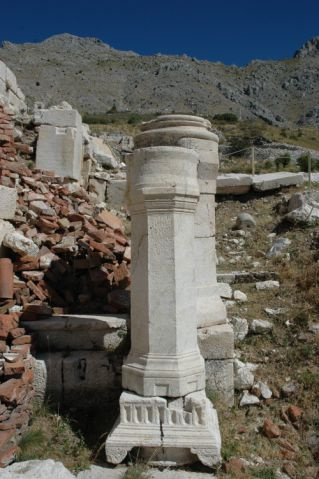
Base for statue of Julian, emperor. Sagalassus (Pisidia). 355-360
Record details
Photographs
Inscription
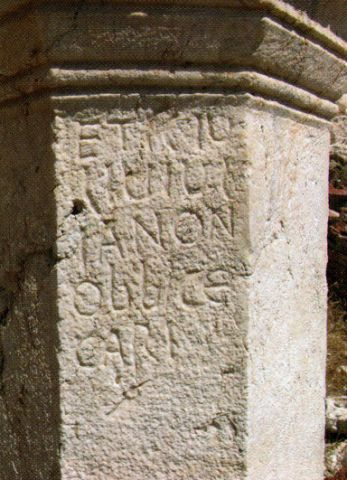
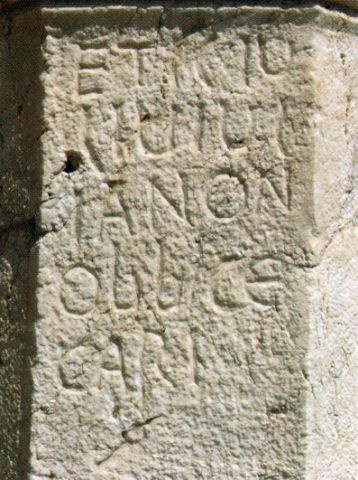
ET ΚΛ(αύδιον)? Iu/lion Iul/ianon / (n)obb(ilissimo)? Ce/σari
Inscription translation
And to Claudius Iulius Iulianus, most noble Caesar.
Bibliography
- Waelkens, M. (and other authors), The 1996 and 1997 Excavation Seasons at Sagalassos, Sagalassos V. Report on the Survey and Excavation Campaigns of 1996 and 1997, ed. by M.Waelkens and L. Loots, Leuven 2000, p. 367 figs. 187, 189, 190
Discussion
INSCRIPTION
In five lines, with Greek and Latin letters mixed even within single words:
ET ΚΛ(αύδιον)? Iu/lion Iul/ianon / (n)obb(ilissimo)? Ce/σari
'And to Claudius Iulius Iulianus, most noble Caesar.'
Letter height not recorded.
The inscription awaits full publication. The remarkably poor quality of the script, and the garbled nature of the language, make it difficult to read with confidence; the imperial name of Julian, in lines 2-3, is however clearly legible.
DESCRIPTION (from the published photos)
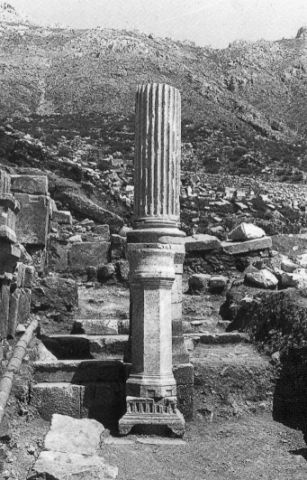
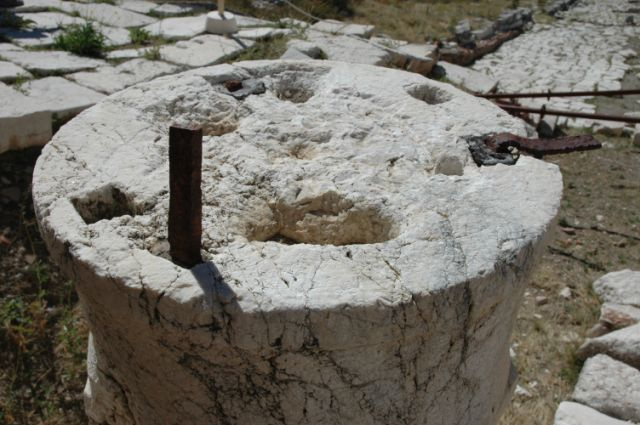
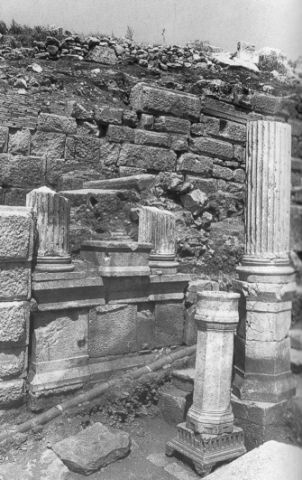
Hexagonal limestone base moulded at top and bottom, with a hexagonal plinth worked from the same block at the bottom, and a circular plinth, likewise from the same block, on top. Each side of the lower plinth has a rectangular indentation. The hexagonal base is set above the inverted upper moulding of an earlier rectangular base or altar; this is decorated with a fluted frieze, acroteria at the corners, and has a round plinth on top. No measurements have been published.
PROVENANCE AND CURRENT LOCATION
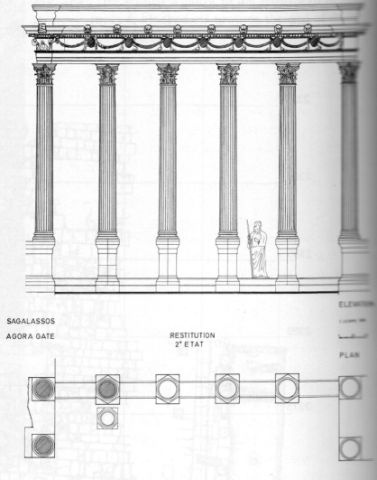
The inscription was excavated in the 1996/7 campaigns at Sagalassus (Waelkens et al. 2000, 367). It was found standing in front of the westernmost column of the central part of the monumental southwestern gateway to the lower agora (Waelkens et al. 1997, 208-12; Waelkens et al. 2000, 362-7); this was probably its original position. The base is still standing in situ.
HONORAND AND DATE
There is little doubt that the honorand was the emperor Julian, while he was a Caesar in 355-60. His full name was 'Flavius Claudius Iulianus', which in our inscription appears to have been garbled as 'Claudius Iulius Iulianus'.
FURTHER DISCUSSION
The standard of late antique epigraphy at Sagalassus was not high, but this inscription, with its bizarre mixture of languages and scripts, is puzzlingly poor.
Discussion references
- Waelkens M. (and other authors), The 1994 and 1995 Excavation Seasons at Sagalassos., Sagalassos IV. Report on the Survey and Excavation Campaigns of 1994 and 1995, ed. by M. Waelkens & J. Poblome, Leuven 1997
Cite: Last Statues of Antiquity, LSA-2527 (Ulrich Gehn).