
LSA-2529
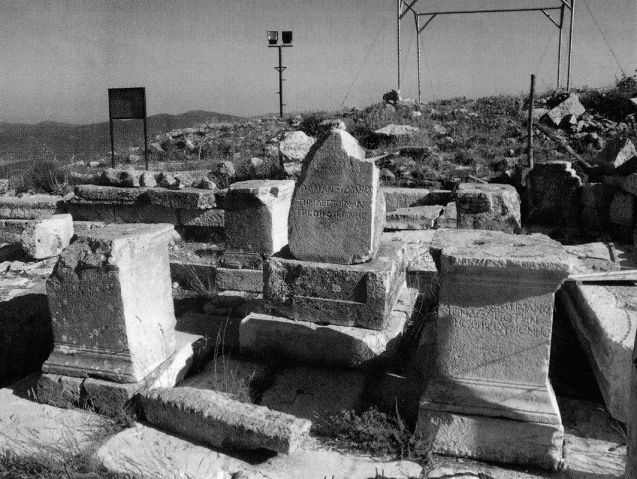
Base for statue of empress Eudoxia, probably Aelia Eudoxia. Sagalassus (Pisidia). 395-404.
Record details
Photographs
Inscription
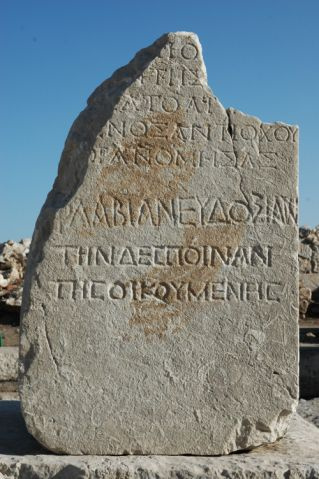
Φλαβίαν Εὐδοξίαν, / τὴν δεσποίναν / τῆς οικουμένης.
Inscription translation
To Flavia Eudoxia, the ruler of the civilised world.
Bibliography
- Devijver, H. & M. Waelkens, Roman Inscriptions from the Upper Agora at Sagalassos, Sagalassos III. Report on the Fourth Excavation Campaign of 1993, ed. By M. Waelkens and J. Poblome, 115-25, Leuven 1995, p. 118-19 no. 6
- L'Année épigraphique, , 1995, 1548
Discussion
INSCRIPTION
In three lines:
Φλαβίαν Εὐδοξίαν, / τὴν δεσποίναν / τῆς οικουμένης.
'To Flavia Eudoxia, the ruler of the civilised world.'
Letter height: 5.8 - 7.2 cm (line 1) and 4.7 cm (lines 2-3).
The first line of the inscription, with the name of the empress, is carved over an earlier erased name; lines 2 and 3 are unchanged from this earlier inscription.
DESCRIPTION (from Devijver & Waelkens 1995, and the published images)
Rectangular base of white limestone: H 98, W 64.5, D 64 cm. The top and both upper corners are broken off, the lower right corner is chipped. The inscription is carved on the lower portion of the block.
Our inscription is the second re-use of the base. Above line 1, remnants of a 2nd-century inscription, from the very first use, are legible (Devijver & Waelkens 1995, 118; Waelkens, Pauwels & Van den Bergh 1995, 25). The first re-use was for an empress, probably Gratian’s wife Constantia (LSA-2531). The second re-use is our dedication to 'Flavia Eudoxia'.
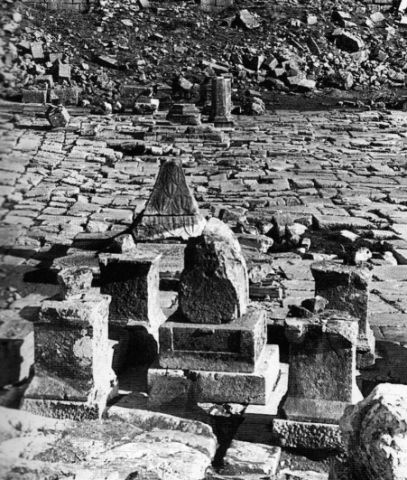
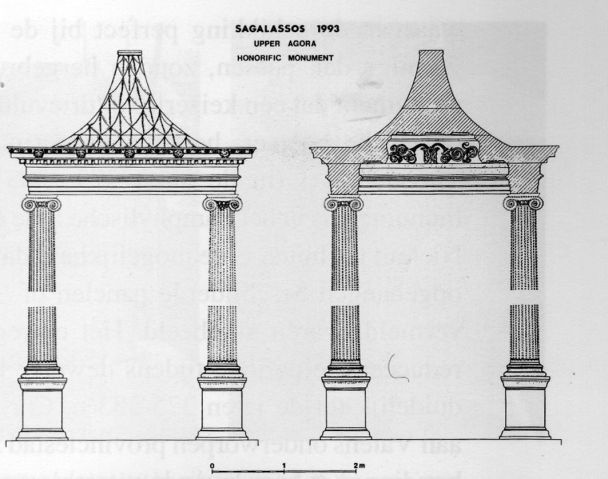
The base stands on a two-stepped plinth, originally under an elaborate architectural canopy consisting of four Ionic columns supporting a square canopy roof (Waelkens, Pauwels & Van den Berg 1995, 24; Waelkens 2009, 205 fig. 148; see below, 'Further Discussion'). This 'tempietto’, which formed the architectural frame for the statue of our empress, was built in the early imperial period as a shrine for the Tyche of Sagalassus (Waelkens, Pauwel & Van den Berg 1995, 24; Waelkens 2009, 202-3 & 205 figs. 148-9); it was first appropriated for the statue of a Valentinianic empress(LSA-2531), before she was replaced by our Eudoxia.
PROVENANCE AND CURRENT LOCATION
The base, and its associated canopy, were excavated on the south side of the upper agora; it stands today, in situ, on the Upper Agora of Sagalassus.
HONORAND, AWARDER AND DATE
The empress, here styled 'Flavia Eudoxia', was almost certainly Aelia Eudoxia, daughter of Flavius Bauto, magister militum of the West in 380-5 and consul in 385 (PLRE I, 159-60 Flavius Bauto), the wife of the emperor Arcadius (Augustus in the East 383-408), whom she married in 395. She died in 404. The nomen gentile given here, 'Flavia ', seems to be unique to our inscription, all other sources name her Aelia Eudoxia (PLRE I, 410 Aelia Eudoxia 1); the 'Flavia' may derive from her father`s name, or it may originate from the nomen gentile of the Theodosian dynasty.
Another possible, but highly unlikely, candidate for our honorand, is Licinia Eudoxia, daughter of Theodosius II, granddaughter of Aelia Eudoxia, and wife of the western emperor Valentinian III (Augustus 425-55), whom she married in 437; Licinia Eudoxia bore the title of Augusta until her death in c. 462. However, it is very unlikely that a major monument in the East would have been dedicated to a western empress at such a late date.
Although the inscription does not record this, the dedication was almost certainly decreed by the city itslef.
Discussion references
- Jones, A. H. M. et al., The Prosopography of the Later Roman Empire. Vol. I 260-395, Cambridge et al. 1971 (1975)
- Martindale, J. R., The Prosopography of the Later Roman Empire. Vol. II A.D. 395-527, Cambridge 1980
- Waelkens, M., Sagalassos – Jaarboek 2008. Het kristallen jubileum van twintig jaar opgravingen, Leuven 2009
- Waelkens, M., Pauwels, D. & J. Van Den Bergh, The 1993 Excavations on the Upper and Lower Agora,
Waelkens, M., Pauwels, D. & J. Van Den Bergh, The 1993 Excavations on the Upper and Lower Agora, Sagalassos III. Report on the Fourth Excavation Campaign of 1993, ed. by M. Waelkens & J. Poblome, Leuven 1995
Cite: Last Statues of Antiquity, LSA-2529 (Ulrich Gehn).