
LSA-253
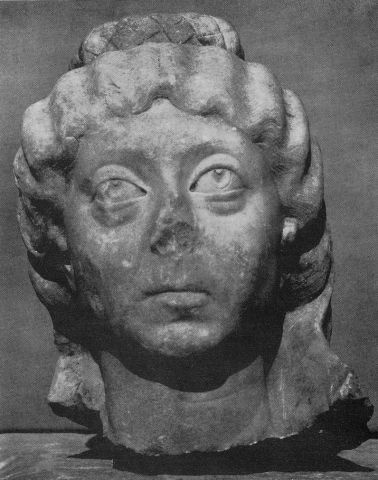
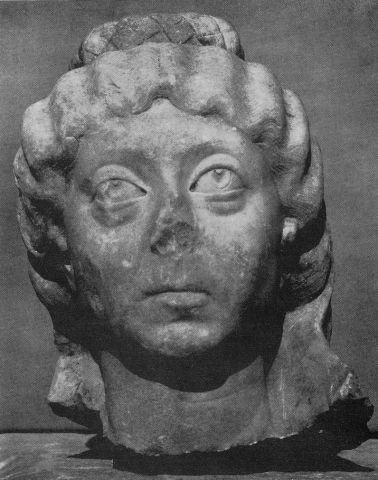
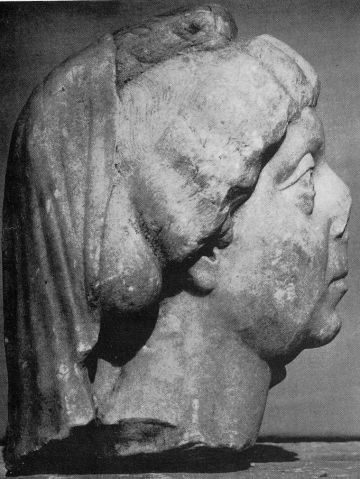
Veiled female portrait head with central braid hairstyle. From Side (Pamphylia). Fourth century.
Record details
Photographs
Bibliography
- Inan, J. and E. Rosenbaum, Roman and Early Byzantine Portrait Sculpture in Asia Minor, Oxford 1966, 201-202, no. 277, pl. 154
Discussion
DESCRIPTION (Object)
Over life-size head. H: 28.5, W: 20 cm. Fine-grained white marble.
The head has broken from a statue through the base of the neck and the drapery flanking the neck. The tip of the nose is missing.
The head is fully finished on all sides. The hair is rendered as rounded areas of thick volume onto which individual strands have been carefully engraved with a fine flat chisel. The irises are a fine semi-circular flat chisel line, and the pupils are large crescent-shape hollows made with a drill. A drill line separates the lips, and drill points mark the inner canthi.
PROVENANCE
Found by villagers near the temples at Side.
DESCRIPTION (Subject)
The portrait head belonged to a statue of a woman whose himation was pulled over the back of the head. The head wears a variation of the central braid hairstyle.
The face features clear signs of age: the sagging flesh beneath the chin; lines and pouches beneath the eyes; and modelled naso-labial folds. This older woman has a low brow, large eyes, a long and hooked nose, and a small pursed mouth in which the upper lip is thin. There are lines also on the neck, but these Venus rings are feminine rather than indicators of age.
The hair has three different sections. The hair around the face is parted in the centre and crimped. It covers most of the ears and has a separate volume from the hair behind it. Behind the ears the hair has solid form without articulation. This hair must be pulled upwards and then braided to form the plait which emerges from the veil at the middle of the head and which folds over itself just before the brow. The hair on the top of the head but not in the plait sits closely against the head in long flat strands.
DATE
The hairstyle of this head features the defining element of late third century hairstyles (the braid pulled up the centre of the head from back to front) as well as an element of Antonine hairstyles (the voluminous band of crimped locks around the face which partly covers the ears and which is separate from the hair at the top of the head ). The central braid hairstyle continued into the fourth century as both coins and two fourth-century portraits attest: a bust from Thessaloniki (LSA-91<k) and a statuette of an Empress (LSA-568).
The technical rendering also provides a terminus post quem. The large crescent-shaped pupils and modelled bulge of the eye below the lower lid should date to the tetrarchic period or later (see, for example other heads from Side, LSA-250and LSA-252). The fine engraving of the hair also suggests a later rather than earlier date (see, for example, LSA-252 and LSA-337). The facial structure, which tapers to the chin, as well as the large nose and small mouth, might even be considered to rely on Constantinian portraiture. The size and shape of the eye with a flat lower lid and a high-arching upper lid are comparable to a head of a Theodosian Emperor in Istanbul, LSA-337. They might, however, equally be compared to a head now in Istanbul (Inan and Rosenbaum, no. 295, which has been dated to c. 170 by Fittschen, p. 66, no. 295) .
Thus, Inan places the head in the Constantinian period. Von Sydow, reaffirmed by Fittschen, considers it early fifth century because of the linear rendering of the hair and the shape of the eyes. Schade places it broadly in the fourth century between the Constantinian and late Theodosian periods. She prefers a date at the end of the fourth century for the same reasons as von Sydow.
Discussion references
- Fittschen, K., “Rezension zu: Roman and Early Byzantine Portrait Sculpture in Asia Minor” , GGA 225 (1973), 66, no. 277 (early fifth century)
- Schade, K., Frauen in der Spätantike--Status und Repräsentation, Mainz 2003, 211-212, no. I 51, pl. 58.1-2 (Theodosian)
- Sydow, W. von, Zur Kunstgeschichte des spätantike Porträts im 4. Jahrhundert. n. Chr, Bonn 1969, 134 (early fifth century)
Cite: Last Statues of Antiquity, LSA-253 (J. Lenaghan).