
LSA-2530
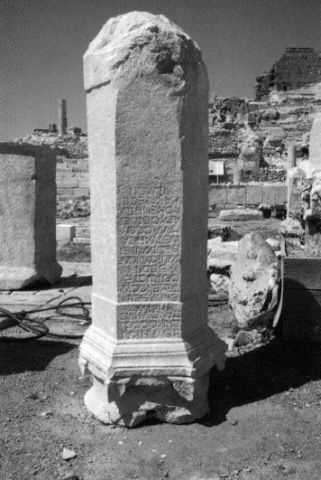
Base for statue of Panhellenius, praetorian prefect or vicar. Sagalassus (Pisidia). Earlier to mid fourth century.
Record details
Photographs
Inscription
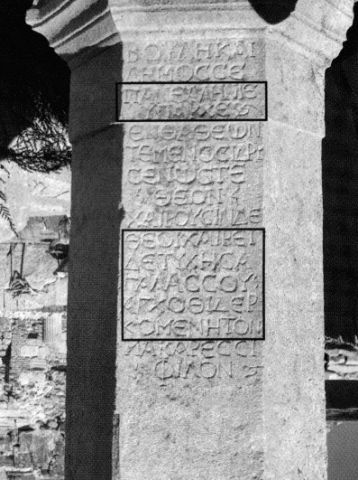
Βουλὴ καὶ / δῆμος σε, / Πανηλλήινε, / ὕπαρχε, /(5) ἔνθα θεῶν / τέμενος ἴδρυ/σεν ὧστε / θεόν. / Χαίρουσιν δὲ /(10) θεοί, χαίρει / δὲ τύχη Σα/γαλάσσου, / ἄγχοθι δ/ερκομένη /(15) τὸν μακαρέσσι / φίλον
Inscription translation
The council and the people set up you, Panhellenius, prefect, at the precinct of the gods, as a god. The gods rejoice, and the Tyche of Sagalassus rejoices, who beholds from nearby him who is friend of the blissful.
Bibliography
- Waelkens, M., Sagalassos – Jaarboek 2008. Het kristallen jubileum van twintig jaar opgravingen, Leuven 2009, pp. 206-8 figs. 152 a, b
Discussion
INSCRIPTION
Verse inscription of two distichs, laid out in 16 lines (four for each line of verse):
Βουλὴ καὶ / δῆμος σε, / Πανηλλήνιε, / ὕπαρχε, /
(5) ἔνθα θεῶν / τέμενος ἴδρυ/σεν ὧστε / θεόν. /
Χαίρουσιν δὲ /(10) θεοί, χαίρει / δὲ τύχη Σα/γαλάσσου, /
ἄγχοθι δ/ερκομένη /(15) τὸν μακαρέσσι / φίλον.
'The council and the people set up you, Panhellenius, prefect, at the precinct of the gods, as a god. The gods rejoice, and the Tyche of Sagalassus rejoices, who beholds from nearby him who is friend of the blissful.'
Letter height not recorded.
DESCRIPTION (from the published photos)
Tall hexagonal base of white limestone, now standing upside-down, with moulding at the (original) top; the (original)bottom damaged and largely lost. At the top it has a circular plinth, worked from the same block; on the top face there are traces of the setting for a bronze statue belonging to the base's first use (Waelkens 2009, 208). No measurements are published. Our inscription is carved on the back side of an earlier one to Titus Flavius Valerianus Alexandrus (unpublished; Waelkens 2009, 208).
PROVENANCE AND CURRENT LOCATION
The inscription was recorded by Waelkens 2009, 206-7 in its ancient location at the eastern edge of the Upper Agora.
The inscription alludes to the Tyche of Sagalassus beholding Panhellenis’ monument from nearby (lines 10-14). This almost certainly alludes to the Tychaion, the shrine of Tyche, on the Upper Agora, which was transformed into an imperial monument in the later 4th century with inscriptions to Valentinian I or II, Gratian, and probably Gratian’s wife Constantia (LSA-2531) (Waelkens 2009, 208; see below, 'Honorand, Awarder, and Date').
The base is now standing upside down, approximately where it was originally set up, at the eastern edge of the Upper Agora.
HONORAND, AWARDER AND DATE
Panhellenius, the honorand, held the office of huparchos (line 4), the Greek word usually used for prefects, and sometimes for vicars (Feissel 1998, 92); he was probably a praetorian prefect of the East, but a vicar of the diocesis of Asiana cannot be excluded.
The allusion to the sanctuary of Tyche (see above, 'Provenance and Current Location') provides a secure terminus ante quem of 383 for our inscription, the last possible date for the transformation of the Tychaion into an imperial monument of the Valentinianic dynasty.
Waelkens 2009, 208 proposed to identify our Panhellenius with a Panhellenius governor of Lydia in 382 (PLRE I, 665 Panhellenius). The name is indeed rare; but the two men cannot have been the same, because our man held a superior office to that of the governor of Lydia (and therefore, were he the same man, would have to have held it subsequently), and yet his statue is datable to 383 at the very latest.
Discussion references
- Feissel, D. 'Vicaires et proconsuls d’Asie du IVe au VIe siècle. Remarques sur l’administration du diocèse asianique au Bas-Empire', Antiquité tardive. Revue internationale d’histoire et d’archéologie, 6, 91-104, Paris 1998
- Jones, A. H. M. et al., The Prosopography of the Later Roman Empire. Vol. I 260-395, Cambridge et al. 1971 (1975)
Cite: Last Statues of Antiquity, LSA-2530 (Ulrich Gehn).