
LSA-2531
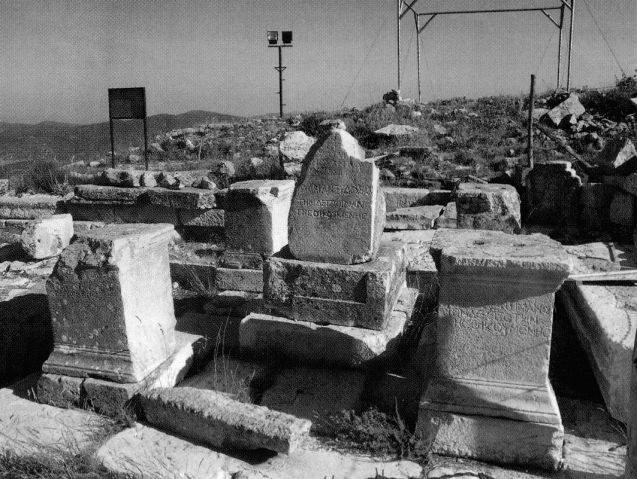
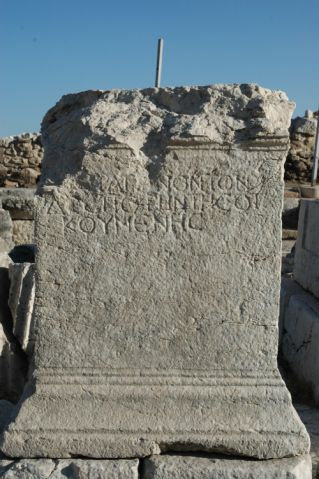
Shrine for the Tyche of Sagalassus, re-used for statue of empress, probably Constantia (wife of Gratian), with dedications also to Gratian and Valentinian I or II. Sagalassus (Pisidia). 374-383
Record details
Photographs
Inscription
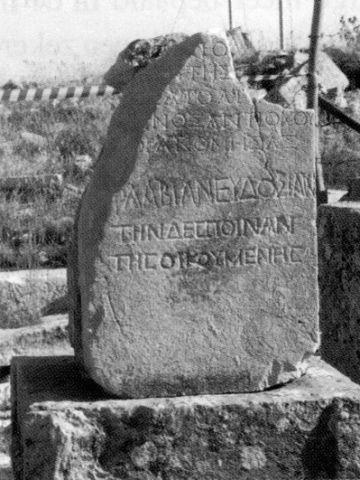
[- - -] / τὴν δεσποίναν / τῆς οικουμένης.
Associated inscriptions:
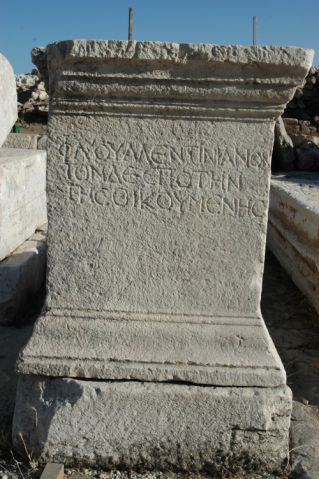
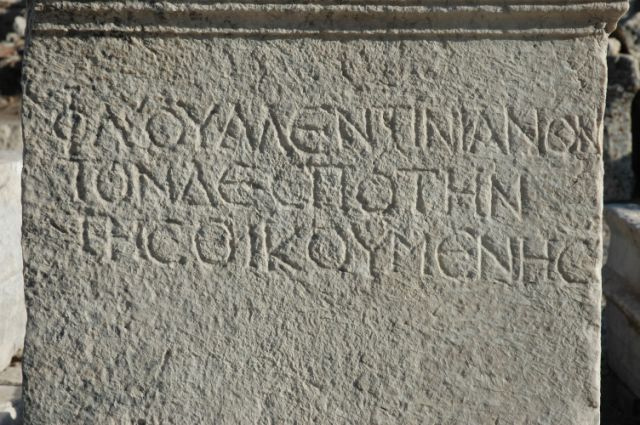
1) Φλ(άουιον) Οὐαλεντινιανὸν, / τὸν δεσπότην / τῆς οἰκουμένης.
2) Φλ(άουιον) Γρατιανὸν, / δεσπότην τῆς οἰ/κουμένης.
Inscription translation
To ..., the mistress of the civilised world.
Associated inscriptions:
1) To Flavius Valentinianus, the master of the civilised world.
2) To Flavius Gratianus, master of the civilised world.
Bibliography
- Devijver, H. & M. Waelkens, Roman Inscriptions from the Upper Agora at Sagalassos, Sagalassos III. Report on the Fourth Excavation Campaign of 1993, ed. By M. Waelkens and J. Poblome, 115-25, Leuven 1995, p. 118 no. 6
- L'Année épigraphique, , 1995, 1546. 1547
Discussion
INSCRIPTION
In three lines:
[- - -] / τὴν δεσποίναν / τῆς οικουμένης.
'To ..., the mistress of the civilised world.'
Letter height 4.7 cm.
The empress's name in line 1 has been erased in a later re-use of the base, and replaced by that of Aelia Eudoxia (LSA-2529; see below, 'Description’ and 'Honorand and Date').
Our dedication is almost certainly to be associated with two very similarly worded inscriptions, on closely related bases (see below 'Description'):
1) Φλ(άουιον) Οὐαλεντινιανὸν, / τὸν δεσπότην / τῆς οἰκουμένης.
'To Flavius Valentinianus, the master of the civilised world.' (Lanckoronski 1892 no. 219; Sagalassos III, 118 no. 4)
2) Φλ(άουιον) Γρατιανὸν, / δεσπότην τῆς οἰ/κουμένης.
'To Flavius Gratianus, master of the civilised world.' (Lanckoronski 1892 no. 220; Sagalassos III, 118 no. 5)
DESCRIPTION (from Devijver & Waelkens 1995, and the published images)
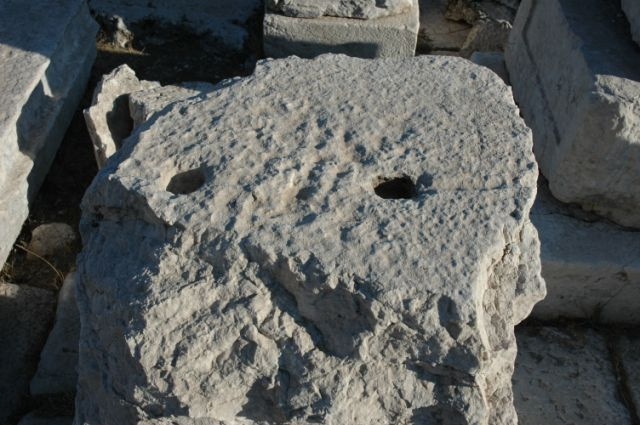
Rectangular base of white limestone: H 98, W 64.5, D 64 cm. The top and both upper corners are broken off, the lower right corner is chipped. The inscription is carved on the lower portion of the block.
Our inscription dates from a first re-use of the base. Above line 1, remnants of five lines of an earlier inscription are legible, probably to a local magistrate (agoranomos) of the 2nd century (Devijver & Waelkens 1995, 118; Waelkens, Pauwels & Van den Bergh 1995, 25). In a second re-use, of the late 4th/early 5th century, our empress's name in line 1 was erased and replaced by that of 'Flavia Eudoxia' (LSA-2529; see below, 'Honorand and Date').
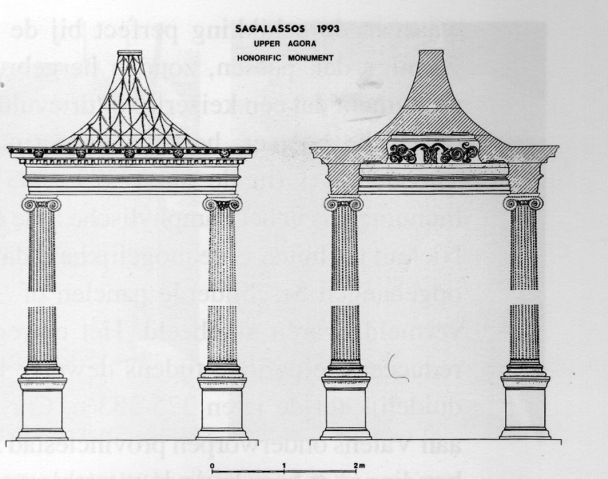
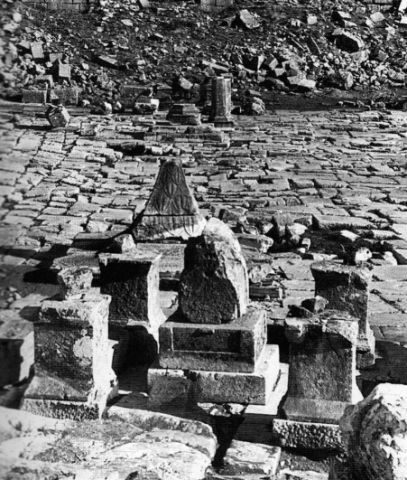
The base stands on a two-stepped plinth, originally under an elaborate architectural canopy consisting of four Ionic columns supporting a square canopy roof (Waelkens, Pauwels & Van den Berg 1995, 24; Waelkens 2009, 205 fig. 148; see below, 'Further Discussion'). The columns are set on rectangular pedestals of which the two facing towards the square bear inscriptions to Valentinian I or II, and Gratian (both presented above, under 'Inscription')). This 'tempietto’, which formed the architectural frame for the statue to our empress, was built in the early imperial period as a shrine for the Tyche of Sagalassus (Waelkens, Pauwel & Van den Berg 1995, 24; Waelkens 2009, 202-3 & 205 figs. 148-9). This shrine is mentioned in the inscription to the praetorian prefect Panhellenius, likewise on the Upper Agora (LSA-2530). When adapted for our empress, the only changes made were the substitution of the statue of the Tyche, and her base, with a statue of the empress and her (re-used) base, and the addition of the dedications to the emperors Valentinian and Gratian.
PROVENANCE AND CURRENT LOCATION
The base, and its associated canopy, were excavated on the south side of the Upper Agora, where it still stands today.
HONORAND, AWARDER AND DATE
The honorand of our inscription, whose name has been erased and replaced, was an empress styled 'δεσποίνα τῆς οικουμένης, mistress of the civilised world'. This same phrase reoccurs (in masculine form) in the inscriptions to one of the Valentinians (364-75 or 375-92) and to Gratian (367-83), which were added to two of the column bases supporting the early imperial canopy. It is therefore very likely that our inscription, before it was adapted to Eudoxia, was to Constantia, the wife of Gratian (367-83) (Waelkens, Pauwel & Van den Berg 1995, 25). Constantia married Gratian in 374 and died in 383, shortly before her husband (PLRE I, 221 Constantia 2). Both Constantia and her father, Constantius II (Augustus 337-61), were popular in the eastern empire (Waelkens 2009, 206), which may explain why such an elaborate monument to a western empress was set up in an eastern provincial city.
The Valentinian honoured on one of the canopy bases was either Valentinian I (Augustus 364-75), or his son Valentinian II (Augustus 375-92), both emperors in the West. All three honorands on this monument are from the western branch of the Valentinianic dynasty. Why the eastern emperor Valens (364-78) is not honoured is puzzling - possibly he had his own prominent statue elsewhere in Sagalassus, which has not yet been found.
FURTHER DISCUSSION
The inscriptions to Valentinian and to Gratian are, as noted above, phrased in exactly the same way as that to the empress, which was certainly for a statue. However, these two subsidiary bases cannot have directly supported statues, since they had to support the front columns of the canopy. Waelkens 2009, 206 raises the possibility that painted panels of the emperors hung on the columns above the inscriptions; another possibility is that statues of the two emperors were set on consoles, or even above the canopy. Otherwise we have to suppose that these were dedicatory inscriptions, without associated images, which is unlikely, given the close similarity of wording to the empress' statue dedication.
Discussion references
- Devijver, H. & M. Waelkens, Roman Inscriptions from the Upper Agora at Sagalassos, Sagalassos III. Report on the Fourth Excavation Campaign of 1993, ed. By M. Waelkens and J. Poblome, 115-25, Leuven 1995, p. 118 no. 6
- Jones, A. H. M. et al., The Prosopography of the Later Roman Empire. Vol. I 260-395, Cambridge et al. 1971 (1975)
- Waelkens, M., Sagalassos – Jaarboek 2008. Het kristallen jubileum van twintig jaar opgravingen, Leuven 2009
- Waelkens, M., Sagalassos – Jaarboek 2008. Het kristallen jubileum van twintig jaar opgravingen, Leuven 2009
- Waelkens, M., Pauwels, D. & J. Van Den Bergh, The 1993 Excavations on the Upper and Lower Agora,
Waelkens, M., Pauwels, D. & J. Van Den Bergh, The 1993 Excavations on the Upper and Lower Agora, Sagalassos III. Report on the Fourth Excavation Campaign of 1993, ed. by M. Waelkens & J. Poblome, Leuven 1995
Cite: Last Statues of Antiquity, LSA-2531 (Ulrich Gehn).