
LSA-2537
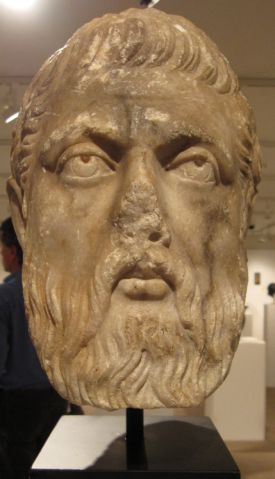
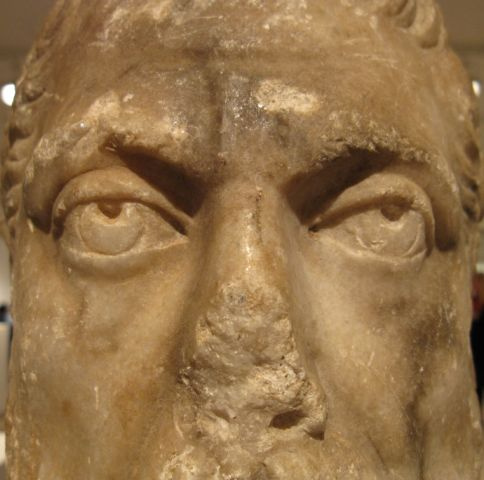
Portrait head of Plato from tondo? From Asia Minor? Fourth century.
Record details
Photographs
Discussion
DESCRIPTION (Object)
Life-size head. H: 25.4 cm. Medium-grained white marble.
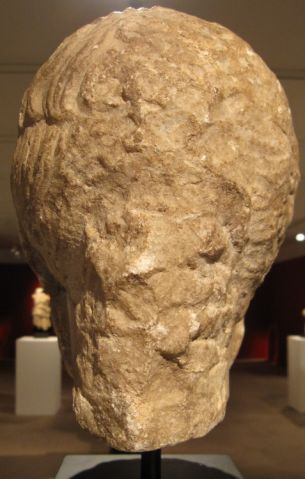
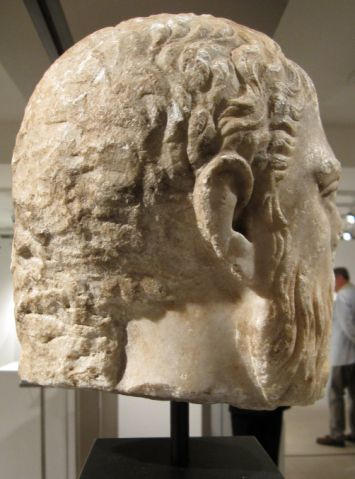
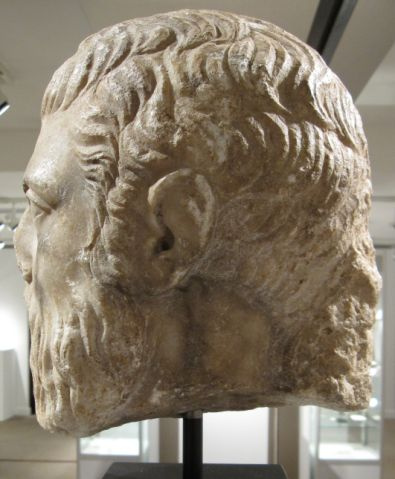
The head has broken through the middle of the neck. It is missing the lower part of the beard. At the back of the neck is a large area of uneven stone which rises to the middle of the back of the head. It preserves no original surface. Around its right side (behind the right ear), the points or ends of drill channels can be seen.
Thus, the head was once attached to a large neck pillar or to another element at the back of the head. Philosophers, such as Plato, were more often represented in busts, herms, or tondi than in statues. These formats do not require neck pillars. This head has probably broken from a tondo: for tondi which show the back of the heads attached to the background, see LSA-209 (the ‘Young Pupil’), LSA-238 (lost Menander from Aphrodisias), or LSA-2109 (Menander from Marbury Hall).
The left side of the head is more fully worked than the right side. The head, therefore, turned to its right. The top of the head is completely worked. The hair is worked with a flat chisel which creates a dry linear effect. The irises are almost complete engraved circles. The pupils are drilled out and have a crescent shape.
PROVENANCE
Acquired by Christies from a private collection in Geneva.
DESCRIPTION (Subject)
The head, which turns to its right, is a recognizable version of the portrait of Plato (compare, especially LSA-712, as well as LSA-710 and LSA-908). He wears a long beard, long moustache, and short hair; the fringe of which curves to his right. There are two furrows, one deep and one shallower above it, across the brow. Two vertical wrinkles rise over the nose. The eyebrows arch over intensely marked eyes, and the visible lower lip is full but short from side to side.
DATE
The style of the head indicates a late date. The hair is rendered in a deliberately flat and ‘antique’ manner. This contrasts to the eye markings which belong no earlier than the late third century. The irises are circular, and the large pupils are crescent-shaped.
Portraits of famous past intellectuals were popular in late antiquity; see, for example, the series of tondi portraits from a late house in Aphrodisias (LSA-206 , LSA-207, LSA-208, LSA-209, LSA-210, LSA-211, LSA-212, LSA-213, and LSA-214). This head probably came from such a gallery.
Cite: Last Statues of Antiquity, LSA-2537 (J. Lenaghan).