
LSA-2538
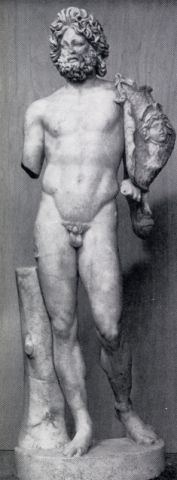
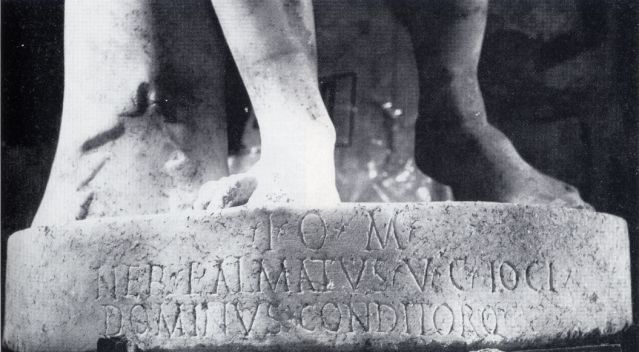
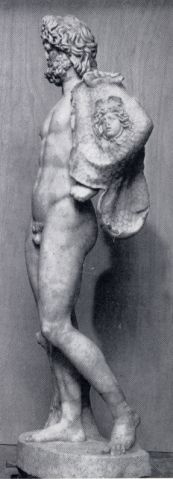
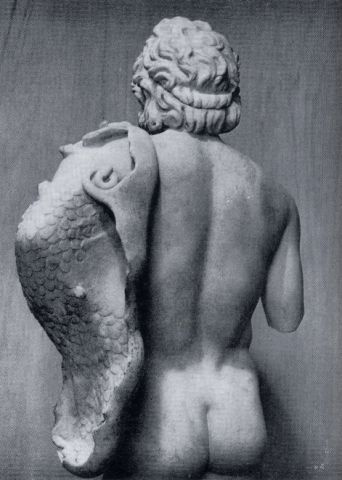
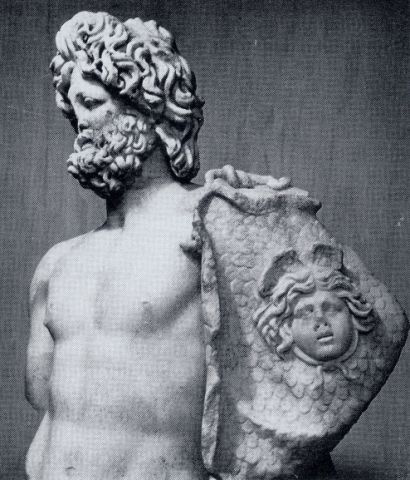
Statue of Jupiter set up by Neratius Palmatus (inscription on plinth). Rome (Porta Viminalis). Early fifth century.
Record details
Photographs
Inscription
I(ovi) O(ptimo) M(aximo) / Ner(atius) Palmatus v(ir) c(larissimus) loci / dominus conditorq(ue)
Inscription translation
To Jupiter Optimus Maximus. Neratius Palmatus, a man of clarissimus rank, lord and founder of (this) place (set this up).
Bibliography
- Jacopi, L. 'La statua dell'egioco Giove vimino', Bollettino d'Arte 65 , Rome 1980, 15-24, figs. 4-10
Discussion
DESCRIPTION (Object)
Over life-size statue. H: 178, H (of plinth): 11.5 cm. Parian marble.
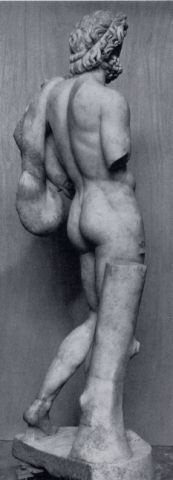
The statue was worked in one piece from its brow to its plinth. The top of the head was worked separately. The plinth is oval at the front and straight across the back; it has no mouldings and is tall. It bears a three-lline inscription.There is a statue support along the outside of the right leg that reaches to the upper thigh and a wedge support under the raised left foot.
The statue is missing its right arm from the elbow to the hand. On the exterior of the right thigh are the remains of the rectangular strut which probably supported the right hand. The fingers of the left hand and the object held within them are also missing. At the left hip are again the remains of a rectangular strut which supported this area.
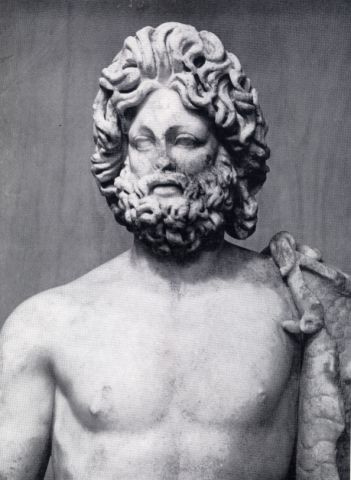
The back is fully finished. The eyes are unmarked. The hair is deeply drilled. The mouth is also deeply drilled
PROVENANCE AND LOCATION:
The statue was discovered in 1977, approximately 30 m. north of the crossing of modern-day via Cavour and Piazza dei Cinquecento, in the vicinity of the ancient Porta Viminalis (Jacobi (1980) p.15). The statue was discovered in the corner of a room belonging to an ancient building that was restored or refurbished in the fourth century (as the use of opus listatum suggests). Epigraphic and literary evidence locate a property of a Palmatus in this area, which was later donated to the church (Lib. Pont. I, 233 (ed. Duchesne)). Our statue might have come from this house, or from a shrine connected to it (see Guidobaldi (1995) and Chioffi (1999)). For further discussion, see LSA-790.
INSCRIPTION:
In three lines.
I(ovi) O(ptimo) M(aximo) / Ner(atius) Palmatus v(ir) c(larissimus) loci / dominus conditorq(ue).
To Jupiter Optimus Maximus. Neratius Palmatus, a man of clarissimus rank, lord and founder of (this) place (set this up).
The inscription records the setting up of a statue of Jupiter, by the founder of an unknown structure.
DESCRIPTION (Subject)
The statue depicts Zeus-Jupiter wearing an aegis over his left arm. The aegis is scaly, fringed with snakes, and has a central Medusa head ornament. The nude Jupiter stands with his weight over his right leg. He turns to his right, following the action of the lowered right hand which is held away from the body. The left arm is lowered and bent; in the left hand he holds another object. Iacopi suggests that the left hand held a sceptre and the right held a bundle of lightning bolts. It is equally possible that the left hand held the bundle of lightning bolts, and the right hand held another object. Alongside the right leg is a tree trunk support.
The head is heavily bearded; the beard has a central part below the chin. The hair is rendered in thick locks which cover the ears and nape. The hair parts markedly over the centre of the brow; two locks fall to either side of it, and four locks spring vertically up from it. Because the top of the head is made in a separate piece, the hair has an especially vertical spring so as to conceal the join behind it.
HONORAND, AWARDER AND DATE:
Naeratius Palmatus was a descendant of the family of the Naeratii, who owned other property in this same area (LSA-790). He is certainly to be identified as the Palmatus, prefect of the City in 412 (PLRE I, 662 Palmatus 1 and 2; PLRE II, 824 Palmatus 1).
COMMENTS ON CHOICE OF STATUE
The statue follows a model (Zeus-Jupiter Aigochos) known in at least eight other versions of the same scale: two from Rome (now Stockholm and Madrid), one from Tivoli (now Liverpool), one from Falerone (now Paris), one from Utica (now Leiden), one from Cyrene, one from Aigion, and a fragment from Aphrodisias. The model was well-known throughout the Empire. This particularly complete and competent version of the model is closest to that from Utica; both have lowered arms and wear the aegis in the same manner. The arms made together with the statue with hands attached by struts as well as deep drill work in the hair of the statue in discussion are typical technical details of second- or early third-century sculptural production.
The type would not however have been considered a representation of Jupiter Optimus Maximus in the high-imperial period. Jupiter Optimus Maximus was represented in a hip-mantle, seated, holding a sceptre and a thunderbolt, and accompanied by an eagle. Presumably in the early fifth-century when Neratius was purchasing a statue, the beauty and preservation of this one was more important than its iconography.
Discussion references
- Chioffi, L., "Sulle case delle élites a Roma e dintorni. Supplemento al Lexicon Topographicum Urbis Romae", Bullettino della Commissione Archeologica Comunale di Roma, 100, 1999, pp. 38-42
- Guidobaldi, F., "Domus Palmati", in E. M. Steinby, Lexicon Topographicum Urbis Romae, vol. 2, Rome 1995, pp. 151-152
Cite: Last Statues of Antiquity, LSA-2538 (J. Lenaghan and C. Machado).