
LSA-2540
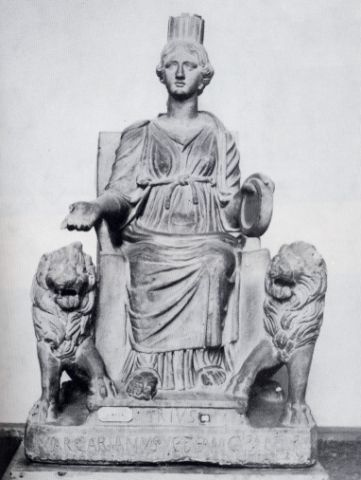
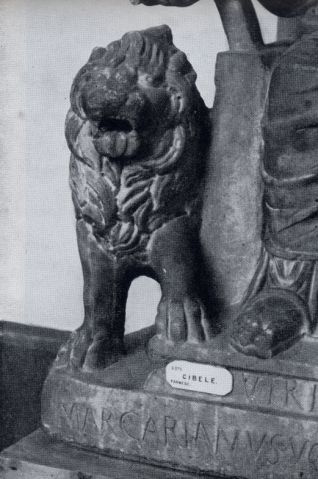
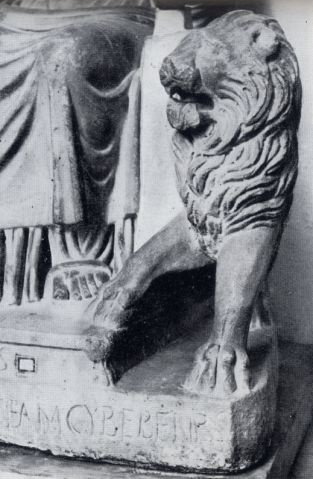
Statue of Cybele set up by Virius Marcarianus. From Ostia. Late third to fourth century.
Record details
Photographs
Inscription
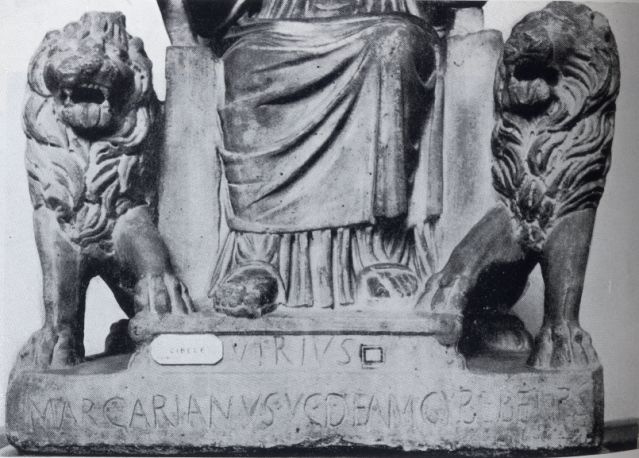
Virius/ Marcarianus v(ir) c(larissimus) deam Cybeben p(ecunia) s(ua)
Inscription translation
Virius Marcarianus, a man of clarissimus rank, (set this up) for the goddess Cybele with his money.
Bibliography
- Corpus Inscriptionum Latinarum; , VI, 513
- Guadagno, G. 'La Cibele Farnese del Museo Nazionale di Napoli', Archeologia Classica 18, Rome 1966, 72-82, pls. 26-30 (dates before 280 on basis of style of statue)
Discussion
DESCRIPTION (Object)
Over life-size statue. H: 98 cm. H (of plinth): 8-8.5 cm. W (at knees): 61cm. D (at knees): 68 cm. Greek marble.
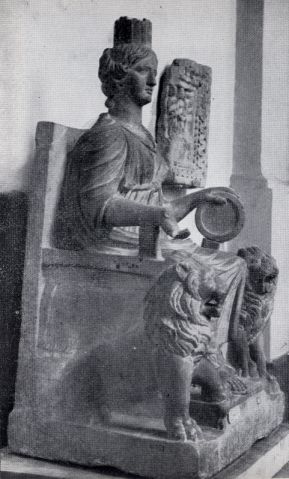
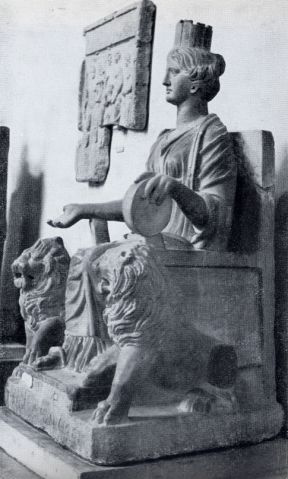
The statue was restored between 1796 and the early 1800s. At that point the head and both forearms were attached; they are assumed therefore to be modern (Guadagno p. 73 fn. 3 and p. 75). The restorations are well-suited to the statue in style, technique, and position; thus, their pertinence or antiquity is difficult to judge from photographs. The thumb and index finger of the right hand are missing. The upper corners of the back of the throne have broken. The back of the throne is not fully carved.
The statue is competently worked with a combination of flat chisels and drill. The eyes of the (modern?) head are unmarked. A two-line inscription has been added on the pedestal of the throne and across the wide plinth of the statue.
PROVENANCE
The statue has been long recorded as in the Farnese collection. Its exact find location was unspecified. A small cippus found in 1942 (G. Calza, “Il santuario della Magna Mater ad Ostia’, Atti della Pontificia Accademia romana di Archeologia. Memorie. 6 1943, 197) in the excavations of the Sanctuary of Magna Mater, the Metroon, at Ostia recorded that the same donor had received a taurobolium and made a dedication to Magna Mater at the sanctuary in Ostia. The cippus or small inscribed base (21 x 15 x 15) reads: Marca/rianus v(ir) c(larissimus) taur(oboliatus)/ m(atri) d(eum) d(ono) d(edit) or Marcarianus, a man of clarissimus rank, who received a taurobolium gave this as a gift for the mother of the gods. It is therefore highly probable that this statue of Cybele (Magna Mater) was dedicated at the santuary in Ostia.
INSCRIPTION
Virius
Marcarianus v(ir) c(larissimus) deam Cybeben p(ecunia) s(ua)
Virius Marcarianus, a man of clarissimus rank, (set this up) for the goddess Cybele with his money.
DESCRIPTION (Subject)
The statue is identified by its attributes and by the inscription as Cybele. It shows a female dressed in an ample chiton that reaches the feet and covers the arms to the elbows. It is belted under the breasts. She wears a himation over the chiton; it covers the back and most of the legs. On her feet she has sandals.
She sits on a throne with a foot rest and a tall back. She holds a tympanum in her left hand. Her right hand is empty but it may once have held a patera. On either side of the throne are two seated lions who put one front paw onto the foot rest and who look up towards Cybele.
The head is unveiled and wears a tall mural crown. The hair is parted in the centre, rolled over the ears, and pulled back. The face looks forward. According to (Guadagno p. 75) that the head is unveiled identifies it as a modern restoration.
DATE
The size and manufacture of the statue belong to the high imperial period. The deep drilling with marble ‘bridges’ over the channels in the manes of the lions suggests a date in the late Antonine or Severan period. Guadagno’s attempt to use this stylistic detail plus the routine carving of the drapery as grounds for a date after the Severan period but before the Tetrarchy is unconvincing.
The inscription on the throne and plinth of the statue is not part of the original design and has probably been added at a later date. It names a man of senatorial rank as the donor, Virius Marcarianus (PLRE I, 542, Virius MARCARIANUS). He is cited without a praenomen or tribe and as a vir clarissimus. This indicates at earliest a date in the third century and most probably in the fourth century. The small base found at the Metroon in Ostia (see above) provides the additional information that Marcarianus was a tauroboliatus. This was a popular ceremony among late antique pagans; see, for example, l>2539">LSA-2539.
Discussion references
- Le collezioni del Museo Nazionale di Napoli. II. La scultura greco-romana, Le sculture antiche della collezione Farnese, Le collezioni monetali, Le oreficerie, La collezione glittica , Rome 1989, 176-7, no. 154 (mid third c. as per past scholarship)
- Vermaseren, M. J., Corpus Cultus Cybelae Attidisque. III Italia-Latium, Leiden 1977, 122, no. 392, pl. 242 (date according to Guadagno)
Cite: Last Statues of Antiquity, LSA-2540 (J. Lenaghan).