
LSA-2542
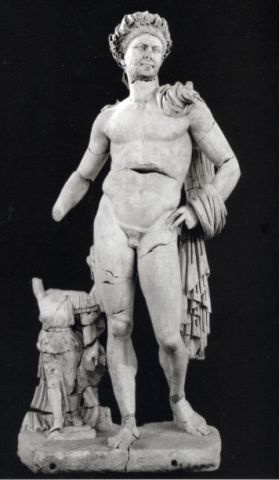
Naked portrait statue of emperor with victory. From Perge. Late third to early fourth century.
Record details
Photographs
Bibliography
- Edip Özgür, M., Skulpturen des Museums von Antalya, Ankara 2008, 140-141, no. 60 (Hadrian, re-used end of 3rd c.)
Discussion
DESCRIPTION (Object)
Over life-size statue restored from c. 13 fragments. H: 236 cm. White marble.
The statue was found in c. 13 fragments and has been restored. Missing are: the nose, the right hand, the penis, the head of the Nike figure, the right hand of the Nike, and the upper part of the trophy of the Nike.
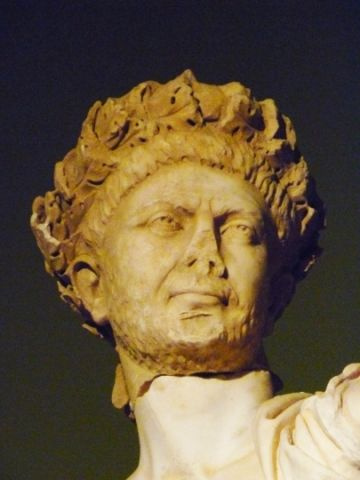
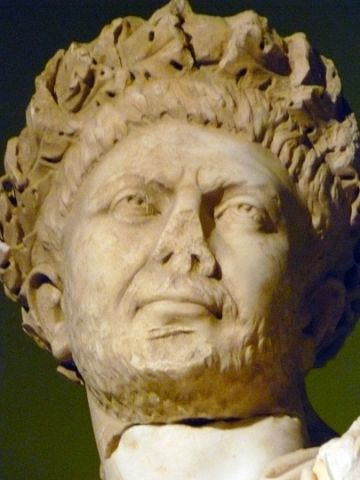
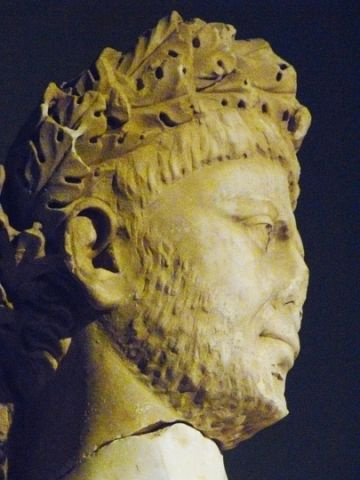
The head, which is supported by a thick neck pillar, has been re-cut from an earlier portrait. The hair beneath the corona civica has been turned into short straight locks that fall forward. The longer hair of the original portrait is visible behind ears and the top of the head. The beard has been rendered in the same way as the new hair.
Each pupil has been marked by a U-shaped drilled out area. The irises are engraved semi-circles.
PROVENANCE
Excavated in the stage building of the Theatre at Perge in 1992.
DESCRIPTION (Subject)
The statue shows a nude emperor who wears a corona civica and a chlamys wound around his left arm and over his left shoulder. He is supported by a small figure of a Nike who raises her right hand towards the emperor and who holds a trophy in her left.
The head of the emperor turns to his left. He has short-cropped hair and a short-cropped beard. Two creases cross the brow, and vertical lines of contraction are visible above the nose. The root of the nose is deeply indented. The ties of the fillet of the crown are visible at the back of the neck.
DATE AND HONORAND
The head represents an Emperor of the later third century; his portrait has been re-cut from that of an earlier emperor. The corona civica, which was not worn after the early fourth century, provides a terminus ante quem.
The head technically, stylistically, and iconographically almost identical to LSA-464 and LSA-2354. Another portrait from the same context in Perge, LSA-2543, repeats the same technique and iconography with a slightly longer beard. It is conceivable that these four portraits represented the Tetrarchs.
Cite: Last Statues of Antiquity, LSA-2542 (J. Lenaghan).